

How Absolute Heating and Air Handles Complex Attic Ductwork Replacements
The Hidden Cause of Uneven Temperatures: Failing Attic Ductwork
Your thermostat is set perfectly, yet your master bedroom feels uncomfortably warm while the rest of the house is freezing. If you are dealing with this frustrating imbalance and wondering how Absolute Heating and Air handles complex attic ductwork replacements, the solution starts by looking right above your ceiling. In our years of serving Palm Desert homeowners, our technicians consistently see that the culprit behind that stubborn hot room rarely lies with the air conditioning equipment itself. Instead, the root cause is often hidden in the dark, restricted spaces of your attic, where a network of degraded, crushed flexible ductwork is quietly failing to deliver conditioned air where you need it most.
For comprehensive air conditioning services, our team is ready to evaluate your entire system and restore balanced airflow throughout your home before the cooler winter nights arrive.
Conditioned air follows the path of least resistance. When the blower motor pushes air into the main supply trunk, that air travels down various branches to reach different rooms. If the flexible duct run stretching to the far side of your home is kinked, collapsed, or torn, the air simply dumps into the closer rooms or escapes into the attic itself. This leaves distant master suites starving for airflow, no matter how long the system runs.
Many homeowners face a critical decision during their fall home maintenance when they discover this issue: continue applying temporary tape patches to failing materials, or invest in a comprehensive ductwork redesign. Slapping a piece of foil tape over a tear might stop a specific leak for a few months, but it does absolutely nothing to fix the underlying structural collapse of the duct. Our focus at Absolute Heating and Air is always on permanent airflow balance. We look at the entire delivery system to ensure that the air your equipment produces actually makes it all the way to the farthest corners of your living space.
The Brutal Reality of Palm Desert Attics on Flexible Plastics
The environment inside a residential attic is incredibly hostile to building materials. As we transition into early fall, our crews see firsthand the damage left behind by extreme summer temperatures in Palm Desert, where attic environments frequently exceeded 130°F just weeks ago. While standard flexible ductwork might survive for decades in milder coastal climates, the relentless, baking heat of the desert rapidly accelerates the breakdown of flexible plastics and industrial adhesives.
According to data from the U.S. Department of Energy, typical residential duct systems lose 20 to 30 percent of the air moving through them due to leaks, holes, and poor connections. In our region, a pattern we see often is that percentage climbing even higher as the materials themselves surrender to the environment. When it is time to stop patching and start fresh, a proper AC installation in Palm Desert must account for these brutal thermal realities.
Thermal Degradation Mechanics
Flexible ductwork is essentially a wire helix wrapped in a thin inner plastic liner, surrounded by a layer of fiberglass insulation, and encased in an outer vapor barrier jacket. Under extreme heat cycles, the inner plastic lining undergoes thermal degradation. It loses its elasticity, becoming brittle and fragile. The continuous expansion and contraction eventually cause the plastic to split.
Simultaneously, the outer jacket deteriorates, exposing the fiberglass insulation to the open attic air. Once the vapor barrier fails, the duct loses its R-value insulation properties. Even if the conditioned air manages to stay inside the duct, the surrounding heat penetrates the compromised insulation, drastically changing the temperature of the air before it ever reaches your bedroom vents.
The Futility of Temporary Tape Patches
When an aging duct system reaches this level of brittleness, a one-for-one replacement of torn sections or applying temporary tape patches is often inadequate for long-term reliability. Patching severely degraded ductwork only shifts the failure point down the line, which is why we recommend comprehensive redesigns over temporary band-aids.
Why patching fails in extreme heat:
• Adhesive breakdown: Standard tapes dry out and peel away when subjected to constant triple-digit temperatures.
• Structural weakness: Fixing a tear does not fix the fact that the surrounding plastic is ready to crack under the slightest pressure.
• Hidden internal collapse: A duct may look intact from the outside, but the inner liner can detach and collapse, blocking airflow entirely.
Addressing the entire run rather than isolated tears is the only way to guarantee the system will perform reliably through both the heating and cooling seasons.
• Tape Patching — Immediate Result: Stops isolated leaks temporarily — Long-Term Reliability: Poor (adhesives dry out in extreme heat) — Impact on Distant Rooms: Minimal improvement in airflow volume
• 1-for-1 Swapping — Immediate Result: Replaces torn material — Long-Term Reliability: Moderate (does not fix underlying design flaws) — Impact on Distant Rooms: Airflow remains restricted by poor routing
• Engineered Redesign — Immediate Result: Eliminates all leaks and kinks — Long-Term Reliability: Excellent (new materials properly suspended) — Impact on Distant Rooms: Maximum airflow restored to master suite
Our Engineered Approach to Static Pressure and Airflow
Solving a complex airflow imbalance requires more than just unrolling new plastic in the attic. It requires a deep understanding of static pressure and fluid dynamics. Static pressure is the resistance to airflow within your HVAC system. Think of it like blood pressure for your home; if the pressure is too high because the ducts are too small or heavily kinked, the blower motor struggles to push air through. If the pressure drops too low due to massive leaks, the air never gains the velocity needed to reach the end of the line.
During the countless pre-heating season tune-ups our team performs every September, we often discover that poor home comfort isn't an equipment issue at all, but a static pressure bottleneck hiding in the attic. This is where our specialized local expertise comes into play. Our process relies on specific, engineered calculations rather than guesswork.
Calculating Optimal Duct Sizing
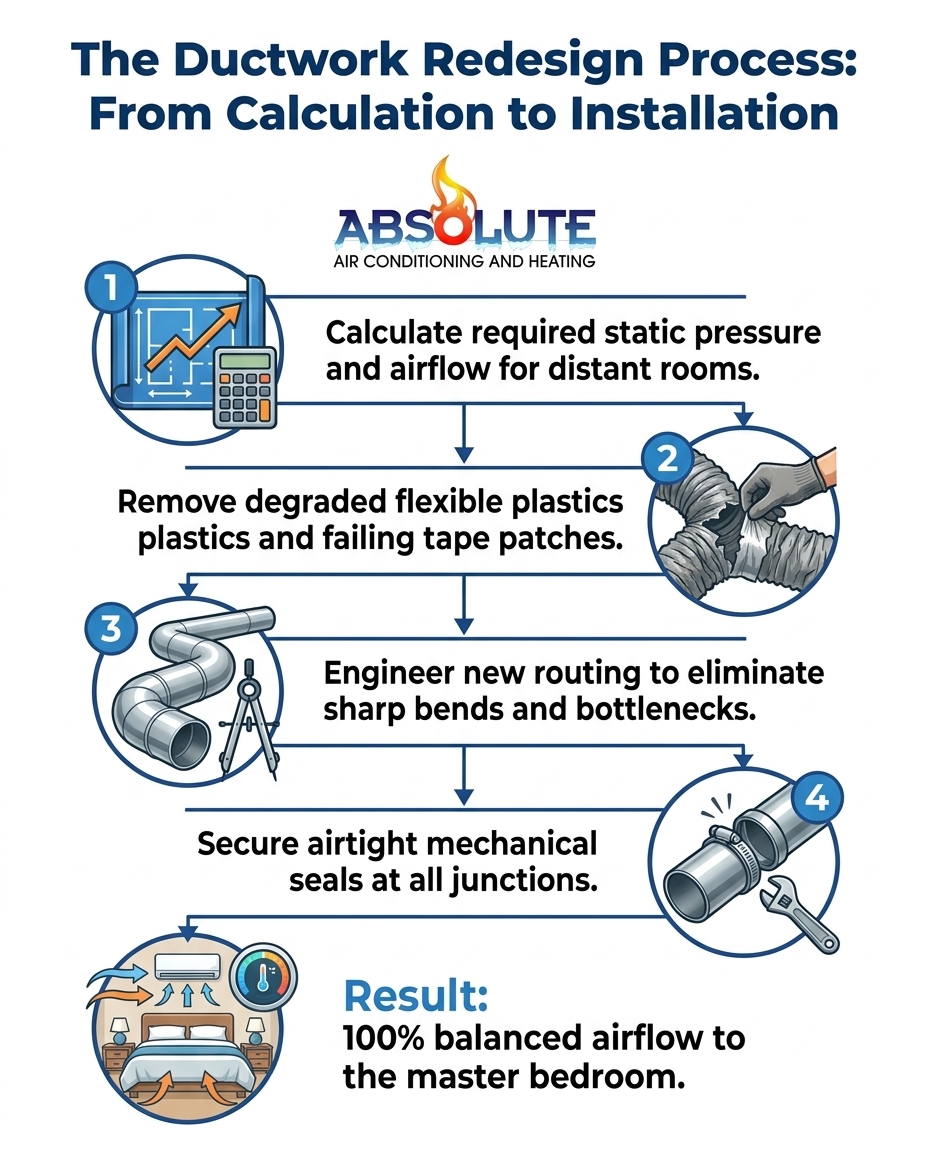
To permanently solve the distant master bedroom airflow problem, our team completely redesigns the routing and sizing of the duct system rather than just replacing it exactly as the original builder left it. Builders often use the cheapest, fastest routing methods, which rarely prioritize optimal static pressure.
Our professional redesign methodology:
1. Evaluating Equipment Specifications: We start by checking the manufacturer-specified static pressure requirements for your specific air handler.
2. Calculating Required Airflow: We determine the exact Cubic Feet per Minute (CFM) required to condition the distant master bedroom based on its square footage and sun exposure.
3. Matching Duct Diameter: We select the correct duct diameter to carry that specific volume of air without creating excess friction.
4. Eliminating Bottlenecks: We redesign the physical path to prevent bottlenecks that choke airflow before it reaches the end of the line.
This extensive troubleshooting ensures the root cause of the pressure drop is permanently resolved. If your system is struggling, professional AC repair paired with proper airflow engineering is the key to lasting comfort.
Navigating Tight Spaces: The Installation and Redesign Process
The physical execution of a complex attic ductwork replacement is demanding work. Attics are not designed for easy movement. They are filled with low-hanging roof trusses, electrical wiring, plumbing vents, and thick layers of insulation. Working in these tight, restricted overhead spaces requires a significant amount of physical discipline and technical skill.
When Brian, Andrew, and Sam from our Absolute Heating and Air team recently fitted a new heat pump to replace an old AC unit during a fall transition project, the entire installation went incredibly smoothly because they mapped out the optimal duct routing beforehand. Delivering a fantastic job means navigating these tight overhead spaces with precision and an eye for long-term durability. We bring a level of care and artistry to every complex retrofit, ensuring a clean workspace and a system that performs beautifully.
Securing the Airflow Path
A major part of our installation process involves how the new ductwork is physically supported. Flexible ductwork cannot simply be dragged across the attic floor or draped over sharp wooden trusses. If a duct sags between supports, it creates a restriction that drastically reduces the amount of air that can pass through.
Key installation standards our technicians follow:
• Proper suspension techniques: We use wide, woven strapping to suspend the ducts, preventing the support material from cutting into the outer jacket over time.
• Strategic routing: We carefully route the new ductwork to avoid sharp 90-degree bends and kinks that restrict an AC unit in the attic.
• Mechanical fastening: Every junction is secured with airtight, mechanically fastened seals—using tension ties and specialized mastic sealant—rather than relying solely on tape.
• Minimizing distance: We ensure the new routing minimizes the total distance and resistance to hard-to-condition rooms.
For more insights on how these systems operate in restricted spaces, you can explore our guide to attic AC systems.
Integrating Whole-Home Air Quality and System Health
The benefits of a mechanical ductwork redesign extend far beyond just balancing the temperature in your master bedroom. The health of your duct system is directly tied to the overall indoor air quality of your home and the longevity of your HVAC equipment—a crucial factor as we button up our homes for the cooler months ahead.
When flexible ductwork is crushed or torn, it does not just leak conditioned air out; it can also pull unconditioned air in. If the return side of your ductwork is compromised, the negative pressure acts like a vacuum, pulling dusty, stagnant attic air directly into the home's living spaces. This introduces fiberglass particles, dust mites, and allergens into the air you breathe every day.
Furthermore, crushed ducts place an immense strain on the blower motor. Modern variable-speed motors will automatically ramp up their RPMs to try and overcome the high static pressure caused by a crushed duct. This constant overworking leads to premature wear and tear, higher energy consumption, and eventual motor failure.
By investing in a sealed, redesigned duct system, you instantly improve your overall indoor air quality by keeping attic contaminants out. This upgrade enhances the efficiency of the entire heating and cooling system, allowing the equipment to move air effortlessly. If you are concerned about the air you are breathing, coupling a duct redesign with professional ventilation services provides a comprehensive solution for a healthier home.
Strategic Timing: Upgrading Before the Chill Arrives
Timing your home improvement projects strategically can save you from significant discomfort. The transition period between peak summer cooling and winter heating is the optimal window for a major ductwork redesign. Specifically, the September pre-heating transition offers a brief reprieve from the extreme attic temperatures, allowing our technicians to work more efficiently and methodically.
Many homeowners associate ductwork issues strictly with summer cooling, but balanced airflow is equally important for distributing warm air effectively during cooler nights. Heat naturally rises, so pushing warm air down from ceiling registers into a distant master bedroom requires strong, unimpeded airflow. If your ducts are crushed, the warm air will simply pool in the rooms closest to the air handler.
Completing this work now prevents cold spots in the master bedroom later in the year. Framing this upgrade as a proactive step in seasonal home maintenance ensures that your HVAC system is fully prepared to handle whatever weather the desert brings. Additionally, federal tax credits and local utility incentive programs may apply to qualifying heat pump installations paired with duct upgrades—we always advise our customers to verify current programs with their utility provider or a tax professional.
Frequently Asked Questions
Why is my master bedroom always the hottest room in the summer and coldest in the winter?
Your master bedroom is likely the farthest room from the indoor air handler, meaning the conditioned air has to travel the longest distance. Because air takes the path of least resistance, any kinks, leaks, or crushed sections in the flexible ductwork will cause the air to escape before it ever reaches your bedroom vents.
Can crushed flexible ductwork be permanently fixed?
No, crushed or severely degraded flexible ductwork cannot be permanently fixed with tape or minor patches. Once the inner wire helix is bent or the plastic lining becomes brittle from extreme heat, the structural integrity is gone, and the affected runs must be completely replaced and properly suspended.
How long does flexible ductwork last in a hot attic environment?
While flexible ductwork can last 15 to 20 years in mild climates, the extreme 130°F+ temperatures in desert attics often reduce its effective lifespan to 10 to 15 years. The constant thermal expansion and contraction cause the outer vapor barrier to flake away and the internal plastics to split prematurely.
Does damaged ductwork affect the performance of my HVAC system?
Yes, damaged ductwork severely impacts your system's performance by forcing the equipment to run longer to reach the set temperature. Leaks allow conditioned air to escape into the attic, while crushed ducts restrict airflow, which can cause the indoor evaporator coil to freeze over or the blower motor to burn out.
Why is proper static pressure important for an air handler in the attic?
Proper static pressure ensures that the air handler can push the correct volume of air through the ducts without overworking the blower motor. If the static pressure is too high due to undersized or kinked ducts, airflow drops dramatically; if it is too low, the air lacks the velocity to reach distant rooms.
Understanding how Absolute Heating and Air handles complex attic ductwork replacements gives you the confidence to move past temporary tape patches. By focusing on proper static pressure, precise routing, and airtight seals, we ensure that your master bedroom receives the exact amount of airflow it needs. Reach out to our team to permanently resolve your airflow imbalances and enjoy consistent, whole-home comfort this fall and beyond.
Serving the Entire Coachella Valley


Assessing Your Home's Heating Needs: When a Heat Pump Outperforms a Gas Furnace in the Desert
Don't wait for the first freezing night to replace your aging heater. See why a high-efficiency heat pump often beats a traditional gas furnace for unique desert climate swings.

Why Your Heat Pump Blows Cold Air on the First Chilly Palm Desert Morning
Turning on your heat pump on a chilly October morning only to feel a cool breeze can cause instant panic. Understand the science behind this harmless temperature illusion versus an actual breakdown.

The Real Cost of Ignoring Your Attic HVAC Unit's Fall Inspection
After a grueling summer, minor wear and tear in an attic HVAC unit can quickly snowball into a major winter breakdown. See why skipping a seasonal checkup puts your entire system at risk.

