

The Physics of Heating a Palm Desert Home After the Sun Goes Down
The 40-Degree Plunge: Why Desert Evenings Demand Immediate Warmth
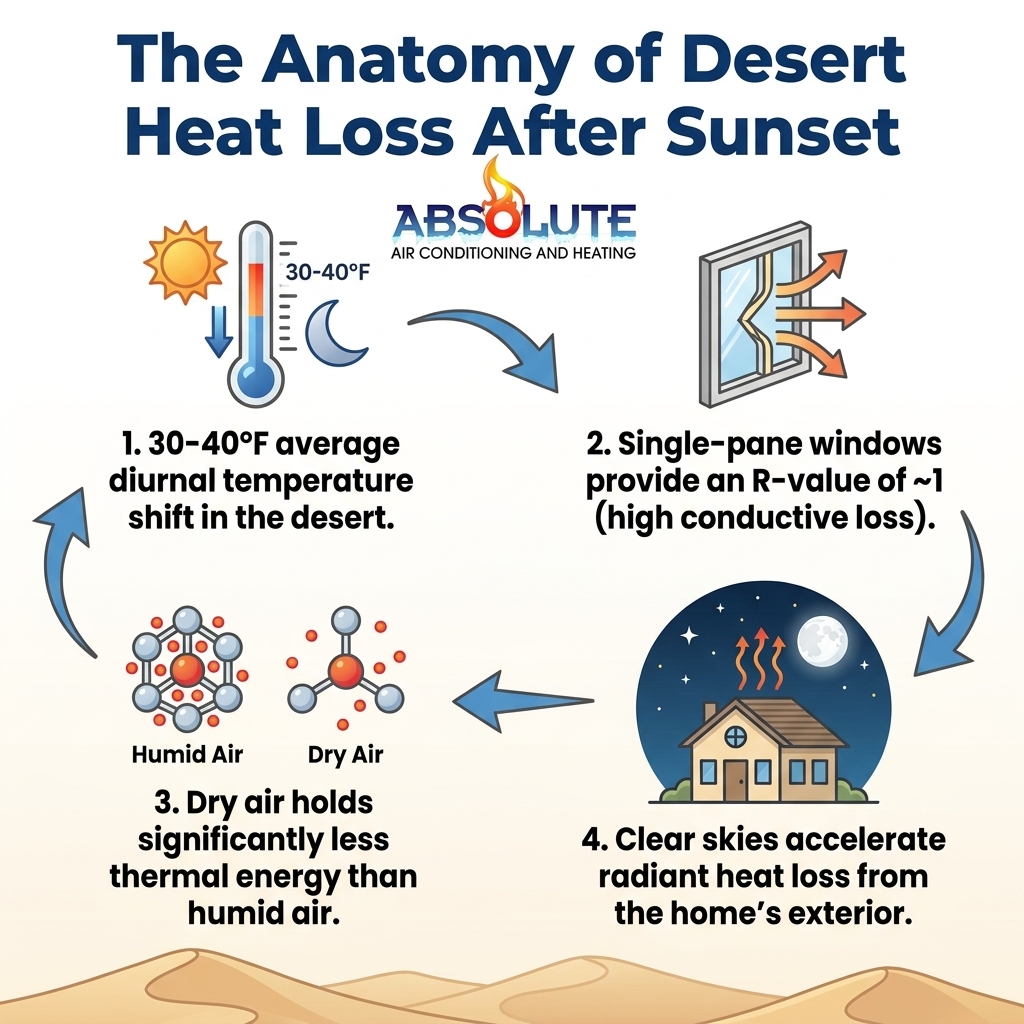
When evaluating the physics of heating a Palm Desert home after the sun goes down, one staggering statistic immediately stands out: local diurnal temperature variations can plunge 30 to 40 degrees Fahrenheit in a matter of hours. During a typical mid-fall day in October, the Coachella Valley might bask in comfortable 80-degree daytime highs. However, the moment the intense desert sun slips below the horizon, that ambient warmth vanishes, leaving nighttime lows hovering in the stark 50s. This rapid thermal shift creates an immediate, physically demanding environment for any residential climate control system.
As local HVAC professionals, we field countless calls during this mid-fall transition. If your system is already struggling to keep up with the evening chill, explore our residential heating services to restore your indoor comfort.
The concrete problem homeowners face is the phenomenon of rapid thermal loss. Throughout the day, the structural materials of a house—stucco, roofing, and concrete foundations—absorb solar radiation. This process masks the underlying inefficiencies of the building's thermal envelope. But as soon as solar radiation ceases, the physical environment immediately seeks equilibrium. The heat trapped inside the home begins flowing rapidly toward the colder outdoor air.
Understanding this aggressive heat transfer is essential for maintaining indoor comfort and energy efficiency. The desert does not cool down gradually like a humid coastal region; it drops off a thermal cliff. Local heating systems must be specifically calibrated to combat these sudden drops, activating quickly and generating enough thermal energy to offset the rapid rate of escape. Without a proactive approach to this mid-fall transition, heating equipment is forced to work continuously just to maintain a baseline temperature, accelerating wear and tear on the system's critical components.
The Thermodynamics of Dry Air: Specific Heat Capacity Explained
To truly understand why desert evenings become so cold so quickly, one must look at the first principles of thermodynamics. The primary culprit behind this rapid cooling is a concept known as specific heat capacity. Specific heat capacity refers to the amount of heat energy required to raise the temperature of a substance by one degree. Water possesses an exceptionally high specific heat capacity, meaning it can absorb and hold onto a massive amount of thermal energy before its temperature changes.
In humid coastal environments, the air is saturated with water vapor. This atmospheric moisture acts as an invisible thermal blanket. Throughout the day, the water molecules absorb the sun's heat, and when night falls, they release that heat slowly back into the environment, keeping evening temperatures relatively stable. In stark contrast, the extreme lack of atmospheric moisture in Palm Desert creates a unique thermal environment. Dry air has a very low specific heat capacity. Without water vapor to trap and hold daytime warmth, the ambient outdoor temperature plummets the exact moment solar radiation stops.
This outdoor atmospheric physics directly dictates the indoor environment's struggle to maintain equilibrium. Because the dry desert air outside cannot hold heat, it becomes a vast, cold sink that relentlessly pulls thermal energy from the warmer interior of your home. Your heating system is not just warming the air inside; it is actively fighting a continuous, losing battle against the boundless, freezing atmosphere outside.
Radiant vs. Conductive Heat Loss
Desert homes battle two distinct forms of thermal escape simultaneously after sunset. Understanding the difference is critical for identifying where your home's thermal envelope is failing.
• Conductive Heat Loss — Mechanism of Transfer: Heat moving directly through solid physical materials. — How It Affects Desert Homes: Warm indoor air transfers heat to cold drywall, which transfers it to exterior stucco, eventually escaping outside.
• Radiant Heat Loss — Mechanism of Transfer: Heat escaping via electromagnetic waves without needing a physical medium. — How It Affects Desert Homes: Thermal energy radiates directly from the home's exterior surfaces into the clear, cold, cloudless night sky.
Because the Coachella Valley experiences very few overcast nights, the cloudless sky offers zero resistance to radiant heat loss. Simultaneously, the drastic temperature difference between the warm indoors and the cold outdoors accelerates conductive heat loss through the walls. Your HVAC system must generate heat fast enough to outpace both of these relentless physical processes.
Architectural Vulnerabilities in Coachella Valley Construction
The Problem: The natural thermodynamics of the desert are often amplified by the very structures we live in. Historically, many older homes in Palm Desert and the surrounding Coachella Valley were designed with summer heat mitigation as the absolute primary focus. Builders prioritized keeping the intense solar radiation out during the grueling summer months, often overlooking the architectural necessities required to keep artificial heat trapped inside during the mid-fall and winter evenings.
The Cause: This historical design philosophy resulted in specific architectural vulnerabilities. Chief among these is the widespread use of single-pane glass. The physics of single-pane windows are detrimental to heat retention; they offer an insulation rating (R-value) of approximately 1. This provides almost zero resistance to conductive heat loss, effectively acting as thermal holes in the side of the house. Furthermore, traditional stucco exteriors paired with minimal wall insulation allow indoor heat to escape rapidly into the cold night air. The thermal mass of stucco, which takes hours to heat up during the day, reverses its role at night, radiating the home's interior warmth outward to the freezing desert air.
The Solution: Counteracting these architectural vulnerabilities requires a deep understanding of local building materials and how they interact with climate control technology. At Absolute Air Conditioning and Heating, our technicians see these structural vulnerabilities every day. In our years of servicing Coachella Valley homes, we've developed deep local expertise regarding regional construction types, recognizing exactly how these specific structures interact with HVAC systems. By identifying the specific paths of conductive and radiant heat loss—whether through outdated single-pane sliders or uninsulated attic spaces—homeowners can target their efficiency upgrades. Pairing structural improvements with correctly calibrated heating equipment ensures that the warmth generated indoors stays indoors, rather than immediately escaping through historically inefficient building materials.
How Modern Heating Systems Counteract Rapid Thermal Escape
Transitioning from the physics of heat loss to applied HVAC technology reveals exactly how modern heating systems are engineered to replace rapidly escaping heat. The core concept here is thermal load. A home's thermal load represents the exact amount of heating energy—measured in British Thermal Units (BTUs)—required to maintain a set indoor temperature. In Palm Desert, a heating system must be capable of generating BTUs faster than the house loses them to the cold night air. If the rate of conductive and radiant loss exceeds the system's BTU output, the indoor temperature will inevitably drop, no matter how long the unit runs.
Different types of heating equipment respond to this sudden evening temperature drop in distinct ways:
• Traditional Gas Furnaces: These systems provide a rapid, high-heat mechanical response. By combusting natural gas, they produce a very hot airstream that can quickly elevate the indoor temperature, making them highly effective at overcoming sudden thermal deficits.
• Modern Heat Pumps: These systems operate by transferring ambient heat from the outside air into the home. While earlier models struggled in near-freezing temperatures, modern variable-speed heat pumps are incredibly efficient at extracting thermal energy even during cold desert nights, providing a steady, consistent warmth that prevents the home from cooling down in the first place.
Proper system sizing is non-negotiable when dealing with desert thermal dynamics. An undersized system will run continuously, struggling in vain to overcome the conductive heat loss through the walls and windows, leading to premature mechanical failure. Conversely, an oversized system will short-cycle, blasting the home with heat and shutting off before it can properly circulate the air, leaving cold spots throughout the house.
Upgrading outdated equipment provides a vastly superior mechanical response to these thermal dynamics. Our team frequently sees the consequences of aging, mismatched equipment. In fact, we recently helped a local homeowner who found this out firsthand when their aging unit finally failed after years of heavy use during a winter cold snap. By having our crew perform a new heat pump installation smoothly and efficiently, they gained a system capable of precisely matching the home's thermal load, ensuring consistent comfort without the massive energy waste associated with their previous failing unit.
Actionable Efficiency: Slowing the Evening Thermal Transfer
While you cannot change the physics of the desert atmosphere, you can control how your home reacts to it. Mitigating heat loss before the heating system is forced to overwork is the most effective way to maintain comfort and efficiency. By slowing the evening thermal transfer, you directly lower the mechanical workload on your HVAC equipment.
Here are the most critical, science-backed steps homeowners can take to fortify their thermal envelope during the mid-fall transition:
1. Address Convective Heat Loss with Weatherstripping: Convective heat loss occurs when warm air physically escapes through gaps and cracks. Identify the most critical areas—typically the seals around exterior doors, the tracks of sliding glass doors, and the frames of older windows. Applying fresh weatherstripping and caulking these gaps prevents the pressurized warm air inside from leaking out into the cold night.
2. Deploy Thermal Window Treatments: Because single-pane glass provides minimal resistance to heat transfer, creating a secondary barrier is highly effective. Installing heavy thermal curtains or cellular shades over large windows acts as a critical buffer against radiant loss. Closing these treatments exactly at sunset traps a layer of air between the fabric and the glass, significantly boosting the window's effective R-value.
3. Implement Anticipatory Thermostat Programming: Do not wait for the house to feel cold before turning on the heat. Smart thermostat programming strategies should anticipate the evening temperature plunge rather than reacting to it. Program the system to raise the indoor temperature by a few degrees about an hour before sunset. This builds a thermal reservoir inside the home, easing the mechanical transition as the outdoor temperatures plummet.
Reducing the home's natural heat loss is crucial for optimizing system performance, especially when a heat pump outperforms a gas furnace in the desert by maintaining a steady, efficient baseline temperature rather than relying on massive bursts of reactive heat.
Getting Ahead of the Chill: The Importance of Pre-Winter System Readiness
Understanding the abstract physics of heat loss highlights a very practical reality: mid-fall is the critical transition period when the evening chill first becomes noticeable. This makes October the ideal time for system readiness. Waiting until the deep winter cold sets in is inherently risky; discovering that a system cannot keep up with the thermal loss on the coldest night of the year often leads to uncomfortable delays and emergency service calls.
A proactive inspection involves rigorous mechanical checks designed to ensure the system can efficiently replace the heat lost through walls and windows. During a professional evaluation, technicians perform several critical tasks:
• Verifying Heat Exchanger Integrity: In gas furnaces, the heat exchanger must be inspected for micro-fractures. A compromised heat exchanger not only fails to transfer heat efficiently but also poses a severe safety risk regarding carbon monoxide exposure.
• Calibrating Sensors and Thermostats: Accurate temperature reading is essential. If the thermostat is miscalibrated, it may fail to trigger the heating cycle promptly when the evening temperature drops, causing the home to fall behind the thermal curve.
• Assessing Airflow and Blower Performance: The blower motor must push the heated air with enough velocity to reach the furthest rooms of the house. Technicians check the amperage draw of the motor and ensure the ductwork is free of obstructions.
• Checking Refrigerant Levels: For heat pumps, the exact volume of refrigerant is critical for absorbing ambient heat from the cold outdoor air. Even a slight undercharge drastically reduces the system's heating capacity.
Routine maintenance restores a system's ability to operate at peak capacity. Waiting too long can lead to complex failures. For instance, our technicians recently assisted a local family who required a complete replacement of their whole heating and cooling system—including ductwork for unpermitted additions—starting right over the winter holidays. While our team provided honest estimates and various brand options that led to a high-quality system being installed fairly and professionally over the holiday break, we always remind our customers that proactive fall maintenance often identifies these failing systems months in advance, preventing high-stress winter emergencies. Scheduling routine heating maintenance now provides the peace of mind that comes from knowing your home's mechanical systems are fully prepared for the stark diurnal shifts ahead.
Frequently Asked Questions About Desert Thermal Dynamics
Why do houses in the desert get so cold at night?
Houses in the desert get cold rapidly because the dry air and clear skies provide almost no insulation against heat loss. Without humidity to trap the daytime warmth, the ambient outdoor temperature plummets as soon as the sun sets. The heat inside the house then naturally flows outward into this massive, cold atmospheric sink through conductive and radiant heat transfer.
How fast does a house lose heat after the sun goes down?
A house begins losing heat the exact moment solar radiation stops hitting the exterior walls and roof. In the Coachella Valley, where diurnal temperature shifts can exceed 30 degrees in just a few hours, a poorly insulated home with single-pane windows can lose several degrees of internal temperature within the first hour after sunset if the heating system is not engaged.
What is the most efficient way to heat a house in the desert?
The most efficient approach combines a tightly sealed thermal envelope with a properly sized, modern variable-speed heat pump. Because desert winters rarely reach extreme sub-zero temperatures, heat pumps are incredibly efficient at extracting ambient heat from the cool night air. Pairing this technology with heavy thermal curtains and fresh weatherstripping ensures the generated heat remains indoors.
Does a lack of humidity affect how my furnace heats my home?
Yes, dry air feels naturally cooler to the human skin because it accelerates the evaporation of moisture from our bodies. Consequently, you may need to set your thermostat a degree or two higher in a zero-humidity desert environment to achieve the same perceived level of comfort you would experience in a more humid climate at a lower temperature setting.
Why does my home feel colder even when the thermostat says 70 degrees?
This phenomenon is often caused by radiant heat loss and poor air circulation. If you are sitting near a cold, single-pane window, your body radiates heat directly toward that cold surface, making you feel chilly regardless of the ambient air temperature. Additionally, if your HVAC system is short-cycling, it may satisfy the thermostat's sensor before adequately mixing the warm air throughout the entire room.
Securing Your Indoor Comfort Before the Winter Deep Freeze
While you cannot change the underlying physics of the desert climate, you have complete control over how your home responds to it. The stark diurnal shifts of mid-fall demand a proactive approach to indoor comfort. By understanding the mechanics of radiant and conductive heat loss, and by fortifying your home's thermal envelope against the rapid evening cooling, you significantly reduce the burden on your HVAC equipment.
A well-maintained, correctly sized heating system is your absolute best defense against the 40-degree plunge of a Palm Desert night. As October signals the definitive end of the cooling season, now is the time to verify your system's mechanical integrity. We encourage you to schedule a professional evaluation to ensure your equipment is fully optimized for the season ahead. Secure your comfort today by booking professional heating service in Palm Desert before the deeper winter cold takes hold.
Serving the Entire Coachella Valley


How Absolute Air Conditioning Diagnoses Uneven Heating in Two-Story Palm Desert Homes
When your downstairs stays freezing while the upstairs swelters, simply cranking the thermostat won't help. We trace these cold spots back to hidden attic ductwork flaws to restore real comfort.

Assessing Your Home's Heating Needs: When a Heat Pump Outperforms a Gas Furnace in the Desert
Don't wait for the first freezing night to replace your aging heater. See why a high-efficiency heat pump often beats a traditional gas furnace for unique desert climate swings.

Why Your Heat Pump Blows Cold Air on the First Chilly Palm Desert Morning
Turning on your heat pump on a chilly October morning only to feel a cool breeze can cause instant panic. Understand the science behind this harmless temperature illusion versus an actual breakdown.

