
Is Your Attic AC Unit Vibrating the Ceiling? Diagnosing Structural Resonance
When the Ceiling Hums: Identifying Attic AC Vibration
You might be sitting in your living room trying to relax when a persistent hum makes you ask: Is your attic AC unit vibrating the ceiling? Diagnosing structural resonance is the first step to figuring out whether this noise is a harmless aging quirk or an escalating mechanical issue that requires immediate attention. That unsettling sensation of a low-frequency hum or a physical vibration felt through the drywall is more than just a nuisance. It is a physical transfer of kinetic energy from your HVAC equipment directly into the bones of your home.
If you need immediate help with a noisy system, explore our air conditioning services or schedule an AC repair in Palm Desert.
In neighborhoods across Palm Desert, air conditioning systems run incredibly hard into the late summer months. When your equipment operates under extreme stress for extended periods, the physical components that keep it balanced and quiet begin to wear down. We see a typical pattern where homeowners initially dismiss a slight vibration, assuming the unit is just getting older. However, ignoring this symptom often allows a minor imbalance to escalate into a major mechanical failure. Understanding exactly what causes this vibration is essential for protecting both your home's framing and your cooling system.
The Physics of Structural Resonance vs. Airborne Noise
To effectively address a noisy ceiling, you first need to understand how sound and motion travel through a house. There is a massive physical difference between a high-pitched airborne squeal and a deep, low-frequency hum that vibrates your floorboards.
Understanding Airborne Noise
Airborne noises are sounds that travel primarily through the air and ductwork. If you hear a high-pitched whistling, a squealing belt, or the rush of heavy airflow, you are dealing with airborne noise. These sounds are certainly annoying, but they rarely cause the physical structure of your home to shake. They are typically tied to airflow restrictions, dirty filters, or minor belt issues within the system.
The Mechanics of Structural Resonance
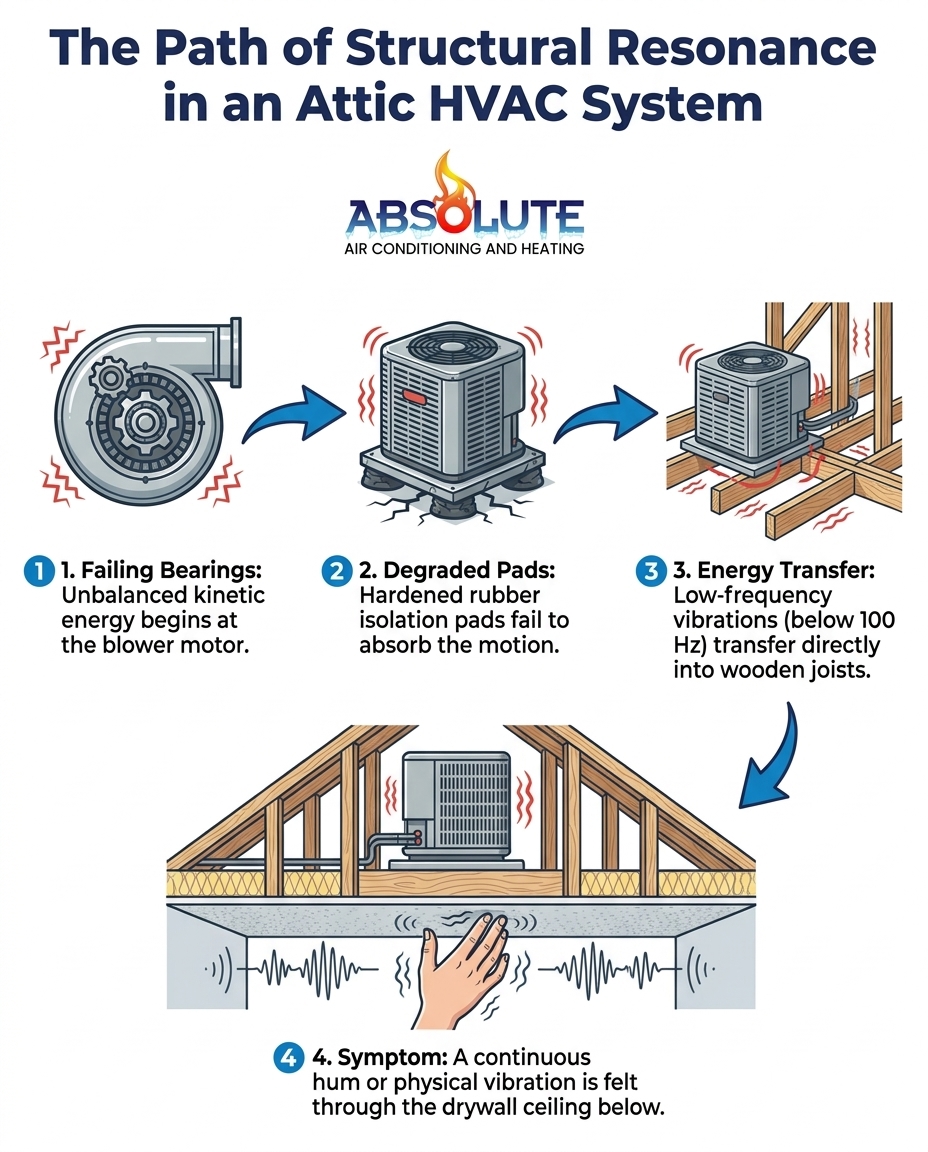
Structural resonance is an entirely different physics problem. It occurs when low-frequency sound waves (typically below 100 Hz) and physical kinetic energy transfer directly into solid materials. If you are wondering what the AC unit in your attic is called, it is typically the air handler. This hidden equipment acts as a heavy kinetic engine. Inside that metal cabinet, a large blower motor spins at high speeds to push conditioned air throughout your home.
When the air handler operates smoothly, its kinetic energy is contained. However, if the unit becomes unbalanced, it generates mechanical vibration. Because low-frequency vibrations easily penetrate drywall and wood framing, that motion transfers down through the attic joists and directly into your ceiling. You aren't just hearing the noise; you are physically feeling the mechanical motion of the air handler operating above you.
How Extreme Attic Heat Bakes Rubber Isolation Pads
One of the most common causes of structural resonance in our region traces back to the very components designed to prevent it. When an air handler is installed, it is typically mounted on elastomeric (rubber) vibration isolation pads or suspended by heavy-duty dampeners. These components act as shock absorbers, soaking up the kinetic energy before it can reach the wood framing.
Thermal Degradation in Desert Climates
With summer highs regularly exceeding 100 degrees in the Coachella Valley, poorly ventilated attic temperatures can easily push well above 130 degrees. This extreme ambient heat creates a hostile environment for any rubber or synthetic component. Over time, the continuous cycle of thermal expansion during the day and contraction at night physically alters the molecular structure of the elastomeric pads.
The rubber loses its elasticity, effectively baking into a hard, brittle puck. Once the isolation pads harden, crack, and fail, they can no longer absorb the motion of the air handler. Instead, the kinetic energy passes straight through the hardened rubber and into the wooden joists. This degradation happens much faster in environments where ambient temperatures remain consistently extreme for months on end.
• Visible cracking: Rubber pads that appear dry-rotted or split under the weight of the unit.
• Flattened dampeners: Pads that have lost their original thickness and sit completely flush against the mounting brackets.
• Metal-on-metal contact: Suspended units where the rubber grommets have disintegrated, leaving the metal hanging bolts rattling against the frame.
Failing Blower Motor Bearings and Mechanical Strain
While degraded isolation pads allow vibration to transfer into the ceiling, the source of that vibration is often internal mechanical wear. After months of heavy, continuous cooling demand, the blower motor operates under immense strain. This is the heart of the air handler, and it works tirelessly to circulate air.
The Anatomy of Mechanical Failure
Inside the blower motor, heavy-duty metal bearings ensure the fan blades spin smoothly and evenly. Over time, these bearings can lose their lubrication, dry out, and begin to grind. When blower motor bearings start to fail, the fan no longer spins in a perfectly balanced circle. Instead, it creates a subtle, violent wobble within the housing.
This unbalanced motion amplifies the structural resonance significantly. If the isolation pads are already compromised by extreme attic heat, the violent wobble of a failing motor will shake the entire unit. Mechanical strain can escalate rapidly if ignored. One local homeowner reached out after returning from vacation to find their air conditioning completely unresponsive—a situation that escalated quickly from minor mechanical strain into a total system shutdown. A technician came over the same day and repaired the air conditioner quickly, getting the system back online in minutes. To avoid being caught off guard by a sudden failure, it is crucial to schedule an AC repair in Palm Desert at the first sign of a persistent hum.
The Escalating Dangers of Ignoring Attic HVAC Vibration
Structural resonance is not just an annoying sound that interrupts your evening; it is a glaring symptom of kinetic energy actively damaging your HVAC system and your home. Ignoring a vibrating ceiling means allowing mechanical stress to compound over time.
Collateral Damage to Ductwork and Framing
Continuous vibration rattles everything connected to the air handler. The sheet metal ductwork attached to the unit is particularly vulnerable. Prolonged shaking can easily vibrate the duct seams loose, breaking the mastic seal and causing massive conditioned air leaks into your hot attic. This leads to significant energy loss, uneven cooling throughout the house, and skyrocketing utility bills.
Beyond the ductwork, the continuous shaking can loosen internal cabinet hardware, rattle electrical connections loose, and even cause micro-fractures in the surrounding drywall over time. Intervening early by investing in routine AC maintenance prevents these minor vibration issues from cascading into catastrophic motor failures or expensive structural repairs.
• Low-frequency hum through ceiling — Underlying Cause: Degraded isolation pads — Potential Consequence if Ignored: Vibration transfer leading to loose ductwork and energy loss.
• Grinding noise with physical vibration — Underlying Cause: Failing blower motor bearings — Potential Consequence if Ignored: Complete motor seizure and sudden system shutdown.
• Intermittent rattling from vents — Underlying Cause: Loose cabinet hardware — Potential Consequence if Ignored: Internal component damage and electrical shorts.
Safe Diagnostics: Why This Isn't a DIY Weekend Project
When a homeowner hears a noise in the attic, the first instinct is often to grab a flashlight and investigate. However, diagnosing structural resonance in hidden HVAC equipment is strictly a job for licensed professionals. The physical hazards of navigating a cramped, hidden space are significant.
The extreme environment: Desert attics are incredibly hostile spaces. With temperatures soaring above 130 degrees, the risk of heat exhaustion is severe. Furthermore, attics are filled with exposed electrical components, high-voltage wiring, and fragile drywall ceilings that cannot support human weight outside of the designated joists.
Diagnosing structural resonance requires specialized acoustic and mechanical knowledge to pinpoint the exact source of the imbalance. Replacing blower motors, balancing fan blades, or safely lifting a heavy air handler to swap out baked isolation pads requires specialized tools and training. This is where Absolute Air Conditioning and Heating's specialized local expertise becomes invaluable. We know how to safely access and diagnose hidden equipment in extreme desert conditions. Instead of risking injury or further damaging your system, rely on professional AC service to handle the heavy lifting safely.
"Never attempt to lift or shift an active air handler to inspect mounting pads; the risk of tearing a high-pressure refrigerant line or causing an electrical short is simply too high."
Preparing for the Shift: Addressing Vibration Before Heating Season
Timing is everything when it comes to mechanical repairs. The month of September marks a critical transition period for your home's comfort system. Your HVAC unit is shifting from handling peak summer cooling loads to preparing for the demands of the upcoming fall and winter heating season.
A system that is already vibrating and straining under current conditions is at an exceptionally high risk of failure when the mechanical demands change. The internal components will soon be tasked with distributing warm air, which alters the thermal dynamics inside the cabinet. If the blower motor bearings are failing now, the added stress of the seasonal shift can easily push them past the breaking point.
Troubleshooting these complex vibration issues takes dedication and expertise. One customer recently selected a team based on reviews to troubleshoot complex existing HVAC issues; the technicians dedicated many hours to resolve the problems and stood behind their work when the manufacturer didn't honor their agreement. Resolving deep-seated vibration problems requires this exact level of thoroughness. A comprehensive inspection and diagnostic visit is a critical fall-prep step. By resolving bearing wear and replacing baked isolation pads now, you ensure a quiet, reliable, and efficient system that will keep you comfortable straight through the winter.
Frequently Asked Questions About Attic AC Vibration
Why does my ceiling vibrate when the AC is on?
Your ceiling vibrates due to structural resonance, which transfers kinetic energy from the attic air handler directly into your home's wood framing. This usually happens when the rubber isolation pads beneath the unit harden and fail due to extreme attic heat. Without these shock absorbers, the natural motion of the spinning blower motor travels straight through the joists and into your drywall.
Is a vibrating AC unit dangerous?
While a vibrating AC unit is rarely an immediate life-safety hazard, it strongly indicates mechanical failure that can cause costly damage to your home. Continuous shaking can rattle ductwork loose, causing severe energy leaks, and can loosen internal electrical connections. Over time, the vibration can also cause micro-fractures in your ceiling drywall and framing.
How do you stop an air handler from vibrating?
Stopping an air handler from vibrating requires a licensed professional to diagnose and correct the underlying mechanical imbalance. This typically involves replacing degraded rubber isolation pads, balancing the fan blades, or installing a new blower motor if the internal bearings have failed. Because the unit is heavy and connected to high-voltage power, this is never a DIY repair.
Why is my attic AC unit so loud inside the house?
An attic AC unit sounds loud inside the house either because of airborne noise traveling through leaky ductwork or low-frequency structural resonance transferring through the ceiling framing. High-pitched whistling usually points to airflow restrictions or dirty filters, while a deep, continuous hum points to mechanical vibration bypassing the unit's isolation dampeners.
Are vibrating AC pipes dangerous?
Yes, vibrating AC refrigerant pipes can be dangerous to the lifespan of your system. If the copper lines vibrate continuously, they can rub against the wooden framing, masonry, or the unit's metal cabinet. This friction will eventually wear a hole in the copper, leading to a massive refrigerant leak and total system failure.
Restoring Quiet to Your Home Before the Season Changes
A vibrating ceiling is a solvable physics problem, not something you have to live with. Whether the underlying cause is degraded rubber isolation pads baked by the extreme desert heat, or failing blower motor bearings struggling under the weight of a long summer, the solution requires professional intervention. Validating these symptoms early and seeking a professional diagnostic is the smartest, most proactive choice you can make for protecting your home's framing and the longevity of your HVAC equipment. As we move through the September transition and prepare for cooler weather, don't let a minor mechanical hum turn into a major mid-season breakdown. Reach out for a professional assessment today to restore peace, quiet, and reliability to your living space before the heating season officially begins.
Serving the Entire Coachella Valley


Addressing the Musty Smell from Your Attic Air Handler After Summer Humidity
That sudden dirty socks odor from your vents isn't just a nuisance—it is a sign of biological growth. Find out if it is a simple filter fix or a job for a pro.

Why We Recommend Scheduling Your Pre-Heating Tune-Up Before the October Rush
Waiting for the first cold snap to test your furnace often leads to long service delays. Take a behind-the-scenes look at how local HVAC supply chains operate in the fall.

Evaluating the Switch from a Traditional Attic AC to a Heat Pump System This Fall
If your aging air conditioner barely survived the summer, you face a crucial choice before winter. See why a unified heat pump offers better year-round efficiency than standard gas combos.

