

What Is the AC Unit in the Attic Called? Demystifying Your Home's Hidden Equipment
What Is That Big Metal Box Above Your Ceiling?
If you have ever poked your head through the access hatch and seen a massive metal cabinet humming away in the dark, you might be asking: What Is the AC Unit in the Attic Called? Demystifying Your Home's Hidden Equipment is the first step toward better HVAC care. You are certainly not alone in your confusion. Most homeowners rarely interact with their hidden HVAC equipment until something goes wrong. When a strange noise starts echoing through your ceiling or you realize it is time to schedule seasonal maintenance, trying to explain the setup to a dispatcher can feel incredibly frustrating if you do not know the right terminology.
Knowing whether you are looking at an air handler, a furnace, or an evaporator coil is the very first step toward effective troubleshooting and proper upkeep. Here at Absolute Air Conditioning and Heating, our technicians have spent years navigating Palm Desert attics, and we know firsthand that identifying this equipment is much easier than it looks—you certainly do not need to be a mechanical engineer to understand how it works.
For expert Air Conditioning Services or fast AC repair in Palm Desert, our team is ready to help.
The Short Answer: Identifying Your Attic HVAC Unit
The short answer is that the "AC unit" in your attic is usually just the indoor half of a split HVAC system. Because central air conditioning systems are split into two main parts—the outdoor compressor and the indoor distribution center—that large box above your ceiling is responsible for circulating the conditioned air throughout your home. Depending on how your home is heated and cooled, that equipment is typically called one of three things:
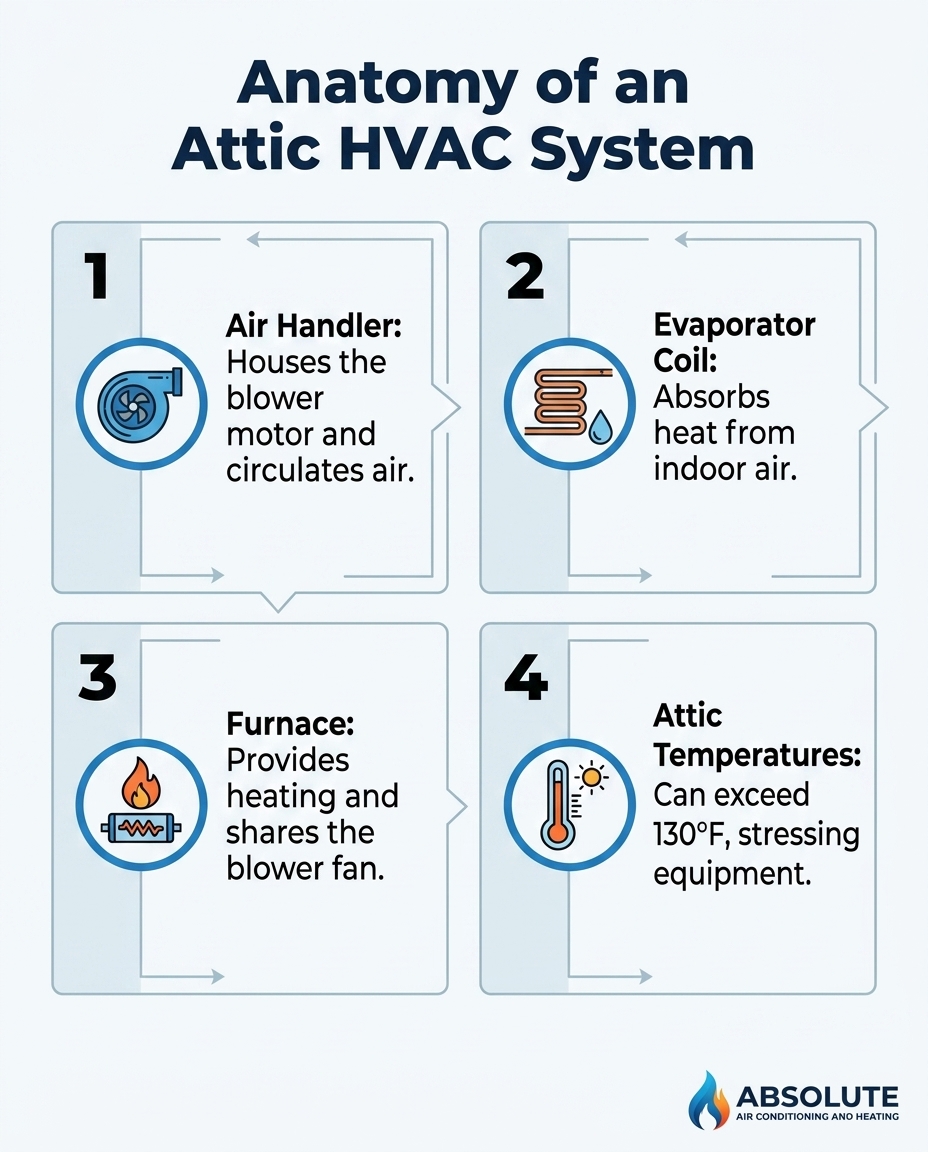
• The Air Handler: This is the indoor unit typically paired with a heat pump or a straight-cooling outdoor unit. It houses the blower motor and an internal coil.
• The Evaporator Coil: If you have a gas furnace, the evaporator coil is the dedicated cooling component. It is a separate encased metal box that sits directly on top of or right next to the furnace.
• The Furnace: This is the primary heating element for homes with gas heat. Even though it is a heater, it shares its powerful blower fan with your air conditioner to push cold air through the vents during the summer.
Understanding these three terms gives you the exact vocabulary you need to describe your system accurately. Below, we will look closer at what each component actually does.
Breaking Down the Components: Air Handler vs. Evaporator Coil vs. Furnace
To truly demystify the equipment hidden above your ceiling, it helps to understand the specific job each component performs. These parts work together seamlessly, especially when shifting roles during the September pre-heating-season transition. Upgrading or replacing this equipment is a major project, though it is worth noting that qualifying high-efficiency heat pump or furnace installations may be eligible for federal tax credits and local utility incentives (always verify current programs with your utility or a tax professional). For instance, one local homeowner recently needed to overhaul their aging setup during the fall transition. Our team spent two days installing two brand-new AC and furnace systems, ensuring the complex attic ductwork and indoor units were perfectly calibrated for the upcoming season. If you are facing a similar upgrade or just need routine heating repair, knowing what these parts do is incredibly helpful.
The Air Handler (Blower and Coil)
If your home relies on a heat pump or an all-electric cooling system, the large metal box in your attic is an air handler. You can think of the air handler as the lungs of your home. It does not create cold air on its own; instead, it circulates it.
What it does: The air handler contains a large blower motor and an indoor coil. It pulls warm, unconditioned air from your home through the return vents, pushes that air across the cold internal coil to remove heat and humidity, and then blows the newly chilled air back through your supply ducts.
The Evaporator Coil (The Cooling Core)
If you have a gas furnace in your attic, the air conditioning component attached to it is the evaporator coil. This is usually a smaller, separate metal cabinet bolted directly to the furnace.
What it does: The evaporator coil is filled with cold liquid refrigerant pumped in from your outdoor unit. As warm indoor air blows across this coil, the refrigerant absorbs the heat. Because this process pulls moisture out of the air, the evaporator coil produces a lot of condensation. This is why you will always see a PVC drain line running out of this specific box to carry water safely out of your attic.
The Furnace (The Heating Element)
Many homeowners are confused to find a furnace in the attic when they are primarily thinking about their air conditioning. However, in a split system, the AC and the heater share the same ductwork and the same blower fan.
What it does: During the winter, the furnace generates heat (usually via gas burners). During the summer, the furnace burners stay off, but the furnace's powerful blower motor turns on to push air through the attached evaporator coil and into your home. The furnace acts as the engine for air distribution all year long.
Why Is the AC Unit in the Attic in the First Place?
A very common question homeowners ask is why builders put such large, heavy, and important machinery in a dark, cramped space to begin with. In regions like Palm Desert CA, where homes rarely have basements, placing the indoor HVAC unit in the attic is a standard architectural choice. While it might seem inconvenient when you need to change a filter, this placement offers several distinct advantages.
1. Maximizing Living Space: A typical furnace or air handler takes up the footprint of a small closet. By moving the equipment into the attic, builders free up valuable square footage inside the living areas of the home.
2. Efficient Air Distribution: Cold air naturally sinks. Placing the air distribution system above the living space allows for gravity-fed ductwork. The blower motor does not have to work as hard to push heavy, cold air downward into your rooms, which is highly efficient for single-story homes.
3. Noise Reduction: Blower motors and gas burners can be loud. Keeping this machinery insulated above the ceiling prevents the mechanical hum from interrupting your daily life.
However, this setup comes with one major drawback: the unit is subjected to the ambient temperature of the attic space. To combat this, homes with attic AC systems require exceptionally well-sealed ductwork and proper insulation to prevent the conditioned air from absorbing the extreme attic heat before it ever reaches your vents.
The Impact of Extreme Desert Heat on Your Hidden Equipment
Attic placement is incredibly common in our region, but it requires special attention due to the extreme thermal loads. In our years of servicing systems throughout Palm Desert CA, we consistently see how enclosed attic spaces bake under the sun, easily exceeding 130 degrees Fahrenheit when summer highs push past 110 degrees outdoors. This hostile environment takes a physical toll on your hidden equipment.
The Problem: Severe Thermal Stress
HVAC systems generate their own internal heat while running. When you combine that operating heat with a 130-degree ambient attic temperature, the system is pushed to its absolute limits. Electronics, wiring, and blower motors are forced to operate in an oven-like environment, which can shorten the lifespan of sensitive components like capacitors and circuit boards.
The Cause: Dried Out and Brittle Materials
The extreme heat does not just affect the electronics; it targets plastics and plumbing. The PVC condensate drain lines that carry water away from your evaporator coil can become brittle and crack over time. Furthermore, the intense heat can evaporate the water in the drain traps, leading to dry traps that allow foul odors or warm air to get sucked back into the system.
The Solution: Proactive Ventilation and Maintenance
As local experts who specifically understand how to diagnose and protect systems subjected to the Coachella Valley's extreme attic heat, Absolute Air Conditioning and Heating knows exactly what to look for. Proper attic ventilation, radiant barriers, and robust indoor air quality services can help mitigate these stressors. Upgrading your attic insulation and ensuring your ductwork is heavily sealed prevents your system from fighting a losing battle against the desert sun.
The September Shift: Preparing Your Attic Unit for the Heating Season
Because your attic equipment works so hard during the summer, the early fall transition period is the most vulnerable time for your HVAC system. The September pre-heating-season transition is when your equipment shifts from running constant cooling cycles to engaging the heating elements for the first time in months.
It is easy to fall into the "out of sight, out of mind" trap with attic units. But skipping early fall maintenance is a major risk. One local family relies on our technicians—including Jen, Brian, and Andrew—each fall to handle all their ongoing service and repairs impeccably, ensuring their equipment transitions safely between seasons.
Here is a checklist of what a professional technician looks for during a pre-heating-season tune-up in your attic:
• Condensate Drain Clearing: Summer cooling creates gallons of water. Algae and dust can clog the drain lines, which will overflow and cause ceiling damage if not cleared before winter.
• Blower Motor Inspection: The motor that ran non-stop all summer needs to be inspected for wear and tear before it is tasked with pushing heavy, warm air all winter.
• Heat Exchanger Safety Check: If you have a gas furnace, the heat exchanger must be inspected for microscopic cracks. A cracked heat exchanger can leak dangerous exhaust gases into your home's air supply.
• Electrical Connection Tightening: The constant vibration of the unit, combined with extreme temperature swings in the attic, can cause electrical connections to vibrate loose over the summer.
How to Describe Your Attic Unit to an HVAC Dispatcher
If you notice a problem with your system, being able to describe the attic unit accurately will help the dispatcher send the right technician with the right parts. Remember, you should NEVER open the equipment cabinet yourself, as it contains high-voltage electrical components and delicate parts that require a licensed professional to handle safely. However, you can safely observe the exterior of the unit and note a few key details.
First, determine your fuel source. If you know your home uses gas heating, the metal box in your attic is almost certainly a gas furnace paired with an evaporator coil. If your home is fully electric, you are likely looking at an air handler connected to a heat pump.
Use this simple observation table to help guide your conversation when calling for service:
• Water dripping from the ceiling under the unit — What It Usually Means: Clogged condensate drain line or cracked drain pan — What to Tell the Dispatcher: "My attic unit is leaking water and the drain pan seems full."
• Loud rattling or banging when the air turns on — What It Usually Means: Loose blower wheel or failing motor bearings — What to Tell the Dispatcher: "There is a mechanical banging noise coming from the blower motor in the attic."
• A burning dust smell when the heat first turns on — What It Usually Means: Dust burning off the furnace heat exchanger (normal in fall) — What to Tell the Dispatcher: "I smell burning dust from the vents; I need a fall furnace inspection."
• The outdoor unit runs, but no air comes from vents — What It Usually Means: Failed blower motor in the air handler or furnace — What to Tell the Dispatcher: "The outdoor unit is on, but the indoor air handler is not blowing any air."
Frequently Asked Questions About Attic HVAC Systems
Is an air handler the same as an AC unit?
No, an air handler is not the entire AC unit. It is only the indoor half of a split system. The air handler contains the blower motor and indoor coil, while the outdoor unit houses the compressor and condenser. Both pieces must work together to cool your home.
What is the difference between an air handler and a furnace?
The main difference is how they generate heat. A furnace creates heat by burning fuel (like natural gas) or using heavy electrical resistance strips. An air handler does not create heat; it simply circulates air over a coil that is heated or cooled by an outside heat pump.
Why is my AC unit in the attic?
Builders place HVAC units in the attic to save valuable floor space inside the home and to make ductwork installation easier. Because cold air naturally falls, an attic-based system can efficiently distribute conditioned air through ceiling registers without the blower motor fighting gravity.
Can an AC unit be in the attic safely?
Yes, an AC unit can operate safely in an attic, provided the space is properly ventilated and the equipment is professionally installed. It requires regular maintenance, a secondary drain pan to prevent ceiling leaks, and heavily insulated ductwork to protect the system from extreme ambient heat.
What is the indoor AC unit called?
The indoor AC unit is generally called an air handler (if you have a heat pump or all-electric system) or an evaporator coil (if it is attached to a gas furnace). Both terms refer to the equipment responsible for absorbing heat and blowing conditioned air into your rooms.
How often should an attic AC unit be serviced?
An attic HVAC system should be serviced twice a year. You need one tune-up in the spring to prepare the cooling components for extreme summer heat, and a second inspection in the early fall to ensure the heating elements are safe to operate before winter arrives.
Get Peace of Mind Before the Heating Season Begins
Knowing exactly what the big metal box above your ceiling is called does more than just solve a mystery—it empowers you to take better care of your home. Whether you are dealing with an air handler, a furnace, or an evaporator coil, understanding this hidden equipment makes it much easier to communicate with professionals and recognize when something sounds or looks wrong. As the weather shifts, do not let your attic equipment remain out of sight and out of mind. Take action now to ensure a smooth transition into the cooler months. For a thorough inspection, professional tune-up, or reliable AC repair in Palm Desert, reach out to our local experts today. We provide the clear, jargon-free guidance you need to keep your system running efficiently all year long.
Serving the Entire Coachella Valley


The Anatomy of a Cracked Heat Exchanger: What Our Technicians Look For
Microscopic metal fatigue cracks in your furnace are invisible to the naked eye but can cause dangerous carbon monoxide leaks. See exactly how we spot this hidden threat during fall inspections.

Evaluating Air Purifier Add-Ons for Your Attic Air Handler
Preparing for closed-window season means addressing trapped desert dust. Compare UV lights, media filters, and electronic cleaners to find the right upgrade for your existing HVAC system.

What to Do When Your Attic AC Unit Starts Making a Grinding Noise During Heating Mode
Switching your thermostat to heat shouldn't sound like a freight train in your ceiling. We explain if that loud grinding is a normal transition or a failing motor.

