
Heating Service in Palm Desert, CA
Is your heating system failing when you need it most? Whether you woke up to a freezing home or your heater is blowing cold air, Absolute Air Conditioning and Heating offers fast, reliable solutions to restore your comfort today. We provide same-day service, transparent flat-rate pricing, and comprehensive warranties to ensure your heating system works efficiently and safely. Don’t wait in the cold; contact us now or apply for financing online to get your heating system fixed promptly and professionally.
Schedule Your Heating Repair Now
Get Your Heating Fixed Today
Stop suffering through chilly nights. Our certified technicians are ready to diagnose and repair your heating system quickly and accurately. With stocked service vehicles and expert knowledge, we aim to complete repairs on the first visit. Click below to schedule your service and bring warmth back to your Palm Desert home.
Is Your Heating System Failing When You Need It Most?
Waking up to a freezing home or realizing your heater is blowing cold air creates immediate stress and discomfort, especially during the sharp temperature drops common in the desert nights. You need a solution that restores warmth immediately, not days from now, so contact us or apply for financing online to get started.
Homeowners in Palm Desert deserve a heating system that functions reliably and efficiently. Our certified technicians provide:
- Same-day diagnostic availability to identify the root cause of the failure quickly.
- Accurate, flat-rate pricing provided upfront so you never face surprise costs.
- Comprehensive warranties covering both parts and labor for your peace of mind.
We are a fully licensed, bonded, and insured provider offering flexible financing options to ensure your comfort is never compromised by budget constraints.
What You Can Expect From Our Heating Service Today
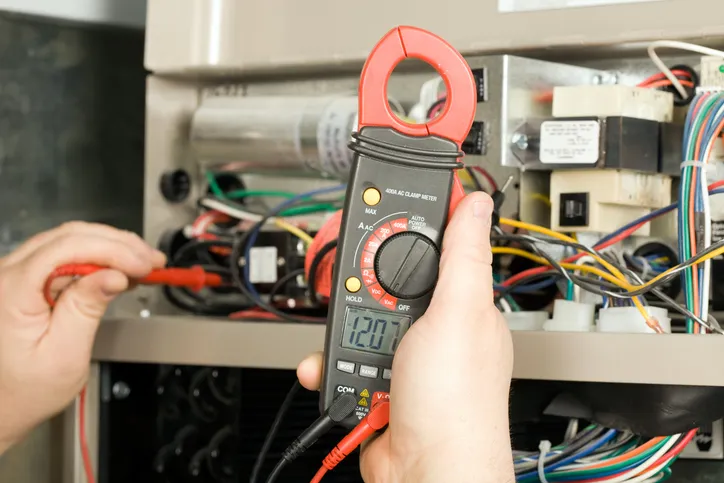
When you request a service visit, the objective is to restore your system to optimal performance with minimal disruption to your daily routine. Absolute Air Conditioning and Heating approaches every service call with a focus on technical precision and safety. We do not operate on guesswork; we utilize advanced diagnostic tools to pinpoint the exact failure point within your furnace or heat pump.
- Comprehensive System Diagnostics: The service begins with a thorough evaluation of your entire heating infrastructure. Technicians do not simply kick the tires; they inspect the critical components that drive performance. This includes testing the ignition system, verifying flame sensor operation, and checking the heat exchanger for cracks, which is a vital safety step to prevent carbon monoxide leaks. For heat pumps, we analyze refrigerant levels, reversing valve operation, and compressor health.
- Immediate Repair Capabilities: Our service vehicles are stocked with a wide inventory of common parts, including igniters, pressure switches, capacitors, contactors, and control boards. The goal is to complete the repair during the initial visit whenever possible. If a specific part must be ordered, we provide a clear timeline and temporary solutions to keep you safe.
- Safety and Efficiency Calibration: Beyond just fixing the broken part, the service includes a calibration of the system. We measure airflow to ensure your blower motor is moving heat effectively through the ductwork. We also check gas pressure in furnaces to ensure the fuel-to-air mixture is correct for efficient combustion. This attention to detail ensures that the repair does not just work for today but helps prevent future breakdowns later in the season.
Detailed Breakdown of Common Heating Failures We Resolve
Understanding what has gone wrong helps you make informed decisions. We handle a wide array of heating issues that affect properties in the region.
- Ignition Control Issues: Modern heating systems rely on electronic ignition rather than standing pilot lights. If your system clicks but does not fire, it is often an issue with the hot surface igniter or the spark electrode. We replace these components to restore reliable startup cycles.
- Airflow Restrictions and Limit Switch Faults: If your furnace shuts down repeatedly after only running for a few minutes, it is likely overheating. This is often caused by restricted airflow from dirty filters or blocked ducts, which triggers the high-limit switch to cut power to the burners. We identify the source of the restriction and replace faulty limit switches to stop short-cycling.
- Thermostat and Control Board Communication Errors: Sometimes the heating unit is functional, but the signal from the thermostat is not reaching the control board. We trace the low-voltage wiring to find shorts or breaks and test the control board to ensure it is distributing power correctly to the blower and gas valve.
- Heat Pump Reversing Valve Stiffening: In our region, heat pumps are common. If your system is running but blowing cold air, the reversing valve may be stuck in "cooling" mode. We troubleshoot the solenoid and the valve body to ensure the system switches seamlessly between heating and cooling functions.
How the Repair and Installation Process Works
We have streamlined our operational procedures to ensure clarity and efficiency from the moment you reach out until the technician leaves your driveway.
- Initial Assessment and Safety Check: The technician arrives within the scheduled window and puts on shoe covers to protect your flooring. The first step is a safety inspection to rule out immediate hazards like gas leaks or electrical shorts. Once safety is confirmed, the diagnostic process begins to isolate the mechanical or electrical failure.
- Presentation of Options and Upfront Quote: Once the issue is identified, the technician provides a detailed explanation of the problem. You receive a written quote that includes all parts, labor, and taxes. There are no hidden fees or hourly rate surprises. If multiple repair options exist, or if the system is nearing the end of its life, we present a comparison of repair versus replacement costs.
- Execution of Work: Upon your approval, work begins immediately. The technician isolates the power and gas supply, removes the faulty components, and installs the new manufacturer-approved parts. We adhere to strict industry standards for torque settings, wiring connections, and gas piping sealing.
- System Testing and Verification: After the repair is complete, the system is run through a full heating cycle. The technician measures the temperature rise (the difference between the air entering the return and leaving the supply) to confirm it falls within the manufacturer’s specified range. This verifies that the repair was successful and the system is heating effectively.
- Site Cleanup and Final Report: The work area is cleaned thoroughly, with all old parts and packaging removed from your property. You receive a digital invoice and a detailed service report outlining what was done, along with warranty information for the new parts.
Deciding When to Replace vs. Repair Your Heating System
One of the most difficult decisions homeowners face is whether to invest in another repair or upgrade to a new unit. While our priority is always to repair when feasible, there are mathematical and practical tipping points where replacement becomes the more financially sound option.
- The Age and Frequency Factor: Heating systems typically last between 15 and 20 years. If your unit is over 12 years old and requires a repair that costs more than 50% of the value of the system, replacement is generally recommended. Additionally, if you have required repairs more than twice in the last two years, the system is likely entering a phase of rapid component failure, view our HVAC FAQs for more insights.
- Efficiency and Operating Costs: Older furnaces often operate at 60% to 80% AFUE (Annual Fuel Utilization Efficiency). This means up to 40 cents of every dollar you spend on heating is wasted. Modern systems operate at 95% efficiency or higher. If your energy bills have been steadily climbing despite normal usage, the savings from a high-efficiency unit can often offset the monthly cost of financing a new installation.
- Comfort and Safety Concerns: If your current system involves a cracked heat exchanger, replacement is mandatory due to carbon monoxide risks. Furthermore, if your home has hot and cold spots or the system is excessively noisy, a new unit with variable-speed technology can significantly improve home comfort and air distribution.
- Parts Availability: As systems age, manufacturers stop producing specific parts. If sourcing a replacement part takes weeks or requires expensive retrofitting, upgrading to a modern system ensures you have access to readily available components and serviceability.
Important Local Factors for Palm Desert Residents
Operating a heating system in Palm Desert presents unique challenges compared to other regions. The desert environment influences how systems should be maintained and installed.
- Extreme Temperature Fluctuations: While days are warm, desert nights drop significantly. This rapid shift puts thermal stress on heating components, particularly the heat exchanger, as it expands and contracts. Regular inspections are vital to catch stress cracks early before they become safety hazards.
- Dust and Air Quality Impact: The arid environment leads to higher concentrations of dust and particulate matter. This infiltrates the system, clogging filters and coating blower motor blades faster than in humid climates. Neglecting filter changes in this region leads to faster motor burnout and reduced efficiency. We recommend checking filters monthly during peak usage.
- Utility Incentives and Regulations: California has strict Title 24 energy standards that dictate installation practices, including duct testing and thermostat capabilities. Our team handles all permitting and compliance requirements to ensure your installation meets state and local codes. We also stay updated on rebates offered by local utility providers for high-efficiency upgrades, helping you maximize your investment.
- Gas vs. Electric considerations: Many homes in the area rely on natural gas furnaces, while others utilize electric heat pumps. Understanding your specific utility rate structures can help decide which system is more economical for your home. We can perform a load calculation to determine the exact heating requirements based on your home’s insulation, windows, and square footage.
Technical Differentiators: Why Precision Matters
In the HVAC industry, the quality of the technician determines the longevity of the repair. Incorrect diagnosis leads to wasted money on parts that weren't broken, while poor installation practices can reduce a new system's efficiency by up to 30%.
- Certified Expertise: Technicians are trained to handle high-voltage electrical connections and combustible gases. This does not work for general handymen. Proper handling of refrigerant in heat pumps and precise calibration of gas valves in furnaces requires specialized tools and certification.
- Proper Sizing and Load Calculation: A heating system that is too large will short-cycle, wearing out parts prematurely and causing temperature swings. A system that is too small will run continuously without ever reaching the set temperature. We utilize Manual J load calculations to ensure any replacement unit is sized exactly for your home’s thermal envelope.
- Ductwork Integrity: Even the best furnace cannot heat a home effectively if the ductwork is leaking. We view the heating unit and the duct system as a single entity. Our service often includes inspecting visible ductwork for separations or tears that could be leaking conditioned air into the attic or crawlspace.
Secure Your Comfort With Reliable Service
A functioning heating system is not a luxury; it is a necessity for your home environment. Waiting until the system fails completely can lead to higher emergency repair costs and uncomfortable nights. Whether you are dealing with a minor noise, a complete breakdown, or simply want a professional assessment of your system’s health, decisive action is required.
We provide the technical expertise, the local knowledge, and the inventory to solve your heating challenges on the first visit. Do not settle for temporary fixes or unreliable contractors.
For professional diagnostics, repair, or replacement in Palm Desert, contact Absolute Air Conditioning and Heating today. Secure your appointment now and restore consistent warmth to your home.

