

Comparing High-Efficiency vs. Standard Air Handlers for Attic Installations
Is It Safe to Put a High-Efficiency Air Handler in a Blistering Attic?
When comparing high-efficiency vs. standard air handlers for attic installations, the most critical question our team at Absolute Air Conditioning and Heating hears is whether sensitive modern electronics can survive the extreme heat trapped above your ceiling. If you are replacing an aging unit during the early fall transition and pre-heating season, you are likely weighing a difficult decision. On one hand, you want the superior indoor air quality and energy savings that come with top-tier equipment. On the other hand, you know exactly how hot your attic gets during the peak of the day. The right choice depends heavily on the specific environment inside your attic, rather than just looking at the SEER or HSPF ratings printed on the box. Placing an air handler in an attic requires a careful balance between the technology you choose and the thermal realities of your home.
For expert guidance on your next upgrade, explore our air conditioning services or schedule your AC installation in Palm Desert to ensure your system is matched perfectly to your home.
The Extreme Reality of Unconditioned Attics
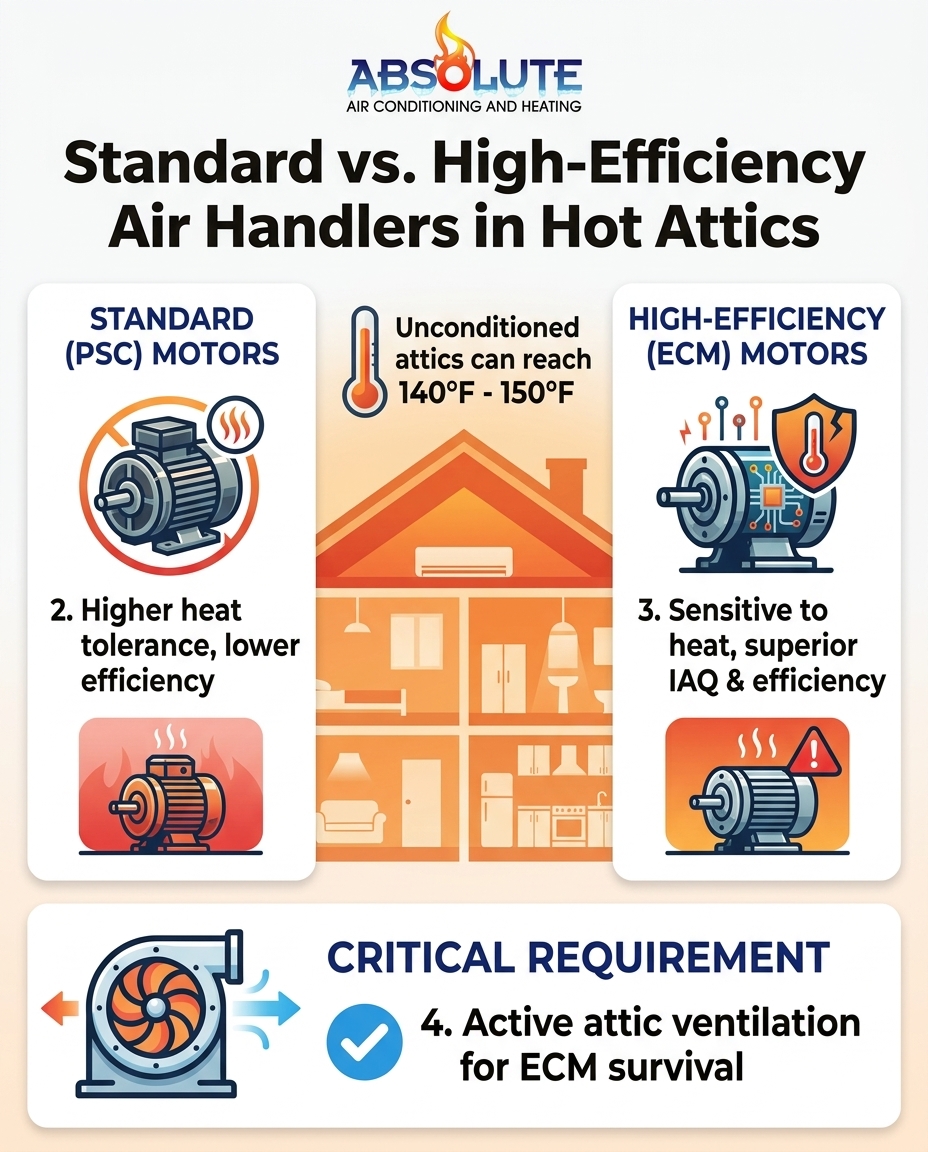
Before deciding on the type of equipment to install, it is vital to understand the hostile environment of an unconditioned space. In many Palm Desert homes with unconditioned attics, our technicians routinely measure temperatures above the ceiling that are vastly different from the temperature outside. Radiant heat from the sun beats down on the roof deck, transferring directly into the enclosed space below. During peak afternoon hours, these spaces can easily reach 140 to 150 degrees Fahrenheit. In our years of servicing local HVAC systems, we've found that many homeowners do not realize this lingering extreme heat continues well into the early fall, keeping attic temperatures hostile to sensitive electronics much later in the year than in other regions.
This ambient heat forces your attic air handler to work significantly harder just to perform its baseline functions. The surrounding thermal load means the equipment chassis itself is baking, which accelerates wear and tear on every internal component. Electrical parts, capacitors, and blower motors are forced to operate outside of their ideal temperature ranges, leading to premature degradation. The longer the heat lingers, the more strain is placed on the system.
Our crew saw this firsthand during a recent late-summer heat wave when a customer's 18-year-old air conditioning unit began malfunctioning under the strain of a blistering attic. We responded quickly, managing to keep the aging unit running just long enough to secure and install a replacement. Our technicians acted as a critical lifeline during the peak temperatures, proving exactly how fast extreme ambient heat can push older, stressed equipment past its breaking point. If you are planning an upgrade, understanding this extreme thermal reality is the first step in making a wise investment.
Standard Single-Stage Air Handlers: Rugged but Basic
When evaluating options for our customers, standard single-stage air handlers represent the traditional approach to residential heating and cooling. These units operate on a very simple premise: they run at one speed, which is 100% capacity. When the thermostat calls for cooling or heating, the system turns on at full blast until the target temperature is reached, and then it shuts off completely. While this technology is older, we often find it has distinct characteristics that make it highly relevant for specific installation environments.
The advantages of a standard system:
• Rugged motor design: Standard units typically utilize Permanent Split Capacitor (PSC) motors. These motors are mechanically simpler and lack complex, delicate microprocessors.
• Higher heat tolerance: Because they rely on basic mechanical and electrical components rather than sensitive digital boards, PSC motors are generally much more resilient to the 140-degree temperatures found in unconditioned attics.
• Simplified maintenance: When a basic component fails under thermal stress, AC repair is often straightforward and involves swapping out standard, widely available parts.
The drawbacks of a standard system:
• Lower energy efficiency: Because the motor only operates at full capacity, it consumes more electricity every time it cycles on, leading to higher baseline energy usage.
• Louder operation: The sudden rush of air when the system kicks on at 100% capacity creates a noticeable noise disruption in the home.
• Poor humidity control: Short, frequent cycles do not give the system enough time to effectively pull moisture out of the air, which can leave your home feeling clammy during transitional weather.
We typically recommend a standard single-stage unit in older homes with poorly ventilated attics where sensitive electronics would quickly fry. If improving the attic's thermal envelope is not an option, a rugged PSC motor is often the safest, most reliable choice.
High-Efficiency Variable-Speed Air Handlers: Sensitive but Superior
On the other side of the spectrum are high-efficiency variable-speed air handlers. These modern systems utilize Electronically Commutated Motors (ECM), which are a massive leap forward in HVAC technology. Instead of simply turning on or off, an ECM adjusts its speed incrementally. It can run at 30%, 50%, or 80% capacity depending on exactly what the home needs at that exact moment. This allows for precise, continuous temperature control without the harsh temperature swings associated with single-stage units.
However, this advanced functionality comes with a significant vulnerability. ECMs contain sensitive electronic control boards and microprocessors built directly into the motor assembly. These digital components are highly susceptible to heat damage. When exposed to sustained ambient temperatures of 140 degrees or more, the delicate solder joints and microchips degrade significantly faster than standard mechanical parts. Installing an ECM in a poorly ventilated, baking-hot space is a recipe for premature failure and costly motor replacements.
In our experience, if the environment can be managed, the upside is tremendous. Variable-speed units provide superior indoor air quality (IAQ) and air circulation. Because they run longer, slower cycles, they continuously filter the air and remove excess moisture. This is particularly beneficial during the early fall transition and pre-heating season, when humidity levels fluctuate and stagnant indoor air becomes a nuisance. Furthermore, upgrading to a high-efficiency variable-speed model may qualify your installation for generic energy rebates or federal tax credits, helping to offset the initial investment. You should always consult with your local utility provider or a tax professional to see what generic incentives apply to your specific upgrade.
Side-by-Side Comparison: Efficiency, Durability, and IAQ
To help you weigh the pros and cons, it helps to look at exactly how these two technologies stack up against each other when subjected to extreme environments. We always tell our clients that the right choice is a balancing act between long-term performance and the harsh realities of where the equipment will live.
• Upfront Investment — Standard Single-Stage (PSC): Lower initial equipment cost. — High-Efficiency Variable-Speed (ECM): Higher initial equipment cost.
• Energy Efficiency — Standard Single-Stage (PSC): Baseline efficiency; consumes more power per cycle. — High-Efficiency Variable-Speed (ECM): Maximum long-term energy savings; uses only the power needed.
• Durability in 140°F+ Heat — Standard Single-Stage (PSC): Highly resilient; simple mechanical parts handle extreme heat well. — High-Efficiency Variable-Speed (ECM): Vulnerable; sensitive electronics degrade quickly without proper ventilation.
• Indoor Air Quality (IAQ) — Standard Single-Stage (PSC): Basic filtration due to short run cycles. — High-Efficiency Variable-Speed (ECM): Superior filtration and humidity control due to long, continuous cycles.
• Noise Levels — Standard Single-Stage (PSC): Noticeable air rush when cycling on at 100%. — High-Efficiency Variable-Speed (ECM): Whisper-quiet operation at lower speeds.
When to Choose Standard
• Your attic lacks active ventilation: If the space is sealed tight and bakes in the afternoon sun, standard equipment is safer.
• Budget prioritization: If keeping the initial installation cost as low as possible is the primary goal over long-term energy savings.
• Simplicity is preferred: If you prefer basic, straightforward mechanical systems that are easier to troubleshoot in extreme environments.
When to Choose High-Efficiency
• Your attic is well-ventilated or conditioned: If you have active solar fans, ridge vents, or a spray-foamed conditioned space.
• Air quality is a priority: If you want maximum indoor air quality, superior humidity control, and even temperatures throughout the home.
• Seeking maximum efficiency: If you want to take advantage of generic energy rebates and reduce your long-term electrical consumption.
The Deciding Factor: Assessing Attic Ventilation
Ultimately, the success of installing an air handler in an attic—especially a sensitive, high-efficiency model—hinges entirely on the quality of your attic ventilation. You can purchase the most advanced, highest-rated variable-speed system on the market, but if you place it in a 150-degree oven, the electronic control board will eventually fail. The environment dictates the lifespan of the equipment.
Proper ventilation is the only way to mitigate the extreme heat that destroys ECM motors. Passive systems like ridge vents and soffit vents allow hot air to escape naturally, while active systems like solar attic fans forcefully pull trapped heat out of the space, dramatically lowering the ambient temperature around your HVAC equipment. This airflow is the protective shield your new investment requires.
Because the stakes are so high, you should never attempt a DIY assessment of your attic's thermal envelope. A professional must evaluate the space before recommending sensitive equipment. At Absolute Air Conditioning and Heating, our team provides honest, local expertise, carefully assessing the attic environment for durability and realistic returns on investment before simply upselling a sensitive high-efficiency unit. We evaluate the airflow, the insulation, and the peak temperature load to ensure that whatever system you choose will actually survive.
During a recent early fall project, our installation crew worked with a local homeowner who needed to install two new AC and furnace systems. We spent two full days carefully evaluating the space and completing the complex setup. Because our team took the time to assess the environment rather than rushing, the installation met all expectations and the new systems were perfectly matched to the home's thermal realities. If you are considering installing an air handler in a Palm Desert attic, getting a professional thermal assessment is the single most important step you can take.
Frequently Asked Questions
Is it okay to put an air handler in the attic?
Yes, it is perfectly acceptable to install an air handler in the attic, provided the space is properly evaluated first. The primary concern is extreme heat, which can strain the equipment and reduce its lifespan if the area lacks adequate ventilation. A professional installer will assess your attic's thermal envelope to ensure the unit you choose is rugged enough to handle the environment.
Does an attic air handler lose efficiency?
An air handler located in an unconditioned attic will naturally lose some efficiency compared to one in a climate-controlled closet. The extreme ambient heat forces the system to work harder to cool the air, and any minor leaks in the ductwork will draw in hot, dusty attic air. Proper duct sealing, heavy insulation, and active attic ventilation are required to minimize this efficiency loss.
What is the life expectancy of an air handler in the attic?
A standard air handler in an attic typically lasts between 10 and 15 years, depending on the severity of the climate and the quality of maintenance. Extreme heat accelerates wear and tear on blower motors, capacitors, and belts. Regular pre-heating season tune-ups and consistent filter changes are essential to helping the unit reach its maximum potential lifespan.
Is a variable speed air handler worth it in a hot attic?
A variable-speed air handler is only worth the investment if your hot attic has adequate active ventilation to protect the sensitive electronics. If the attic remains unventilated and routinely reaches 140 degrees, the delicate ECM motor will likely fail prematurely, negating any energy savings. However, if the space is properly ventilated, the superior humidity control and indoor air quality make it a fantastic upgrade.
How does extreme attic heat affect HVAC equipment?
Extreme heat causes the metal chassis of the equipment to bake, transferring high temperatures directly into the internal components. This thermal stress degrades delicate electronic control boards, dries out capacitors, and forces the blower motor to operate outside of its safe temperature range. Over time, this constant strain leads to frequent breakdowns and shortens the overall life of the system.
Can attic ventilation protect my high-efficiency air handler?
Absolutely. Proper attic ventilation is the primary defense against heat-related equipment failure. By utilizing ridge vents, soffit vents, or solar attic fans, you can constantly cycle hot air out of the space, significantly lowering the ambient temperature around the air handler. This airflow protects the sensitive microprocessors in high-efficiency units from thermal degradation.
Make the Right Choice for Your Home's Comfort
Comparing high-efficiency vs. standard air handlers for attic installations doesn't have to be a guessing game. By understanding exactly how extreme heat impacts different types of motors, you can make an informed decision that balances superior indoor air quality with long-lasting durability. Don't risk putting a sensitive, high-efficiency unit into a baking attic without a thorough evaluation of your ventilation first. Reach out to our team at Absolute Air Conditioning and Heating today for a realistic, region-specific breakdown of your attic's thermal envelope, ensuring your next HVAC investment is built to survive and thrive.
Serving the Entire Coachella Valley


Why Your Heat Pump Blows Cold Air on the First Chilly Palm Desert Morning
Turning on your heat pump on a chilly October morning only to feel a cool breeze can cause instant panic. Understand the science behind this harmless temperature illusion versus an actual breakdown.
The Real Cost of Ignoring Your Attic HVAC Unit's Fall Inspection
After a grueling summer, minor wear and tear in an attic HVAC unit can quickly snowball into a major winter breakdown. See why skipping a seasonal checkup puts your entire system at risk.
First Time Turning on the Heat? Differentiating Normal Dust Burn-Off from Electrical Issues
That burning smell on the first chilly morning usually triggers panic. Find out how to tell harmless baking dust from a dangerous wire, and know exactly when to shut your system down.

