

The Hidden Costs of Installing an Air Handler in a Palm Desert Attic
The Myth of 'Out of Sight, Out of Mind' for Palm Desert HVAC Systems
At Absolute Air Conditioning and Heating, we often hear from homeowners who view keeping their HVAC equipment hidden away above the ceiling as the ultimate space-saving strategy. The hidden costs of installing an air handler in a Palm Desert attic, however, become painfully obvious the moment your system struggles to keep up with the summer heat. Many of our customers assume that as long as the equipment is out of sight, it will quietly do its job without issue. The reality we see in the field is far more complicated, especially when you factor in the extreme thermal realities of our local climate.
We routinely find that aging attic units face severe efficiency tolls due to the extreme environmental heat radiating through the roof. When your current system inevitably reaches the end of its lifespan, you are faced with a critical decision. You must weigh the convenience of replacing the unit in its current location against the structural investment of an interior closet relocation. Making the right choice requires looking beyond the initial installation day and understanding how the environment impacts your equipment over the next decade.
As we move into the September early fall transition, our team believes now is the ideal time to evaluate your home's cooling infrastructure. Before you commit to another decade of attic-based cooling, it pays to understand exactly what you are asking your air conditioning services to overcome. The decision you make today will dictate your home's comfort, your monthly energy usage, and the longevity of your new equipment.
The Thermal Reality: Why 140°F Attics Drain Your Energy Budget
In our years of servicing Coachella Valley homes, our technicians have seen firsthand why an attic is a hostile environment for sensitive electronic and mechanical HVAC components. During the peak of summer in Palm Desert, ambient outdoor temperatures regularly exceed 105°F. The sun beats down on your roof for hours, transferring that radiant heat directly into the unconditioned space below. Without aggressive ventilation and insulation, we regularly measure trapped attic heat pushing well past 140°F.
The thermal penalty: Placing an air handler in an environment that is 60 to 70 degrees hotter than your desired indoor temperature forces the system to fight an uphill battle. The chilled air produced by the evaporator coil must travel through ductwork surrounded by extreme heat. Even with heavy insulation, thermal bleed is unavoidable. According to guidelines from the U.S. Department of Energy, and confirmed by our own field tests, locating ductwork and air handlers in unconditioned spaces can reduce heating and cooling efficiency by up to 20 percent.
This extreme thermal load does more than just inflate your monthly utility bills; it acts as a massive energy sink that accelerates component wear. The blower motor has to work harder and run longer to deliver the same amount of cooling to your living room. We frequently replace capacitors, circuit boards, and wiring that have been constantly baked in the heat, making them brittle and prone to premature failure. For a comprehensive guide to attic AC systems, it is crucial to recognize that the attic environment actively works against the very purpose of your air conditioner.
The lifespan impact: Modern high-efficiency systems are packed with delicate microprocessors and variable-speed components. Subjecting these advanced parts to 140°F daily cycles significantly reduces the operational lifespan of the equipment. What starts as a minor efficiency loss compounds over time, leading to frequent breakdowns and a system that requires replacement years earlier than a comparable unit we install in a climate-controlled space.
Attic Replacement: The Path of Least Structural Resistance
When an existing attic system fails, we find that a homeowner's first instinct is often to simply swap the old box for a new one. This approach certainly has its advantages, primarily related to the upfront scope of work. However, objectively evaluating the pros and cons of keeping the new air handler in the existing attic location in Palm Desert reveals significant long-term drawbacks that must be considered alongside the immediate convenience.
Pros of Attic Placement
• No loss of interior square footage: The most significant benefit of keeping the unit in the attic is preserving your living space. You do not have to sacrifice a hallway closet or build out a new utility room to house the equipment.
• Fewer structural modifications: Because the platform, electrical runs, and primary ductwork pathways are already established in the attic, a direct swap requires significantly less framing, drywall work, and aesthetic patching from our crews.
• Faster installation timeline: Utilizing the existing infrastructure generally means our installation crew can remove the old unit and position the new one with fewer days spent on site.
Cons of Attic Placement
• Severe efficiency penalties: As established, trapping brand-new, high-efficiency equipment in an extreme heat environment guarantees you will never achieve the system's maximum rated efficiency during peak summer heat.
• Accelerated component wear: The continuous exposure to extreme temperature fluctuations degrades belts, motors, and electrical components faster than normal, leading to more frequent service calls.
• Difficult access for regular servicing: Attic access often requires navigating narrow pull-down stairs or small ceiling hatches. This makes routine AC maintenance and simple filter changes a cumbersome, uncomfortable chore for homeowners.
• Increased risk of hidden water damage: Air conditioners produce gallons of condensation during operation. If an attic condensate drain clogs and the secondary drain pan overflows, the water has nowhere to go but down through your ceiling drywall, often causing extensive damage before the leak is ever noticed in the living space below.
Interior Closet Relocation: Upgrading for Longevity and IAQ
Whenever possible, we strongly recommend moving your air handler out of the hostile attic environment and into a conditioned interior space. This major upgrade fundamentally changes how your HVAC system operates. By relocating the unit to a dedicated hallway closet or utility room, you are drastically reducing the thermal load on the equipment. Instead of fighting 140°F ambient air, the air handler operates in the same 72°F environment it is working to maintain.
Maximizing system longevity: This stable, temperate environment is exactly what modern, high-efficiency HVAC components are designed for. Without the stress of extreme heat baking the circuit boards and forcing the blower motor into overdrive, the system experiences significantly less wear and tear. This proactive, long-term investment in home comfort ensures that your equipment can actually reach its intended lifespan without being crippled by the Palm Desert climate.
Improving Indoor Air Quality (IAQ): Attic installations always carry the risk of pulling unconditioned, dusty air into the system through microscopic leaks in the return plenum. Attics are full of fiberglass insulation particles, dust mites, and outdoor allergens. When our team locates the air handler inside the conditioned envelope of the home, any minor leaks in the immediate return housing only pull in air that has already been filtered and conditioned, leading to noticeably cleaner indoor air quality.
The convenience factor: Beyond efficiency and air quality, an interior closet relocation transforms how you interact with your system. Easy ground-level access means you no longer need to drag a ladder into the hallway just to change an air filter. Visual inspections of the condensate drain line and the unit's general condition can be done in seconds, allowing you to catch minor issues before they escalate into major problems.
The Hidden Structural Complexities of Moving Your Air Handler
While the benefits of an interior relocation are substantial, we always remind our clients that moving an air handler is not a simple swap. It is a major structural project that requires highly experienced professionals. Our team at Absolute Air Conditioning and Heating brings localized expertise in Coachella Valley home structures, demonstrating the hands-on authority required to manage these complex framing and ductwork modifications safely and effectively.
One recent fall project highlights the level of coordination required for this type of upgrade. When a local homeowner needed two new AC and furnace systems installed, Brian and our installation team spent two full days executing the complex structural and technical requirements. The installation met all high expectations because our crew managed the intricate ductwork and electrical rerouting with strong leadership, proving that the right team makes all the difference when modifying a home's infrastructure.
Ductwork and Airflow Redesign
Moving the heart of your HVAC system requires a complete redesign of how air enters and exits the unit. The main supply and return ductwork must be rerouted from the attic down into the new interior location.
1. Reconfiguring plenums: Our technicians must build custom sheet metal plenums to connect the new interior air handler to the existing attic duct network. This ensures balanced airflow from the new central location, preventing hot spots or cold zones in the house.
2. Sealing and insulating: Every new connection is meticulously sealed with mastic and heavily insulated. If the transitions between the conditioned closet and the unconditioned attic are not perfectly sealed, you risk severe energy loss and condensation buildup inside the walls.
Electrical and Drainage Rerouting
Creating a code-compliant HVAC closet involves significant utility modifications. The infrastructure that powered and drained the old attic unit must be safely brought down to the new location.
1. Extending high-voltage circuits: The dedicated 240-volt electrical circuits that power the air handler and auxiliary heating strips must be safely extended or entirely re-run from the breaker panel to the new interior closet, adhering to strict local building codes.
2. Establishing gravity slopes: Air handlers remove significant amounts of humidity from the air, which turns into liquid condensate. Rerouting the condensate drain lines requires establishing proper gravity slopes from the new closet to an appropriate exterior drainage point, ensuring water flows freely without backing up into the home.
Strategic Timing: Why the Fall Transition is the Ideal Installation Window
We always advise our customers that timing is everything when it comes to major structural HVAC upgrades. Attempting a complex air handler relocation in the middle of July is not just uncomfortable; it can be dangerous. The September early fall transition provides the ideal installation window for Palm Desert homeowners looking to make this strategic upgrade.
Safer working conditions: As the intense summer heat begins to break, attic temperatures drop to safer, more manageable levels. This cooler environment allows our technicians to safely perform the extensive labor, custom ductwork sealing, and precise framing modifications required for a system relocation without the severe hazards of peak-summer heat exhaustion.
Pre-winter preparation: Executing a permanent structural upgrade during the fall transition ensures your new system is perfectly dialed in before the winter heating season begins. You avoid the rush of emergency AC repair calls that flood local companies during the first major heatwave or cold snap of the year.
By taking action now, you can move away from endless summer breakdown cycles. Instead of waiting for your aging attic unit to fail on the hottest day of the year, a planned fall relocation allows you to take control of your home's comfort on your own terms, ensuring the structural work is done meticulously and without the pressure of an emergency timeline.
Head-to-Head Comparison: Weighing Your Installation Options
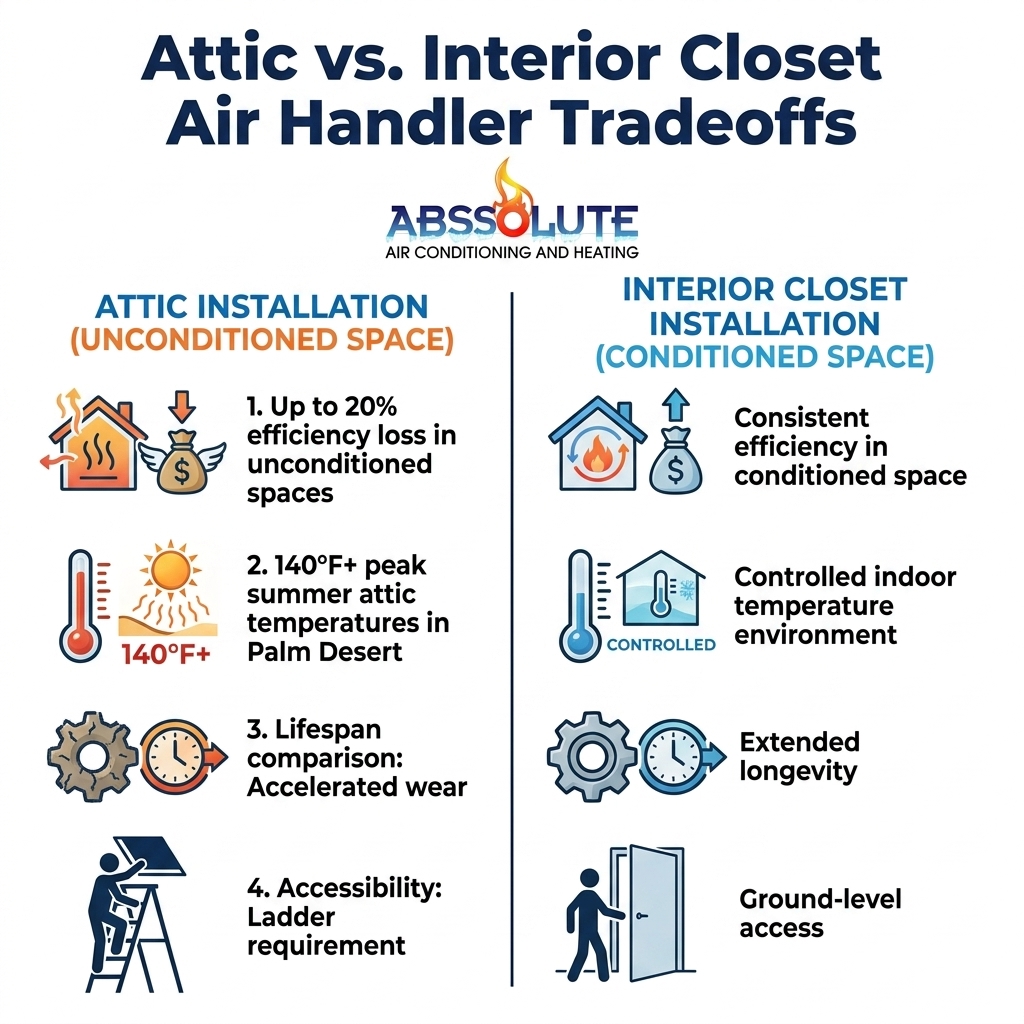
To help our clients finalize their decision framework, we find it helps to view the tradeoffs side-by-side. While the upfront structural investment of a closet relocation is higher, the long-term gains in efficiency and accessibility are profound. Here is a clear breakdown of how attic replacements compare to interior closet relocations in Palm Desert homes.
• Thermal Efficiency — Attic Replacement: High losses due to 140°F+ ambient heat forcing the system to work harder. — Interior Closet Relocation: Maximized efficiency; equipment operates in a stable, conditioned environment.
• Structural Investment — Attic Replacement: Minimal upfront modifications; utilizes existing platforms and duct pathways. — Interior Closet Relocation: Significant framing, drywall, and custom ductwork rerouting required.
• Equipment Lifespan — Attic Replacement: Reduced longevity due to accelerated wear on heat-stressed components. — Interior Closet Relocation: Extended lifespan; sensitive electronics are protected from thermal extremes.
• Accessibility — Attic Replacement: Difficult ladder access; makes filter changes and inspections cumbersome. — Interior Closet Relocation: Easy ground-level access; simplifies routine maintenance and visual checks.
• Water Damage Risk — Attic Replacement: High risk of ceiling damage if hidden drain lines clog and overflow. — Interior Closet Relocation: Lower risk; leaks are immediately visible and easier to manage safely.
Frequently Asked Questions About Air Handler Placement
How much efficiency is lost with an AC in the attic?
In our experience, you can lose up to 20 percent of your system's efficiency when the air handler and ductwork are located in an unconditioned attic space. This loss occurs because the extreme ambient heat warms the chilled air inside the ducts before it reaches your living space. The system must run longer and consume more electricity to overcome this continuous radiant heat transfer.
What is involved in moving an AC unit from the attic to a closet?
Relocating an air handler requires significant structural and mechanical modifications to your home. Professionals must frame a dedicated closet, reroute the main supply and return ductwork plenums, and safely extend high-voltage electrical circuits. Additionally, new condensate drain lines must be established with proper gravity slopes to ensure moisture is safely removed from the interior space.
Is it a good idea to put an air handler in the attic?
While an attic installation saves interior living space and reduces upfront installation modifications, we generally do not consider it ideal for the longevity or efficiency of the equipment. The extreme heat of a Palm Desert attic accelerates wear on sensitive electrical components and forces the blower motor to work much harder. Over time, the energy penalties often outweigh the initial space-saving benefits.
Why are air handlers originally installed in attics?
Builders frequently place air handlers in attics to maximize the sellable square footage of a home's interior. By moving the bulky HVAC equipment out of the living space, they avoid taking up valuable hallway or closet space. It is primarily a construction convenience that passes the long-term efficiency costs onto the homeowner.
Can extreme attic heat cause my AC to fail prematurely?
Yes, we frequently see that prolonged exposure to 140°F+ temperatures causes rapid degradation of HVAC components. Capacitors dry out, wiring insulation becomes brittle, and blower motors overheat from the constant strain. This hostile environment significantly shortens the operational lifespan of the system compared to a unit housed in a climate-controlled interior closet.
Make a Strategic Upgrade for Your Home's Comfort
At Absolute Air Conditioning and Heating, we believe deciding where to place your new HVAC system is just as important as choosing the brand or capacity. While an interior relocation requires an initial structural investment, the long-term efficiency gains, improved indoor air quality, and extended equipment longevity are substantial. By moving your air handler out of the punishing Palm Desert attic, you are making a permanent upgrade to your home's infrastructure that pays dividends in comfort and reliability.
The September early fall transition provides the perfect window of opportunity to execute this complex work safely and meticulously. Furthermore, general federal tax credits and local utility incentives may apply to qualifying high-efficiency installations, making this upgrade even more advantageous (we advise checking with your utility or a tax professional for current programs). Do not wait for your aging attic unit to fail during the next major heatwave. Contact our professionals for an expert evaluation of your home's layout to see if an AC installation in Palm Desert featuring an interior closet relocation is the right strategic move for your long-term comfort.
Serving the Entire Coachella Valley


The Anatomy of a Cracked Heat Exchanger: What Our Technicians Look For
Microscopic metal fatigue cracks in your furnace are invisible to the naked eye but can cause dangerous carbon monoxide leaks. See exactly how we spot this hidden threat during fall inspections.

Evaluating Air Purifier Add-Ons for Your Attic Air Handler
Preparing for closed-window season means addressing trapped desert dust. Compare UV lights, media filters, and electronic cleaners to find the right upgrade for your existing HVAC system.

What to Do When Your Attic AC Unit Starts Making a Grinding Noise During Heating Mode
Switching your thermostat to heat shouldn't sound like a freight train in your ceiling. We explain if that loud grinding is a normal transition or a failing motor.

