

Why Your Heat Pump Blows Cold Air on the First Chilly Palm Desert Morning
Is Your Heat Pump Broken, or Just Adapting to the Cold?
Are you wondering why your heat pump blows cold air on the first chilly Palm Desert morning of the season? You are not alone. It is a common experience: you wake up on that first chilly October morning, switch your thermostat from cooling to heating, and wait for a blast of warmth. Instead, you hold your hand over the vent and feel what seems like a cool breeze. Panic sets in as you assume your system has failed right when you need it most.
Here is the thing: what you are experiencing is often a harmless physiological illusion rather than a mechanical failure. Knowing the difference between normal heat pump operation and a system that actually needs professional repair can save you a lot of unnecessary stress. To get to the bottom of this, you need to understand the science behind how your system moves heat and how your body perceives temperature.
If you need immediate assistance with your system, you can explore our heat pump services or schedule professional heating repair in Palm Desert to restore your comfort.
The Science Behind the 'Cold Air Illusion'
To understand why your heating system feels like it is blowing cold air, we have to look at biology and thermodynamics. The sensation of heat or cold on your skin is not just about the temperature of the air coming out of the vent; it is about how that air interacts with your own body temperature. When you combine standard human biology with the way modern HVAC systems operate, you get a perfect recipe for sensory confusion.
Human Body Temperature vs. HVAC Output
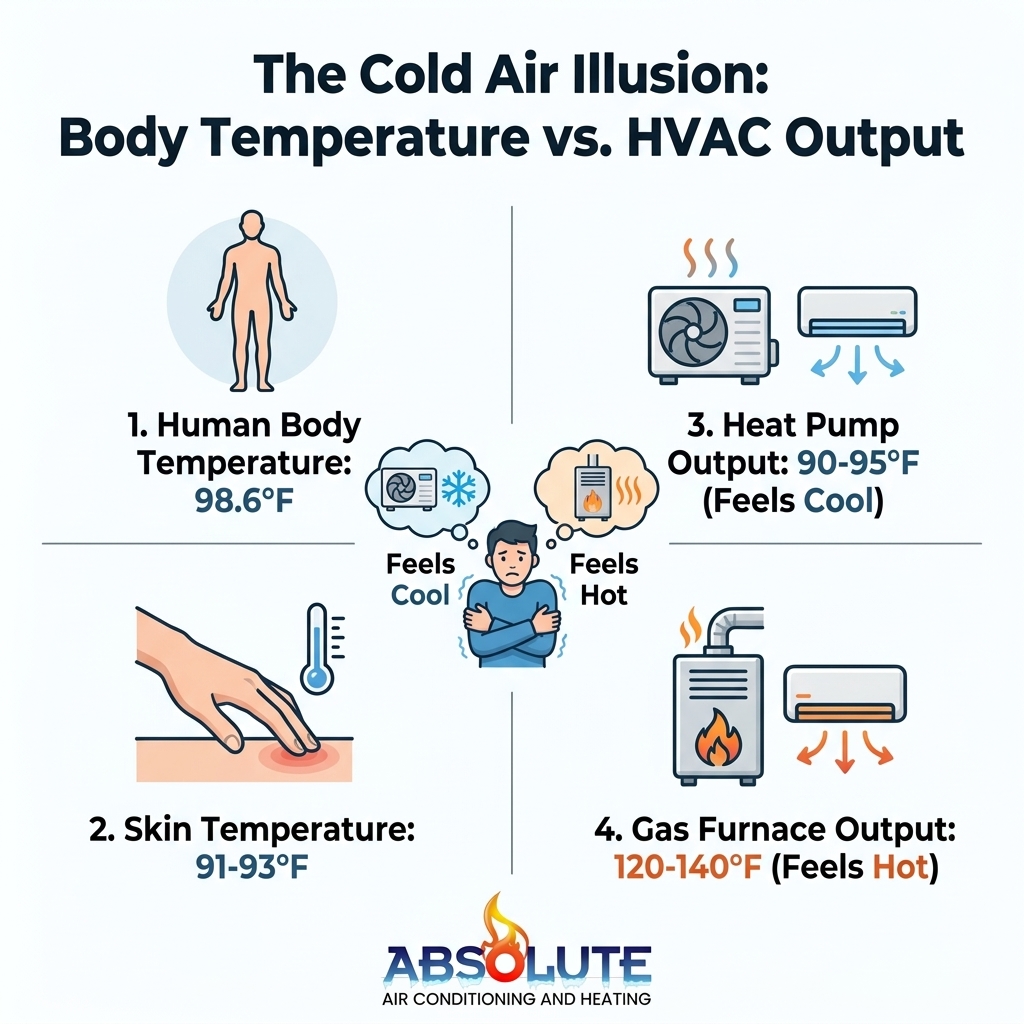
Your internal human body temperature rests naturally at roughly 98.6 degrees Fahrenheit. However, the surface temperature of your skin is slightly cooler, typically hovering between 91 and 93 degrees Fahrenheit. This baseline is crucial for understanding how you perceive the air circulating in your home.
Normal heat pump output air generally measures between 90 degrees Fahrenheit and 95 degrees Fahrenheit. When you do the math, a 90-95°F heat pump output vs 98.6°F body temperature reveals a physical reality: the air coming out of your vents is often lower than your internal body temperature, and sometimes lower than your skin temperature.
When air that is 92 degrees blows across skin that is 93 degrees, your body heat transfers into the moving air. This creates a wind chill effect. Your nervous system registers this heat loss and tells your brain that you are feeling a cool breeze. However, if your living room is currently 65 degrees, that 92-degree air is more than warm enough to successfully heat the room to a comfortable 70 degrees. The system is doing exactly what it was designed to do, even if it feels deceptively cool to your touch.
Why Heat Pumps Feel Drastically Different Than Gas Furnaces
Much of the confusion surrounding heat pump output comes from our past experiences. If you recently moved to Palm Desert or recently upgraded your home's HVAC system, you might be carrying over expectations from traditional gas furnaces. Gas furnaces operate on a completely different principle, relying on the combustion of fossil fuels to generate intense, localized heat.
Comparing Output Temperatures
Traditional gas furnaces typically output air at temperatures ranging from 120 degrees Fahrenheit to 140 degrees Fahrenheit. Because this air is significantly hotter than your 98.6-degree body temperature, it feels like a powerful, hot blast when you hold your hand over the register. Heat pumps, on the other hand, do not generate heat through combustion; they extract existing ambient heat from the outside air and move it indoors.
This heat transfer process results in the "low and slow" heating method. Instead of blasting your home with short, intense bursts of 130-degree air, a heat pump provides a steady, continuous flow of 90-degree to 95-degree air. While this lacks the dramatic "heat blast" you might expect, it is incredibly energy efficient. The system uses far less electricity to transfer heat than a furnace uses in fuel to create it from scratch.
• Output Temperature — Traditional Gas Furnace: 120°F - 140°F — Modern Heat Pump: 90°F - 95°F
• Sensation on Skin — Traditional Gas Furnace: Hot to the touch — Modern Heat Pump: Lukewarm or cool breeze
• Heating Method — Traditional Gas Furnace: Combustion (creating heat) — Modern Heat Pump: Refrigeration cycle (moving heat)
• Operational Cycle — Traditional Gas Furnace: Short, intense bursts — Modern Heat Pump: Long, steady, continuous cycles
• Room Target Temp — Traditional Gas Furnace: 68°F - 72°F — Modern Heat Pump: 68°F - 72°F
Ultimately, both systems share the exact same goal: bringing your home's ambient temperature up to a comfortable 68 to 72 degrees. The heat pump simply takes a gentler, more efficient route to get there.
How Desert Temperature Swings Trigger Defrost Mode
Living in the Coachella Valley comes with unique environmental challenges. Palm Desert's arid climate means that while our afternoons can remain beautifully warm well into the autumn months, early mornings in fall and winter often see sharp temperature drops into the 50s or lower. This rapid overnight heat loss creates a sudden, heavy demand on your heating system right as the sun comes up.
When the outdoor temperature drops and the air holds specific levels of humidity, the moisture in the air can freeze on the outdoor coils of your heat pump. To protect itself and maintain efficiency, the system automatically enters what is known as "Defrost Mode." During this normal operational cycle, the system temporarily reverses its function, acting like an air conditioner for a few minutes to send warm refrigerant back outside and melt the accumulated frost.
Signs Your System is Just in Defrost Mode
If you wake up on that first chilly October morning and feel genuinely cool air coming from your vents, your system might just be defrosting. Before you assume the unit is broken, look for these normal signs of a defrost cycle:
1. The outdoor fan stops spinning: The system intentionally halts the outdoor fan so the warm refrigerant can quickly melt the ice without cold air blowing across the coils.
2. A whooshing sound occurs: You may hear a distinct whoosh or a brief hiss as the internal reversing valve shifts the flow of refrigerant.
3. Cool air blows indoors temporarily: Because the system is routing heat outside to melt the ice, the air blowing inside your home will briefly feel cooler.
4. The cycle resolves quickly: A normal defrost cycle typically lasts anywhere from 5 to 15 minutes before the system automatically shifts back into standard heating mode.
If you notice these signs, simply wait 15 minutes. If the warm air returns, your system is operating perfectly. To ensure these cycles run as efficiently as possible, keeping up with routine heating maintenance is essential before the cold weather fully sets in.
When to Actually Call a Professional for Heating Diagnostics
While the cold air illusion and defrost cycles are perfectly normal, there are times when cool air from your vents indicates a real mechanical failure. Knowing where to draw the line between a harmless physiological effect and a malfunctioning system is vital for protecting your home comfort equipment.
Real Symptoms of Heat Pump Failure
If your system is blowing 90-95°F heat pump output, it is doing its job. However, if the air is genuinely cold, you need to take action. Watch for these actual red flags that require professional diagnostics:
• Ambient temperature drops: The most obvious sign of failure is if your thermostat is set to 70 degrees, the system runs continuously, and the room temperature drops to 65 degrees and stays there.
• Vents blow air below 70 degrees: If the air coming out of your registers is at room temperature or colder, the system is not transferring heat.
• System runs non-stop without cycling: While heat pumps run longer cycles than furnaces, a system that never shuts off and fails to warm the house is struggling.
• Strange grinding or screeching noises: Unusual mechanical sounds from the outdoor compressor indicate failing hardware, not just a defrost cycle.
When these symptoms appear, the underlying issues can range from a faulty reversing valve stuck in cooling mode to a low refrigerant charge caused by a leak. Thermostat miscalibrations can also force the system to behave erratically. Because modern HVAC equipment relies on high-voltage electricity and pressurized chemical refrigerants, you should never attempt DIY repairs on these components.
As a local provider, Absolute Air Conditioning and Heating brings specialized expertise in diagnosing desert-specific heat pump performance. We validate your concerns without relying on generic guesswork, tracking down the exact cause of the malfunction. Sometimes, persistent troubleshooting reveals that an older system needs more than just a quick fix. For example, one local homeowner reached out to us in the spring after dealing with an aging HVAC system they had relied on since 2012. Our technician Brian dedicated the time to provide clear options, eventually installing a highly efficient mini-split system over several days to ensure everything was perfect and reliable for the long haul.
Long-Term Solutions for Aging Heat Pumps
Heat pumps in a demanding desert environment work incredibly hard. Unlike a gas furnace that only runs in the winter, a heat pump operates year-round, fighting off triple-digit heat in the summer and managing sharp temperature drops in the winter. Because of this continuous duty cycle, the typical lifespan of a heat pump in the Coachella Valley is often around 10 to 12 years.
Weighing Repair vs. Replacement
If you are consistently dealing with cold air issues, rising energy bills, and frequent breakdowns, your older unit may be pointing toward compressor wear or unrepairable refrigerant leaks. When a system reaches the end of its functional life, continuing to pour money into patch repairs becomes a losing battle.
Upgrading to a modern, high-efficiency system offers significant benefits. Newer models are designed with variable-speed compressors that handle the extreme temperature swings of Palm Desert much more gracefully, providing precise climate control without the heavy energy draw of older, single-stage units. Furthermore, when you decide it is time for a heater replacement, you may be able to take advantage of various energy rebates or federal tax credits that apply to qualifying high-efficiency installations. A professional assessment can help you map out the best long-term strategy for your home.
Frequently Asked Questions About Heat Pump Output Temperatures
Understanding the nuances of your HVAC system can be overwhelming. To help you navigate the start of the heating season, we have compiled quick answers to the most common questions homeowners ask when their systems do not behave as expected. For more detailed insights on maximizing your system's efficiency, review our heat pump installation best practices.
Why is my heat pump blowing cold air on heat mode?
Your heat pump is likely blowing 90-degree air, which feels cold when blowing against your 98.6-degree skin. This physiological illusion is the most common reason homeowners think their system is blowing cold air. Additionally, your system may be in a temporary defrost cycle. However, if the air is truly room-temperature or colder, you may have a primary mechanical issue, such as a failing reversing valve that is stuck in air conditioning mode.
How warm should air from a heat pump be?
Normal output air from a healthy heat pump measures between 90 and 95 degrees Fahrenheit. It will not reach the 120-plus degrees expected from a traditional gas furnace. As long as the output air is warmer than the ambient room temperature, the system is successfully transferring heat into your home.
Is it normal for a heat pump to blow cool air when it first turns on?
Yes, it takes a few moments for the outdoor coils to heat up and for the system to pressurize the refrigerant. The initial push of air you feel from the vents is simply the system clearing the unheated, room-temperature air that was resting inside your ductwork. After a minute or two, the air temperature should rise to its normal operating range.
How long does a heat pump stay in defrost mode?
A standard defrost cycle typically lasts between 5 to 15 minutes. During this brief window, the system reverses operation to melt frost off the outdoor coils, which may cause a temporary flow of cooler air indoors. Once the outdoor frost is completely melted, normal heating resumes automatically.
Can a dirty air filter cause my heat pump to blow cold air?
Yes, severely restricted airflow caused by a clogged filter can cause the indoor coils to malfunction and the system to overheat or freeze up. When the system cannot breathe, it cannot transfer heat effectively into your living space. Regular maintenance and monthly filter changes are the easiest ways to prevent this issue from occurring.
Ensure Your System is Ready for the Season Ahead
Waking up to a chilly house on that first chilly October morning can be startling, but understanding the difference between the "cold air illusion" and a true mechanical failure puts you back in control. While it is completely normal for a heat pump's 90-degree output to feel like a cool breeze against your skin, a system that fails to warm your home requires an expert eye.
Do not wait until the deeper winter temperatures arrive to find out if your system is truly struggling. Scheduling a comprehensive pre-winter inspection allows a professional to catch failing reversing valves, hidden refrigerant leaks, or worn compressors before they leave you in the cold. If you are unsure about your system's performance, contact Absolute Air Conditioning and Heating today to schedule dedicated diagnostics and secure your peace of mind for the season ahead.
Serving the Entire Coachella Valley

The Real Cost of Ignoring Your Attic HVAC Unit's Fall Inspection
After a grueling summer, minor wear and tear in an attic HVAC unit can quickly snowball into a major winter breakdown. See why skipping a seasonal checkup puts your entire system at risk.
First Time Turning on the Heat? Differentiating Normal Dust Burn-Off from Electrical Issues
That burning smell on the first chilly morning usually triggers panic. Find out how to tell harmless baking dust from a dangerous wire, and know exactly when to shut your system down.
Deciding Between Repairing a Leaky Attic Evaporator Coil or Replacing the Entire Handler
Facing a refrigerant leak as the seasons change? Weigh the long-term value and technical viability of a drop-in coil repair versus upgrading your entire air handler.

