
Surviving Late Summer: Why Your Palm Desert AC Unit Runs Non-Stop Even After Sunset
The 10 PM Cooling Struggle: Is Your AC Working Too Hard?
Late August nights in the Coachella Valley are unrelenting. The sun finally dips behind the mountains, but the outdoor temperature barely budges, leaving your home baking in the residual warmth. If you are looking for answers on Surviving Late Summer: Why Your Palm Desert AC Unit Runs Non-Stop Even After Sunset, you are likely listening to your condenser humming away at 10 PM and wondering if something is terribly wrong. Hearing your system run continuously well past dark is stressful. It immediately sparks a dilemma: is the equipment simply responding normally to the massive heat load of the house, or is it on the verge of a catastrophic mechanical breakdown?
For most homeowners, the immediate reaction is to assume the system is failing. However, diagnosing late-night cooling cycles in extreme desert climates requires looking beyond basic troubleshooting and understanding the unique thermal physics of your home. Before you panic about a broken compressor, it helps to understand what your system is actually fighting against. Navigating these brutal late August nights requires a reliable system, which is why having access to professional Air Conditioning Services is critical when you need a definitive answer on your equipment's health.
What you need to know right now:
• Continuous operation isn't always a failure: In severe heat, a system running for hours might actually be functioning exactly as designed.
• Indoor temperature is the true test: If the house is staying cool, the unit is doing its job. If the temperature is creeping up while the unit runs, you have a problem.
• Desert physics play a massive role: The materials your home is built from heavily dictate how your air conditioner behaves after dark.
The Science of Thermal Mass in Palm Desert Architecture
To understand why your air conditioner refuses to shut off at night, you have to look at the building materials surrounding you. The concept of "thermal mass" refers to the ability of heavy, dense materials to absorb and store heat energy. Because of the intense daytime solar radiation in the Coachella Valley, local architecture relies heavily on high-thermal-mass materials. While these materials are excellent at slowing down heat transfer during the peak afternoon hours, they act like giant heat batteries that must eventually drain.
Palm Desert homes with high thermal mass (stucco/tile) spend the entire day absorbing 110-degree heat. By the time the sun goes down, those exterior walls and heavy roof tiles are fully charged with thermal energy. As the outside air finally begins to cool slightly, all that trapped heat reverses direction and begins radiating inward toward your living spaces.
Common thermal mass materials and how they affect your AC:
• Stucco exteriors: Stucco is dense and thick. It soaks up direct sunlight for 10 to 12 hours a day, holding onto that energy long after sunset.
• Concrete roof tiles: These tiles take the brunt of the midday sun. They can reach scorching temperatures and slowly release that heat into your attic space throughout the evening.
• Brick and masonry: Any decorative brickwork or heavy masonry walls act as thermal sponges, releasing warmth into the surrounding air for hours after dark.
This delayed heat release process means your air conditioner is not just cooling the air inside your rooms; it is actively fighting the heat radiating out of your walls and ceiling. This continuous, massive heat transfer necessitates extended cooling cycles. In many cases, a system running non-stop at 11 PM is a completely normal response to the delayed thermal load draining out of your home's structure.
Why Your Attic is Forcing Your AC to Run Overtime
While your walls hold a significant amount of heat, your attic is arguably the biggest culprit behind late-night AC struggles. During a typical summer afternoon, an unventilated or poorly insulated attic can easily reach temperatures exceeding 150 degrees. Because heat naturally moves toward cooler areas, that trapped, superheated air presses down aggressively through your ceiling.
Even if you have decent insulation, the sheer volume of heat trapped under a concrete tile roof will eventually penetrate the thermal barrier. This turns your ceiling into a giant, low-level radiator that warms your living space long into the evening. For Palm Desert homes with high thermal mass (stucco/tile), the attic essentially caps the house in a bubble of retained heat.
The hidden strain on your ductwork:
The problem compounds if your home's ductwork or air handler is located inside this superheated attic space. As your air conditioner works hard to push 55-degree air through the ducts, the 150-degree attic air surrounding those thin metal or flexible tubes warms the conditioned air before it ever reaches your vents. Your system has to work twice as hard just to deliver cool air to your living room.
To combat this extreme environment, many homeowners eventually upgrade to specialized attic AC systems or focus heavily on advanced ventilation strategies. By reducing the ambient temperature in the attic, you drastically reduce the radiant heat pressing down on your ceiling, allowing your primary air conditioner to finally cycle off during the night.
Environmental Heat Load vs. Mechanical Strain
Distinguishing between a system that is simply working hard and a system that is failing requires understanding the difference between environmental heat load and mechanical strain. Environmental heat load is the total amount of heat your system must remove from the home to maintain your desired temperature. During historical 116-degree heat waves, that load pushes even perfectly maintained, top-of-the-line systems to their absolute limits.
One local homeowner experienced this firsthand during a brutal summer heat wave when temperatures averaged 116 degrees. Their older air conditioning unit began malfunctioning under the extreme environmental heat load, struggling to keep up with the overwhelming thermal pressure. A technician came out twice to perform targeted repairs, keeping the stressed unit running safely until a brand-new system could be secured and installed a week later. This scenario highlights how extreme environmental loads can expose underlying mechanical weaknesses in older units.
Continuous running is often by design. Modern variable-speed air conditioners are engineered to run for long, slow cycles to maintain a consistent temperature against a massive thermal load, rather than blasting cold air and shutting off repeatedly. However, mechanical strain occurs when the system runs constantly but lacks the capacity or mechanical integrity to actually lower the indoor temperature.
• Indoor Temperature — Environmental Heat Load (Normal): Holds steady at or near the thermostat set point. — Mechanical Strain (Failing): Slowly rises throughout the evening despite running.
• Airflow Quality — Environmental Heat Load (Normal): Air coming from vents feels consistently cold. — Mechanical Strain (Failing): Air coming from vents feels lukewarm or room temperature.
• System Cycling — Environmental Heat Load (Normal): Runs for long, continuous stretches without stopping. — Mechanical Strain (Failing): Short-cycles (turns on and off rapidly) without cooling.
• Condenser Noise — Environmental Heat Load (Normal): Steady, even hum of the fan and compressor. — Mechanical Strain (Failing): Loud grinding, buzzing, or violent shaking on startup.
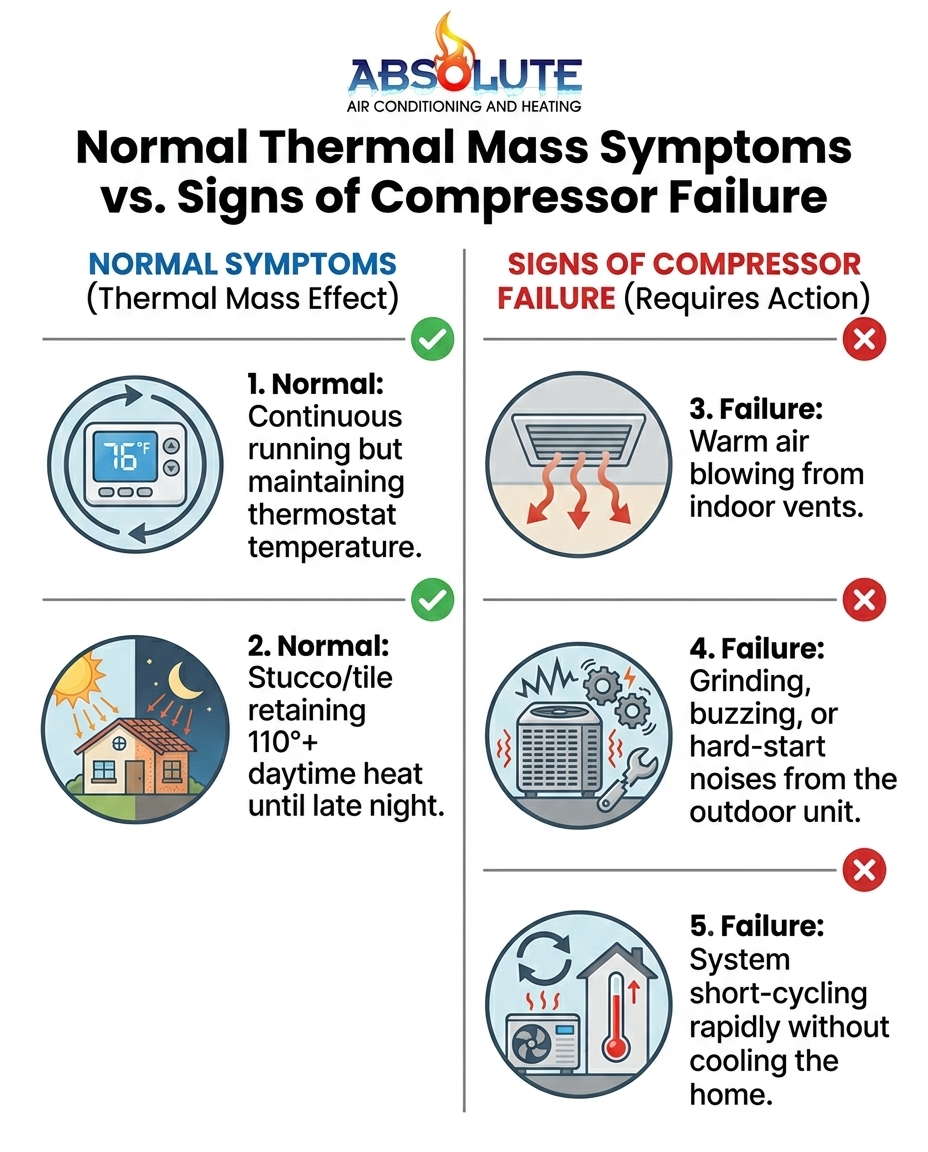
Red Flags: Non-DIY Signs of a Failing Compressor
While late August nights naturally force your system into prolonged operation, there are specific, undeniable warning signs that indicate true mechanical failure. The compressor is the heart of your air conditioning system. When it begins to fail, the symptoms are usually obvious, provided you know what to look and listen for.
If you suspect your system is crossing the line from normal thermal mass response to actual mechanical breakdown, you must rely on professional diagnostics. Compressor issues involve high-voltage electricity and pressurized chemical refrigerants. You should never attempt DIY electrical testing, capacitor replacement, or refrigerant checks. Instead, focus on observing the symptoms safely from the outside and scheduling proactive AC maintenance to catch these issues before they result in a catastrophic overnight failure.
Listening to the Condenser
Your ears are one of the best diagnostic tools you have. While you should never open the outdoor unit, you can stand next to it and listen to how it operates.
1. Identify the normal baseline: A healthy condenser produces a steady, even hum from the fan blade and a smooth vibration from the compressor itself.
2. Listen for the "hard start": If the unit makes a loud, struggling buzz for several seconds before the fan finally kicks on—or if the lights in your house dim significantly when it starts—the compressor is struggling to draw enough amperage to engage.
3. Check for grinding or shrieking: Metal-on-metal grinding sounds or high-pitched shrieks are immediate red flags. These noises often indicate failing internal bearings or extreme pressure imbalances inside the compressor shell.
Monitoring Output Temperatures
The most definitive non-technical test you can perform is checking the actual temperature of the air leaving your vents.
1. Locate the closest vent: Find a supply register that is relatively close to the indoor air handler.
2. Check the airflow: Place your hand over the vent. The air should feel noticeably cold, usually 15 to 20 degrees cooler than the ambient room temperature.
3. Identify the failure: If the system is running continuously but the air coming out of the vent feels lukewarm, humid, or exactly the same as the room temperature, the compressor is likely not pumping refrigerant. A lack of cold air during continuous operation is an immediate signal to turn the system off to prevent further electrical damage.
When Prolonged Cooling Cycles Require Professional Diagnostics
Setting the boundary between normal desert strain and a broken system ultimately comes down to performance. If your home is maintaining its thermostat set point—even if the unit is running for four hours straight—that prolonged operation is likely just the system battling the thermal mass of your stucco walls and tile roof. However, if the indoor temperature is actively rising while the unit runs, it is time to call for an expert assessment.
Local expertise is critical in these situations. An out-of-town technician might look at a system running continuously at 10 PM and assume it's undersized or failing. A local expert understands the unique physics of Palm Desert homes with high thermal mass (stucco/tile) and can accurately diagnose desert-specific HVAC strain without upselling you on unnecessary replacements. For example, one local customer relied on routine maintenance and honest advice to keep their aging AC unit running far beyond its expected lifespan. When the system finally reached the point where prolonged cooling cycles were no longer just thermal mass but actual mechanical decline, they were able to smoothly transition to a brand-new heat pump without the panic of an unexpected breakdown.
Rapid response is vital when you return home to a failed system in extreme heat. If you observe any of the mechanical red flags discussed above—warm air from vents, grinding noises, or rapidly rising indoor temperatures—do not wait for the system to correct itself. Shut the unit off to protect the compressor from permanent burnout and schedule AC Repair in Palm Desert immediately. Addressing the issue early ensures you get the clear explanation and reliable fix you need to sleep comfortably through the rest of the summer.
Frequently Asked Questions
Why does my AC run all night in Palm Desert?
Your AC runs all night because it is battling the heat stored in your home's building materials. Materials like stucco and concrete tile absorb intense solar heat all day and slowly release it into your living spaces after dark. The system must run continuously to remove this delayed radiant heat.
Is it bad if my AC runs constantly in extreme summer heat?
It is not inherently bad if your system runs constantly during severe heat waves, provided it is maintaining the indoor temperature. Modern systems are designed to run long, continuous cycles to effectively manage massive thermal loads. However, if it runs constantly and the house gets warmer, that indicates a mechanical problem.
How many hours a day should an AC run in 100+ degree weather?
In temperatures exceeding 100 degrees, it is completely normal for an air conditioner to run 15 to 20 hours a day. During peak afternoon heat and late evening thermal release, the system may not shut off at all for several hours. As long as the indoor temperature remains stable, this extended run time is expected.
Why is my house so hot at night even with the AC on?
Your house stays hot at night because your attic and walls are acting like giant radiators. Unventilated attics can trap 150-degree heat during the day, which presses down through your ceiling long after sunset. This radiant heat transfer makes the home feel warm even while the air conditioner is pushing cold air.
What are the most common signs of a failing AC compressor?
The most common signs of a failing compressor include warm air blowing from your vents, loud grinding or buzzing noises from the outdoor unit, and hard starts where the system struggles to turn on. Additionally, frequent short-cycling—where the unit turns on and off every few minutes without cooling the home—is a major red flag.
How does stucco exterior affect my home's cooling needs?
Stucco has a high thermal mass, meaning it absorbs a massive amount of heat energy from direct sunlight. Instead of reflecting the heat, it stores it and slowly releases it inward as the outside air cools down. This forces your air conditioner to work much harder and run much later into the night to counteract the warming effect.
Serving the Entire Coachella Valley


The Anatomy of a Cracked Heat Exchanger: What Our Technicians Look For
Microscopic metal fatigue cracks in your furnace are invisible to the naked eye but can cause dangerous carbon monoxide leaks. See exactly how we spot this hidden threat during fall inspections.

Evaluating Air Purifier Add-Ons for Your Attic Air Handler
Preparing for closed-window season means addressing trapped desert dust. Compare UV lights, media filters, and electronic cleaners to find the right upgrade for your existing HVAC system.

What to Do When Your Attic AC Unit Starts Making a Grinding Noise During Heating Mode
Switching your thermostat to heat shouldn't sound like a freight train in your ceiling. We explain if that loud grinding is a normal transition or a failing motor.

