

Transitioning Your Thermostat: Finding the Sweet Spot for Palm Desert's Unpredictable Fall
The September Challenge: Balancing Comfort and System Health
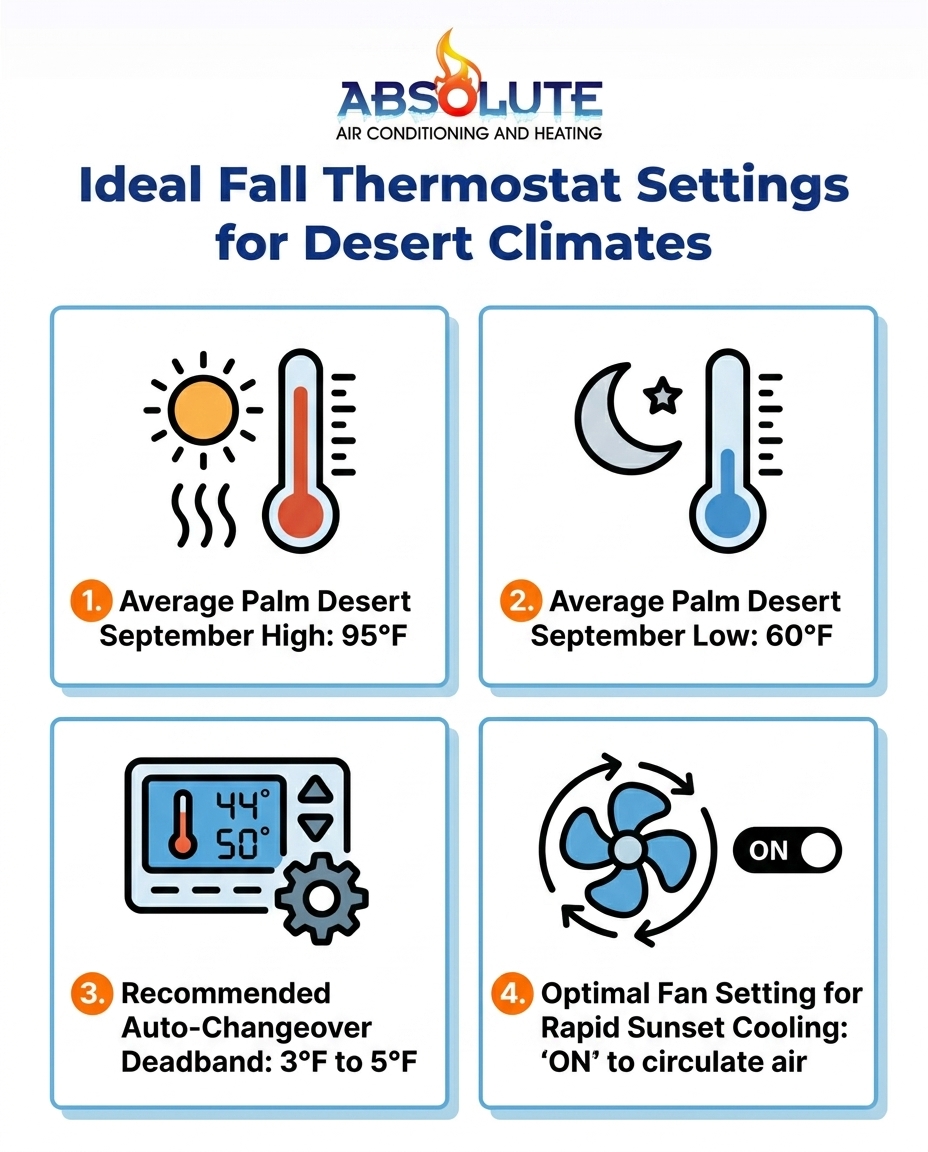
With the summer heat beginning its slow retreat, transitioning your thermostat: finding the sweet spot for Palm Desert's unpredictable fall becomes the most critical step in protecting your home's HVAC system. Early fall in the Coachella Valley presents a unique and frustrating climate puzzle. In our years of keeping local homes comfortable, our team at Absolute Air Conditioning and Heating sees this pattern constantly: you often wake up shivering in the early morning, only to find yourself sweating in your living room by two in the afternoon. This specific September transition means your home is battling 95-degree days that rapidly crash into 60-degree nights, forcing your indoor climate control to work overtime just to keep up.
Most homeowners react to this discomfort by constantly walking over to the wall and toggling their system between heat and cool modes. While this reactive adjusting might offer a few minutes of temporary relief, it is actually a severe mechanical threat to your equipment. Your air conditioner and furnace were not designed to play tug-of-war within the same 12-hour window. Instead of aggressively forcing the system to switch gears every time the sun moves, you need a strategy for proactive thermostat management.
The core problem: When you manually force the system to rapidly switch between heating and cooling demands, you strip away its ability to run in long, efficient cycles. If your system is already struggling with this transition, securing professional heating services now ensures your equipment is mechanically prepared for the erratic weather ahead. Mastering your thermostat settings is the first line of defense against premature breakdowns.
Understanding the Mechanical Toll of 35-Degree Daily Swings
In our daily service calls across Palm Desert, our technicians at Absolute Air Conditioning and Heating see firsthand how extreme desert swings put unique stress on compressors, going far beyond the generic advice you might read online. A 35-degree daily temperature shift forces your equipment to operate in highly volatile conditions. Without the right settings, your system will rapidly cycle on and off, trying to chase a moving target as the outdoor temperature plummets after sunset.
The Threat of Short-Cycling
Short-cycling occurs when your HVAC system turns on, runs for only a few minutes, and immediately shuts back down before completing a full cooling or heating cycle. During the 95-degree days to 60-degree nights transition, a rapid drop in outdoor temperature can cause the indoor temperature to hit your thermostat's setpoint almost instantly. This triggers a premature shut-off.
• Lost efficiency: Systems are designed to run in steady 15-to-20-minute intervals to reach peak efficiency.
• Poor humidity control: Short cycles do not give the evaporator coil enough time to extract moisture from the air, leaving your home feeling clammy.
• Uneven temperatures: Rooms furthest from the blower motor will never receive adequate airflow if the system shuts down after five minutes.
Compressor Strain Explained
Your HVAC compressor is the heart of the system, and it draws the most electrical power during startup. Think of it like a car engine accelerating from a dead stop—that initial burst requires immense energy and puts heavy friction on moving parts. When erratic fall weather causes your system to start and stop a dozen extra times a day, that cumulative wear and tear drastically shortens the lifespan of the equipment.
A pattern we see often involves premature compressor failure due to thermostat mismanagement. Just recently, a local homeowner signed up for our yearly maintenance package after one of our comprehensive early fall inspections revealed exactly how much stress their compressor had endured from constant thermostat toggling. We performed a prompt, friendly, and professional check-up that caught the wear early, proving that routine oversight offers outstanding value. Proper AC maintenance is vital to help older units survive these stressful transition periods without suffering a catastrophic failure.
Mastering the Thermostat Deadband to Prevent System Battles
If you use an auto-changeover thermostat—a model that automatically switches between heating and cooling based on the room temperature—you must understand how to configure the "deadband." The deadband is simply the temperature differential between your cooling setpoint and your heating setpoint. Without a proper deadband, your furnace and air conditioner will literally fight each other all day long.
The golden rule of auto-changeover: The American Society of Heating, Refrigerating and Air-Conditioning Engineers (ASHRAE) recommends a minimum deadband of 3 to 5 degrees to prevent systems from battling. Based on the hundreds of thermostats our team calibrates each season, we highly recommend a wider gap during the unpredictable September transition.
Here is a concrete example of how to set this up correctly:
• Cooling Setpoint: Set to 74°F.
• Heating Setpoint: Set to 69°F.
• The Deadband: The 5-degree gap between 69°F and 74°F is your system's resting zone.
When the afternoon sun pushes the house up to 75°F, the AC kicks on and cools the home back down to 74°F, then shuts off. As the sun sets and the desert air rapidly cools the house, the indoor temperature will slowly drift down. The system will remain completely off while the house floats through 73, 72, 71, and 70 degrees. The furnace will only engage if the house drops below 69°F. This simple, strategic gap prevents the AC from running at 4 PM and the furnace from firing up at 6 PM, saving massive amounts of energy and protecting your compressor.
Auto vs. Manual Changeover: Which is Best for Early Fall?
Modern thermostats give you the option to automate the switch between heating and cooling, but automation is not always the smartest choice during extreme diurnal temperature shifts in Palm Desert. In our experience working with Palm Desert's varied home builds, we've found that depending on your home's insulation, sun exposure, and your daily routine, you need to choose the mode that minimizes unnecessary system cycles.
Auto-changeover is incredibly convenient, but if your deadband is set too narrow (for example, cooling at 72°F and heating at 70°F), a passing cloud or a sudden desert breeze can trick the system into switching modes. Manual mode, on the other hand, allows you to intentionally lock out the heating system during unseasonably warm weeks, guaranteeing the furnace will not fire up just because the house felt a little chilly at 5 AM.
If you are identifying home heating problems early in the season, observing how your system behaves in both modes can reveal underlying mechanical issues. If the system struggles to transition or makes strange noises when switching modes, it usually points to a deeper malfunction.
• Auto-Changeover — Best Used For: Homes with deep temperature swings and well-set deadbands (3-5 degrees). — Key Advantage: Hands-off convenience; maintains absolute temperature limits automatically. — Potential Drawback: Can cause short-cycling if the deadband is too narrow.
• Manual Cooling — Best Used For: Early September when daytime highs remain intensely hot. — Key Advantage: Zero risk of the furnace turning on during a cool morning. — Potential Drawback: You may wake up slightly colder than desired before the sun rises.
• Manual Heating — Best Used For: Late fall when the primary threat is nighttime freezing. — Key Advantage: Protects against cold snaps without engaging the AC midday. — Potential Drawback: House may feel stuffy in the afternoon if the sun beats on the windows.
Strategic Fan Settings for Rapid Sunset Cooling
The Coachella Valley's unique topography plays a massive role in how your home retains heat. Because the surrounding mountains block the late afternoon sun and the dry desert air holds very little moisture, the region experiences rapid heat loss immediately after sunset. You can use your thermostat's fan settings to harness this natural cooling effect without engaging the power-hungry AC compressor.
Understanding "Auto" vs. "On":
• Auto setting: The blower fan only runs when the air conditioner or furnace is actively heating or cooling the air. Once the cycle ends, the fan stops.
• On setting: The blower fan runs continuously, circulating air throughout the ductwork 24/7, regardless of whether the compressor or burner is running.
When the outdoor temperature plummets during those 95-degree days to 60-degree nights, switch your thermostat fan from "Auto" to "On" for a few hours in the early evening. This continuously circulates the naturally cooler air from the shaded sides of your house into the warmer, sun-facing rooms. Running just the fan uses a fraction of the electricity required to run the full air conditioning system.
A word of caution: Do not leave the fan on indefinitely if the outdoor humidity unexpectedly rises. A continuously running fan will blow moisture right back off the evaporator coil and into your living space, making the house feel sticky and uncomfortable.
Why Smart Thermostats Excel in Extreme Diurnal Climates
If you are still using a basic programmable thermostat, navigating Palm Desert's extreme diurnal climates requires constant, manual adjustments. Upgrading to a modern smart thermostat automates this complex management and actively learns how your specific house retains heat.
Smart thermostats use advanced learning algorithms to anticipate the rapid evening cool-down. Instead of blindly running the AC at 5 PM because the house is warm, a smart thermostat checks the local weather forecast, recognizes that the outdoor temperature is about to drop rapidly, and lets the house coast naturally to save energy.
Geofencing for effortless efficiency: Many smart models feature geofencing, which uses your smartphone's location to determine if you are home. If the house is empty during the day, the thermostat automatically widens the deadband, allowing the indoor temperature to drift. As soon as you cross back into your neighborhood, the system pre-conditions the house so you walk into perfect comfort.
Furthermore, modern controls integrate flawlessly with advanced, variable-speed HVAC equipment. If you have a system that can run at lower capacities rather than just 100% on or 100% off, a smart thermostat dictates exactly how much power is needed. Upgrading your controls is often the smartest move when planning a heat pump installation, ensuring you get the maximum efficiency out of your new hardware.
Backing Up Your Thermostat Strategy with Professional Preparation
Even the most perfectly programmed smart thermostat is useless if the physical equipment it controls is failing. Thermostats are essentially the brain of your HVAC system, but they cannot compensate for dirty sensors, clogged filters, or worn-out contactors. As you prepare for the September transition, physical system maintenance is non-negotiable.
Calibrating Thermostat Sensors
Over time, the temperature sensors inside your thermostat can experience "sensor drift." This means the thermostat might read 72°F when the room is actually 76°F. Dust buildup inside the thermostat casing or slight electrical degradation causes this inaccuracy. When your thermostat reads the room incorrectly, it forces the system to run longer than necessary or triggers the very short-cycling you are trying to avoid. A professional technician will calibrate the thermostat to ensure it reads the ambient temperature with pinpoint accuracy.
Cleaning Coils Before the Switch
After a long, brutal desert summer, your indoor evaporator coil and outdoor condenser coil are likely caked in fine dust. This buildup acts like a blanket, suffocating the system and restricting airflow. Before you transition into heating mode, these coils must be cleaned. Restricted airflow causes furnaces to overheat and trip their high-limit switches, leaving you without heat on a cold desert night.
A long-time Palm Desert customer who has relied on our Absolute Air Conditioning and Heating team for both A/C and heating service over the years knows firsthand that impeccable, proactive service prevents sudden breakdowns. They trust that a comprehensive pre-season check ensures both the cooling and heating components are ready to handle the extreme daily transitions safely, providing total peace of mind.
Secure Your Comfort Before the True Cold Arrives: Transitioning Your Thermostat: Finding the Sweet Spot for Palm Desert's Unpredictable Fall
Mastering your deadbands, fan settings, and changeover modes is the critical first step to staying comfortable during the erratic early fall weeks. However, software settings can only do so much to protect aging hardware. Now is the time to ensure your physical equipment is as ready as your thermostat program.
Do not wait until the first freezing night to discover your furnace cannot keep up. Schedule your heating maintenance in Palm Desert today to protect your equipment, lower your energy bills, and secure a comfortable home all season long.
Frequently Asked Questions
What is the best temperature to set your thermostat in the fall?
The Department of Energy recommends setting your thermostat to 68°F while you are awake in the fall and lowering it while you sleep. However, in desert climates with extreme daytime heat, a cooling setpoint of 74°F to 76°F and a heating setpoint of 68°F to 69°F creates an ideal balance. This wide gap prevents the system from battling itself during rapid temperature swings.
Does switching between heat and AC damage the system?
Switching modes occasionally does not cause immediate damage, but rapidly toggling back and forth multiple times a day causes severe wear and tear. This constant switching forces the compressor to start and stop frequently, which draws massive amounts of electricity and degrades internal components. Using a proper deadband prevents this rapid cycling.
Should I leave my thermostat on auto or on?
For the fan setting, "Auto" is generally the most energy-efficient choice because the blower only runs during active conditioning cycles. However, switching the fan to "On" for a few hours in the early evening can help circulate naturally cooler air through the house after sunset. Just be sure to return it to "Auto" if outdoor humidity rises to prevent clammy indoor air.
Why is my AC short cycling in the fall?
Short-cycling in the fall usually happens when the outdoor temperature drops rapidly, causing the indoor temperature to hit the thermostat setpoint almost instantly after the AC turns on. It can also be caused by dirty air filters restricting airflow or an oversized system that cools the space too quickly. Widening your thermostat's deadband is the first step to resolving this issue.
How do I set my thermostat deadband for desert climates?
To set a proper deadband, you need to establish a minimum 3 to 5 degree gap between your heating and cooling setpoints on an auto-changeover thermostat. For example, set your cooling to activate at 75°F and your heating to activate at 69°F. This 6-degree resting zone allows your home to drift naturally with the extreme desert temperature swings without forcing the HVAC system to run constantly.
How do extreme daily temperature swings affect my heat pump?
Extreme 35-degree daily swings force a heat pump to rapidly reverse its refrigerant flow from cooling to heating mode, which puts heavy strain on the reversing valve and compressor. Without a proper temperature differential programmed into the thermostat, the heat pump will short-cycle, leading to higher energy consumption and premature mechanical failure. Routine maintenance ensures the reversing valve operates smoothly during these volatile weather transitions.
Serving the Entire Coachella Valley

How to Tell if Your Attic HVAC Unit is Undersized for Your Home's Heating Load
When the first cold snap hits, a system that runs constantly without warming your house is a major red flag. Find out if your equipment is fundamentally too small or just needs seasonal upkeep.

The Danger of Relying on Emergency Heat Mode During a Palm Desert Cold Snap
When a sudden fall chill hits, flipping your thermostat to emergency heat feels like a quick fix. Instead, you are bypassing your heat pump's efficiency and causing massive utility bills.

Why Absolute AC Recommends Sealing Your Attic Ductwork Before Winter
Unsealed ductwork in your attic can silently drain up to 30% of your home's heated air. Addressing these hidden leaks proactively is the key to maintaining reliable winter comfort in Palm Desert.

