

How to Tell if Your Attic HVAC Unit is Undersized for Your Home's Heating Load
When the First Fall Chill Exposes a Struggling System
You wake up to the first real cold snap of the season, turn up the thermostat, and wait—but while your system runs constantly, the house stays stubbornly chilly. If you find yourself shivering indoors while the blower runs non-stop, you might be wondering how to tell if your attic HVAC unit is undersized for your home's heating load. It is an incredibly frustrating problem that usually surfaces right when you need warmth the most. During that crucial October pre-winter heating startup, our team at Absolute Air Conditioning and Heating often discovers that the equipment homeowners rely on simply cannot keep up with the dropping temperatures.
In desert climates, cooling almost always gets the most attention when a home is built or upgraded. Homeowners and contractors alike focus heavily on surviving the intense summer heat, which can sometimes lead to heating capacities being treated as an afterthought. However, heating loads are equally critical to your overall comfort. When the temperature drops, you need a system that can efficiently and effectively warm your living space without running itself into the ground.
The immediate decision point you face is figuring out if your system is fundamentally too small for your home, or if it is just struggling due to a lack of seasonal upkeep. A neglected system can mimic the symptoms of an undersized one. If you are dealing with persistent sizing issues or constant breakdowns, turning to professional heating services for a comprehensive evaluation is the best way forward. In many cases, upgrading to a proper heating installation designed specifically for your home's actual requirements is the ultimate solution for lasting comfort.
The Unique Challenge of Heating in a Cooling-Dominated Climate
Living in a desert region presents a very specific set of challenges for your home's climate control systems. In our years of installing and servicing systems across Palm Desert CA, our technicians have seen firsthand how HVAC design conversations are almost entirely dominated by summer cooling. But this singular focus often creates a hidden vulnerability that only reveals itself when the seasons change.
Understanding Diurnal Temperature Swings
The defining characteristic of a desert climate is the massive diurnal temperature swing. This means you can experience hot, sunny days followed by rapid 30- to 40-degree temperature drops as soon as the sun goes down. Your home loses heat very quickly during these sudden nighttime plummets. If your HVAC system was selected primarily based on its air conditioning tonnage, the internal heating components might lack the sheer capacity required to counteract such a rapid loss of ambient heat.
What Exactly is a Heating Load?
A heating load refers to the exact amount of heat energy that must be added to a space to maintain a comfortable temperature. It is not just about the square footage of your house. Your heating load is influenced by how quickly your home loses heat to the outside environment. In a cooling-dominated market, a system might have plenty of power to remove heat during the summer, but its heating components (like the furnace burners or heat pump compressor) might be rated too low to handle the sudden, aggressive heating load demanded by a cold desert night.
Top Signs Your Attic Heating Unit is Undersized
Diagnosing an undersized system starts with observing how it behaves during normal operation. If your equipment lacks the capacity to meet your home's heating load, it will leave behind clear, undeniable clues. Here are the top diagnostic signs we tell our customers to watch for that point to an undersized attic heating unit:
• The thermostat setpoint is never reached despite continuous running: This is the most glaring red flag. If you set your thermostat to 70 degrees and it stalls at 64 degrees while the system runs for hours on end, the unit simply cannot generate enough heat to overcome the cold air entering your home.
• Noticeable cold spots exist throughout the house: An undersized system lacks the blower power and heating capacity to push warm air to the furthest reaches of your ductwork, leaving distant bedrooms or vaulted living rooms feeling like iceboxes.
• Sudden, unexplained spikes in early fall energy usage: If your energy bill skyrockets during the first few weeks of mild fall weather compared to previous moderate months, it means your system is working overtime just to maintain baseline comfort.
• A constant, drafty feeling in the home: Because the system never cycles off, air is constantly moving through the vents. If that air isn't sufficiently heated, the continuous airflow can actually create a chilling, drafty sensation rather than a warm, cozy environment.
The Vulnerability of an Air Handler in Attic Spaces
Where your HVAC equipment is located plays a massive role in how well it performs. Placing an air handler in the attic is a common building practice, as it frees up valuable square footage inside the home. However, this placement introduces significant mechanical and thermal hurdles, especially during the heating season.
The Problem With Unconditioned Spaces
Most attics are unconditioned spaces, meaning they are not insulated from the outside air in the same way your living room is. During an October pre-winter heating startup, the air inside your attic can be just as cold as the air outside. Your air handler and the attached ductwork are sitting in a freezing environment, trying to generate and transport heat.
The "Heat Bleed" Effect
As your furnace or heat pump generates warm air, that air must travel through the ductwork in the freezing attic before it reaches your vents. The cold ambient air in the attic actively strips heat away from the thin metal casing of the air handler and the flexible ducting. This is known as thermal loss, or "heat bleed." By the time the air reaches your living space, it has already lost a significant portion of its warmth.
Why Undersized Units Fail Here
A properly sized unit accounts for this expected thermal loss and generates enough excess heat to compensate for it. An undersized attic HVAC unit, however, is already struggling to meet the baseline heating load. When you add the extreme thermal loss of an unconditioned attic space into the equation, the undersized unit struggles exponentially more. It simply cannot overcome the ambient heat loss of the attic while also warming the house.
Undersized Equipment vs. Simple Maintenance Issues
Before you assume your system needs a total replacement, it is crucial to rule out basic maintenance problems. In our experience responding to fall service calls, many neglected systems behave exactly like undersized units. Differentiating between a system that is fundamentally too small and one that is just suffering from neglect can save you a tremendous amount of stress.
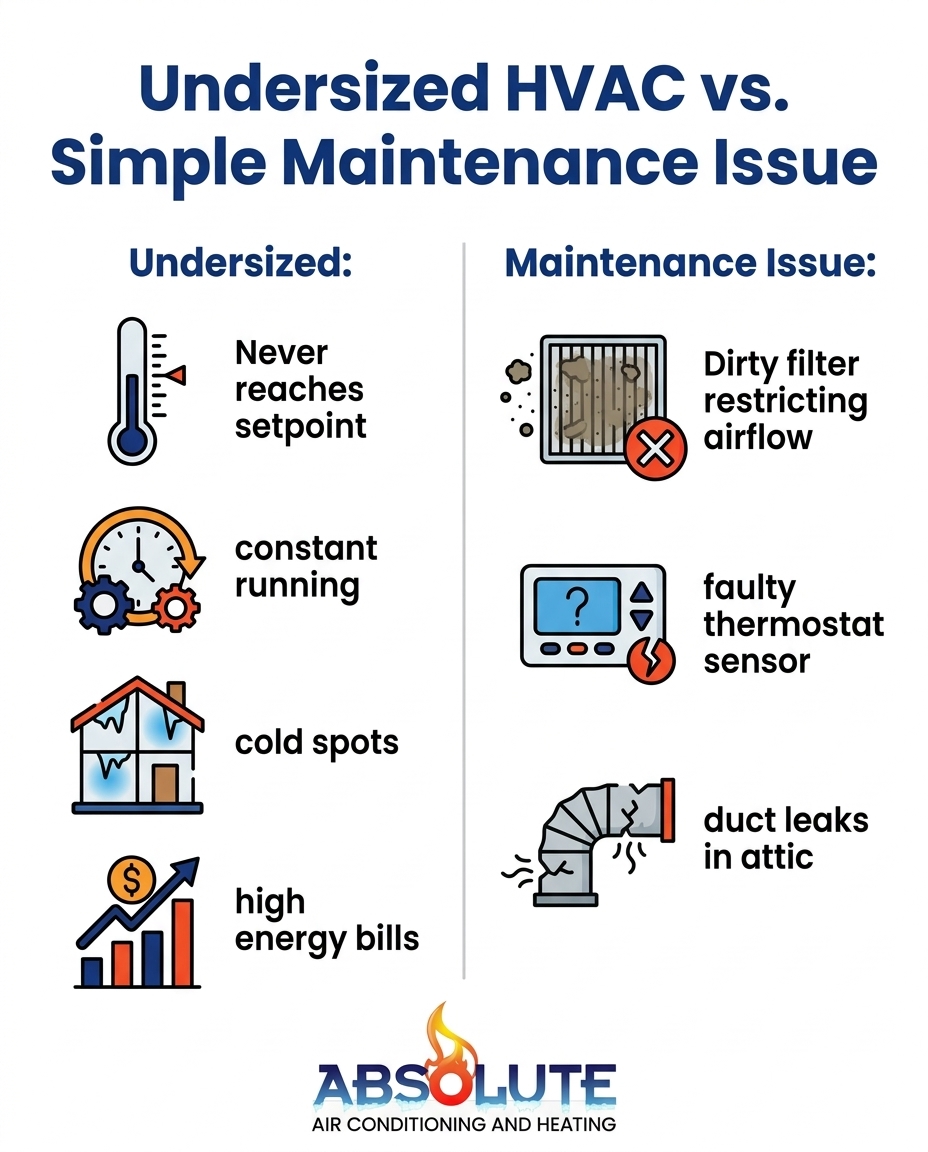
For instance, a severely dirty air filter restricts airflow into the system. When the blower cannot pull enough air in, it cannot push enough warm air out, resulting in a scenario where the thermostat setpoint is never reached despite continuous running. Similarly, faulty thermostat sensors can cause the system to misread the room temperature, causing it to run endlessly without actually warming the space.
Leaky ductwork in the attic is another major culprit. If heated air is escaping into the attic before it reaches your living room, a perfectly sized unit will feel like it is undersized. Regular heating maintenance is the best way to catch and correct these false alarms. A professional tune-up ensures filters are clean, sensors are calibrated, and ductwork is secure, allowing you to see how the system performs when operating at its peak.
• System runs constantly without reaching setpoint — If the Unit is Undersized: Unit lacks the BTU capacity to meet the home's heating load. — If it is a Maintenance Issue: Dirty filter is choking airflow, or low refrigerant (in heat pumps) is limiting heat transfer.
• Weak airflow from vents — If the Unit is Undersized: Blower motor is too small for the ductwork layout. — If it is a Maintenance Issue: Ducts are leaking heated air into the attic, or blower wheel is caked in dust.
• High energy bills — If the Unit is Undersized: System is running 24/7 trying to compensate for lack of power. — If it is a Maintenance Issue: Failing parts are drawing excess amperage to operate.
What is a Proper Heating Load Calculation?
If maintenance issues have been ruled out and your system is still struggling, the next step in the diagnostic process involves looking at how the equipment was originally sized. In the past, many installers used a simple rule-of-thumb based entirely on a home's square footage. Today, we know that this method is entirely obsolete and often leads to improperly sized equipment.
The ACCA Manual J Standard
The only accurate way to size an HVAC system is by performing an ACCA Manual J load calculation. This is a highly detailed, mathematical assessment of your home's unique thermal properties. A proper Manual J calculation looks far beyond just the size of the floor plan.
Factors That Go Into the Calculation
To determine the exact heating load of your home, a proper calculation measures several critical variables. It factors in the quality and thickness of your attic and wall insulation. It evaluates the type, size, and orientation of your windows, knowing that single-pane glass loses heat much faster than double-pane. It also accounts for local climate variables, which is especially important in places like Palm Desert CA, where rapid nighttime cooling drastically changes the home's heating requirements.
Why Precision Matters in the Desert
At Absolute Air Conditioning and Heating, our team brings specialized, on-the-ground expertise in performing precise, desert-specific load calculations. Having worked in countless homes across the Coachella Valley, we know firsthand that systems here must be carefully balanced to handle extreme summer highs without sacrificing the capacity needed for sudden winter lows. A precise calculation is the only way to guarantee that your attic unit has the exact output required to keep your home comfortable, no matter how drastically the temperature swings outside.
The Long-Term Costs of Ignoring an Undersized System
It can be tempting to ignore a struggling heating system, especially if you live in a region where winters are relatively short. You might think that throwing an extra blanket on the bed is easier than dealing with the HVAC unit. However, leaving an undersized system in place carries significant long-term consequences that go far beyond mild physical discomfort.
Accelerated Mechanical Wear and Tear
HVAC systems are designed to operate in cycles—turning on, reaching the desired temperature, and turning off to rest. When a system is undersized, that resting period never happens. Continuous operation leads to significantly faster mechanical wear and tear. Blower motors overheat, heat exchangers endure excessive thermal stress, and electrical contactors wear out prematurely. This constant strain inevitably leads to frequent breakdowns, requiring professional heating repair just to keep the system limping along through the season.
The Financial Drain of Inefficiency
Beyond repair costs, your day-to-day operating expenses will suffer. Energy bills will remain artificially high as the system runs non-stop to fight a losing battle against the cold. You are essentially paying for continuous energy consumption without receiving the comfort you deserve. Over time, the money wasted on high utility bills and frequent repairs adds up rapidly.
Eventually, you have to weigh the cost of keeping a failing system alive against the benefits of starting fresh. If your current setup cannot meet your home's heating load, and you are tired of the thermostat setpoint never reached despite continuous running, it makes sense to look into alternatives. Exploring options like replacing your attic HVAC unit with a properly sized system can ultimately save you money and eliminate the endless cycle of winter frustration.
Taking the Next Step for Reliable Winter Comfort
Understanding the clear diagnostic signs of an undersized unit empowers you to make informed decisions about your home's comfort. You no longer have to guess why your house feels drafty or why your energy bills are spiking. By paying attention to how your system behaves during that crucial October pre-winter heating startup, you can identify red flags early.
If your system runs continuously without reaching the setpoint, and basic maintenance hasn't solved the issue, scheduling a professional evaluation with our team is the safest next step. Don't wait until the deepest winter temperatures arrive to find out your equipment can't keep up. Scheduling an inspection to verify your home's heating load ensures that you have the right solutions in place, giving you the peace of mind that comes with reliable, consistent winter comfort.
Frequently Asked Questions
Why is my attic HVAC unit running constantly but not heating?
A system that runs constantly without producing adequate heat is usually struggling with restricted airflow, a severe maintenance issue, or a fundamental lack of capacity. If the filter is clean and the ductwork is intact, the unit may simply be undersized for your home's heating load. The unconditioned air in the attic can also strip heat from the system before it reaches your living space, making the problem worse.
How do I know if my heating system is undersized?
The most obvious sign of an undersized heating system is a thermostat that never reaches its setpoint, even after hours of continuous operation. You may also notice persistent cold spots in certain rooms, a drafty feeling throughout the house, and unusually high energy bills. If these symptoms persist after a professional tune-up, the equipment likely lacks the necessary heating capacity.
What happens if my heating unit is too small?
If your heating unit is too small, it will run non-stop in an attempt to reach the desired temperature, leading to accelerated wear and tear on the mechanical components. This constant operation drives up your utility bills and increases the likelihood of premature part failures. Ultimately, it fails to keep your home comfortable, leaving you cold despite the system working at maximum effort.
How long should a furnace run to maintain temperature?
Under normal conditions, a properly sized furnace should run in cycles of about 10 to 15 minutes to maintain the temperature in your home. It should cycle on a few times an hour, depending on how cold it is outside. If your system is running for 45 minutes or longer without turning off, it is either undersized, suffering from a maintenance issue, or dealing with severe duct leaks.
Can an undersized HVAC system be fixed without replacing it?
An undersized system cannot be modified to increase its fundamental heating capacity, but you can sometimes improve the home's overall efficiency to reduce the heating load. Adding heavy insulation to the attic, sealing duct leaks, and upgrading windows can help the home retain heat better, which might allow the existing unit to keep up. However, if the sizing disparity is significant, replacement is usually the only permanent solution.
What is a heating load calculation and why is it necessary?
A heating load calculation, specifically a Manual J calculation, is a mathematical formula used to determine exactly how much heating capacity a home requires. It accounts for the home's insulation levels, window types, square footage, and local climate extremes. This calculation is absolutely necessary because it prevents installers from guessing the required size, ensuring your new system is perfectly matched to your home's specific thermal needs.
Serving the Entire Coachella Valley


The Danger of Relying on Emergency Heat Mode During a Palm Desert Cold Snap
When a sudden fall chill hits, flipping your thermostat to emergency heat feels like a quick fix. Instead, you are bypassing your heat pump's efficiency and causing massive utility bills.

Why Absolute AC Recommends Sealing Your Attic Ductwork Before Winter
Unsealed ductwork in your attic can silently drain up to 30% of your home's heated air. Addressing these hidden leaks proactively is the key to maintaining reliable winter comfort in Palm Desert.

Comparing Single-Stage vs. Two-Stage Heating for Desert Climates
Desert winters may be mild, but sharp nighttime temperature drops require the right equipment. See if the enhanced comfort of a two-stage heater justifies the upgrade for your home.

