

Replacing an Attic HVAC Unit: Upgrading in Place vs. Moving to the Garage
The Myth of the Mandatory Attic Replacement
Most homeowners assume that when their old air conditioner fails, the new one has to go exactly where the builder put the original. However, that simply isn't true. When it is time for replacing an attic HVAC unit: upgrading in place vs. moving to the garage is one of the most critical decisions you will make for your home's long-term comfort. At Absolute Air Conditioning and Heating, we have spent years helping Palm Desert homeowners navigate this exact dilemma. Just because the original construction crew decided to hide the air handler up in the rafters to save floor space does not mean your replacement system is eternally trapped there.
To help you navigate this choice, we need to weigh the convenience of a straight, one-for-one equipment swap against the long-term benefits of relocating the system entirely. For homeowners in Palm Desert, this is not just a matter of preference—it is a matter of protecting a major investment from a deeply hostile operating environment. Whether you are looking into comprehensive Air Conditioning Services or scheduling a completely new AC installation in Palm Desert, understanding your placement options is the first step toward a more efficient home.
Builders often place units in the attic because it requires less ductwork during the initial framing of the house. It keeps the equipment out of sight and out of mind. Unfortunately, out of sight usually means difficult to service, and out of mind means you might not realize how hard the system is struggling until it breaks down completely. As our team breaks down the pros and cons of each approach, you will see why challenging the myth of the mandatory attic replacement can save you significant frustration down the road.
The Hidden Cost of the Desert Attic Environment
Keeping your equipment in an unconditioned space during extreme summer heat comes with a severe efficiency penalty. While national average attic temperatures might hover around a manageable level, the reality of our extreme desert climate is entirely different. When ambient summer days regularly exceed 110°F, unconditioned attics quickly turn into 140°F+ ovens. This drastic shift completely alters the standard cost-benefit analysis of where your equipment should live.
The thermal transfer problem: Your air conditioner is designed to produce crisp, 55°F air and push it through your ductwork to cool your home. When the air handler and the surrounding ductwork are baking in a 140°F+ environment, thermal transfer is inevitable. The extreme heat penetrates the equipment casing and the duct insulation, warming the chilled air before it ever reaches your living room. Your system loses cooling capacity simply by existing in that hostile space.
The physical toll on components: Beyond efficiency losses, extreme heat degrades the physical components of your system much faster. Blower motors overheat and burn out prematurely. Sensitive electronic control boards warp and fail under constant thermal stress. Even the materials making up your ductwork become brittle and prone to leaking when exposed to relentless, baking heat day after day.
During a recent summer heat wave where ambient temperatures averaged 116°F, one local homeowner reached out because their 18-year-old air conditioning unit was malfunctioning under the strain. Our technicians at Absolute Air Conditioning and Heating were able to keep the old unit running temporarily until a new system could be secured and installed. Situations like this highlight the extreme stress these systems endure. Summer heat waves push old, attic-bound units to their absolute breaking point, often requiring emergency interventions just to keep them limping along until a replacement arrives.
Upgrading in Place: The Path of Least Structural Resistance
Choosing to leave your new system in the attic is often the most straightforward path. It requires fewer modifications to your home, but it does mean accepting the ongoing challenges of that location. Here is an objective look at the pros and cons our team typically outlines for simply replacing the existing unit where it currently sits.
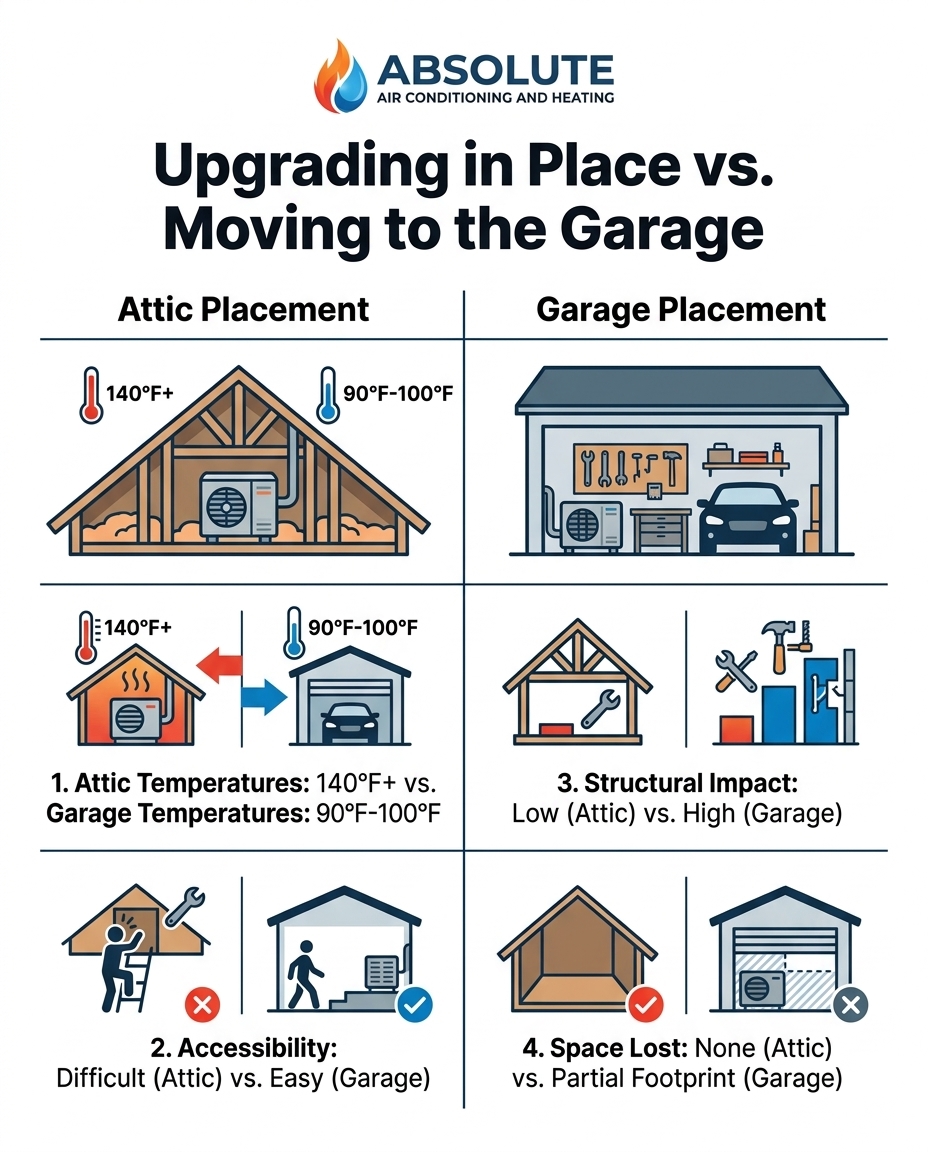
• Structural Impact — Upgrading in the Attic: Low. Existing electrical lines and duct trunks are already routed to this location. — Moving to the Garage: High. Requires rerouting primary ductwork and electrical circuits to a new zone.
• Space Preservation — Upgrading in the Attic: High. Keeps the garage completely free of equipment, preserving parking and storage. — Moving to the Garage: Low. Sacrifices a small footprint of the garage for the air handler and platform.
• Thermal Exposure — Upgrading in the Attic: High. Continued exposure to hostile 140°F+ conditions, shaving years off lifespan. — Moving to the Garage: Moderate. The garage is unconditioned but shaded and significantly cooler than the attic.
• Maintenance Access — Upgrading in the Attic: Difficult. Technicians must navigate tight, sweltering spaces for routine service. — Moving to the Garage: Easy. Ground-level access makes filter changes and repairs straightforward.
The primary advantage of staying in the attic is avoiding invasive construction. Your existing ductwork trunks, high-voltage electrical lines, and copper refrigerant lines are already routed to the attic platform. Reusing this infrastructure keeps the initial scope of the project smaller. Furthermore, it keeps your garage completely free, which is a major priority for homeowners who use every square inch of their garage for vehicles, workshops, or storage.
However, the drawbacks are significant. Continued exposure to hostile thermal conditions will shave years off the equipment's potential lifespan. Additionally, the difficult maintenance access makes routine service challenging. When our technicians have to crawl through a cramped, 140°F space, even a basic AC repair becomes a grueling physical task, and simple tasks like changing the air filter are easily neglected by homeowners who understandably want to avoid the attic entirely.
When Staying in the Attic Makes Sense
Despite the challenges, we recognize there are specific scenarios where keeping the unit in the attic is the most logical choice for a property:
• Spray foam encapsulation: Homes with highly insulated, sealed attics (where the roof deck is sprayed with foam) have conditioned or semi-conditioned attic spaces. In these homes, the attic temperature stays very close to the temperature of the living space, completely eliminating the extreme heat penalty.
• Non-negotiable space constraints: Situations where garage space is absolutely at a premium, and losing even a small corner for an air handler platform would disrupt how the family uses the home.
• Strict timelines: Projects with limited scopes or incredibly tight turnaround times where structural modifications simply are not feasible.
Relocating to the Garage: A Strategic Lifespan Upgrade
If you are willing to undertake a larger project, moving the air handler down into the garage offers incredible long-term benefits. In our experience working on homes throughout Palm Desert, this is not just about making life easier for your service technician; it is a strategic upgrade designed to protect your investment and improve your home's overall efficiency.
Significant reduction in thermal strain: While a garage in Palm Desert is certainly warm in the summer, it is shaded and vastly cooler than an unconditioned attic baking under direct sunlight. Moving the system to a slightly cooler, shaded garage drastically reduces the thermal strain on the air handler. The blower motor doesn't have to work as hard to push air, and the electronics are far less likely to overheat. This cooler operating environment directly translates to a longer, healthier lifespan for the equipment.
Drastically improved accessibility: When your system is in the garage, routine maintenance becomes effortless. You can change your air filters in minutes without needing a ladder or a flashlight. When our professional technicians arrive for seasonal tune-ups or an eventual heater replacement years down the line, they have clear, well-lit, ground-level access. This means faster diagnostics, more thorough cleanings, and less labor time spent navigating tight crawlspaces.
Improved indoor air quality: Relocating the unit often provides an opportunity to improve indoor air quality and reduce duct leakage. By minimizing the length of duct runs through the hottest part of the house and sealing the new connections at ground level, you ensure that more of the clean, conditioned air actually makes it into your living room instead of leaking into the rafters.
The main concession, of course, is space. Relocating the system requires sacrificing a small footprint of garage space to build a sturdy, code-compliant platform for the equipment, alongside the structural modifications required to route the air down from the ceiling.
What to Expect: Structural and Ductwork Modifications
We believe in providing a transparent, honest assessment of the structural hassle versus the long-term gains. Moving an HVAC system is a complex, invasive process requiring licensed professionals. It is never a simple weekend swap. If you choose to relocate your system, here is exactly what our licensed installation team will handle so you know what you are signing up for.
1. Rerouting primary duct trunks: The largest part of the job involves redirecting the main supply and return ductwork. Instead of terminating in the attic, these massive insulated tubes must be extended and routed down through the ceiling into the garage to connect to the new air handler location.
2. Electrical modifications: Your existing system has a dedicated high-voltage circuit and a disconnect box in the attic. A licensed professional must safely terminate those old connections and run a new dedicated circuit from your breaker panel to the new garage location to power the equipment safely.
3. Refrigerant line adjustments: The copper lines that carry refrigerant between the outdoor condenser and the indoor coil must be rerouted, extended, or replaced entirely to reach the garage. This requires precision welding and pressure testing to ensure zero leaks.
4. Code compliance and condensate routing: Air conditioners pull gallons of humidity out of the air, which drains away as liquid water (condensate). The new location must have a proper, gravity-fed or pumped condensate drain line routed to the exterior of the home, fully compliant with current local building codes.
Because of the heavy modifications required, relocation projects demand careful planning. The long-term gains in efficiency and equipment longevity are substantial, but homeowners must be prepared for a multi-day installation process that temporarily turns a portion of the home into a construction zone.
Why Timing Matters: The Fall Transition Window
Because relocation projects require the system to be offline longer than a standard swap—often spanning a couple of days—the timing of the project is absolutely critical. Attempting a major relocation during peak summer heat leaves the home dangerously hot during the downtime. You do not want your family sitting in a house with no air conditioning when it is 110°F outside while technicians rebuild your ductwork.
As we head into September, this early fall transition period is the optimal window for invasive HVAC work. During this time, the extreme summer heat finally breaks, meaning the home remains comfortable even while the system is completely dismantled. Furthermore, scheduling during this mild early fall window ensures the new, highly efficient system is fully operational, tested, and ready long before the winter heating demands begin.
One homeowner recently needed to replace their entire HVAC system while also figuring out heating and cooling for two un-permitted additions. They received multiple estimates before having our team handle the complex installation. Major structural changes take significant time. Whether you are dealing with complex additions or a straightforward garage relocation, scheduling these multi-day projects during mild, transitional seasons minimizes your family's discomfort and allows the installation team to work safely and methodically.
Making the Right Call for Your Home's Future
Ultimately, the choice comes down to summarizing a core tradeoff: are you willing to endure the initial structural hassle and give up a small section of your garage to secure long-term efficiency and equipment longevity? For many homeowners in extreme desert climates, the answer is a resounding yes. Getting the equipment out of a 140°F environment pays dividends year after year in lower strain and easier maintenance.
As you evaluate your garage space availability and long-term plans for the property, remember that professional load calculations and ductwork assessments are strictly required before finalizing any relocation plan. A licensed technician must verify that your current duct system can handle the new routing without losing static pressure. To understand more about the specific penalties of attic installations, you can read more about The Hidden Costs of Installing an Air Handler in a Palm Desert Attic.
Finally, keep in mind that generic energy incentives, federal tax credits, or local utility rebates may apply to high-efficiency equipment upgrades, regardless of the final location you choose. Always verify current programs with your utility provider or a tax professional. By carefully weighing the immediate construction impact against the lifetime benefits of a cooler operating environment, you can make a confident, informed decision for your home.
Frequently Asked Questions
Is it bad to have an AC unit in the attic?
It is not inherently bad, but it is highly inefficient in extreme climates. An AC unit in an unconditioned attic must fight against ambient temperatures that can exceed 140°F, which forces the system to work harder, consumes more energy, and accelerates wear and tear on the components.
Can you move an air handler from the attic to the garage?
Yes, an air handler can absolutely be moved to the garage. However, this is a major structural project that requires a licensed HVAC professional to reroute the primary supply and return ductwork, extend electrical circuits, and adjust the copper refrigerant lines.
What are the benefits of moving HVAC out of the attic?
The primary benefits are improved equipment longevity and vastly easier maintenance access. Moving the unit to a cooler, shaded garage reduces thermal strain on the blower motor and allows technicians to change filters and perform routine service without crawling through a sweltering, cramped space.
Does moving an HVAC unit improve efficiency?
Moving the unit to a cooler environment typically improves overall system efficiency. When the air handler and nearby ductwork are no longer baking in a 140°F attic, there is significantly less thermal transfer, meaning the chilled air stays colder as it travels into your living spaces.
How long does it take to relocate an HVAC system?
Relocating a system generally takes a couple of days to complete. Because the project involves dismantling the old unit, framing a new platform, rerouting major duct trunks, and running new electrical lines, it requires more labor time than a standard one-for-one equipment swap.
Will moving my unit to the garage require new ductwork?
Yes, moving the unit will require structural ductwork modifications. The main supply and return trunks that currently terminate in the attic will need to be extended and redirected down through the ceiling to connect securely to the new equipment location in the garage.
Deciding where to place your new system is a major choice that impacts your comfort for the next decade or more. Whether you are replacing an attic HVAC unit: upgrading in place vs. moving to the garage, our team at Absolute Air Conditioning and Heating is here to provide the clear, objective breakdown you need. Reach out today to schedule a comprehensive evaluation, and we will help you make the most informed decision for your home's unique layout.
Serving the Entire Coachella Valley


How to Tell if Your Attic HVAC Unit is Undersized for Your Home's Heating Load
When the first cold snap hits, a system that runs constantly without warming your house is a major red flag. Find out if your equipment is fundamentally too small or just needs seasonal upkeep.

The Danger of Relying on Emergency Heat Mode During a Palm Desert Cold Snap
When a sudden fall chill hits, flipping your thermostat to emergency heat feels like a quick fix. Instead, you are bypassing your heat pump's efficiency and causing massive utility bills.

Why Absolute AC Recommends Sealing Your Attic Ductwork Before Winter
Unsealed ductwork in your attic can silently drain up to 30% of your home's heated air. Addressing these hidden leaks proactively is the key to maintaining reliable winter comfort in Palm Desert.

