

Why Your Attic Air Conditioner Struggles During Palm Desert's September Heatwaves
The Hidden Reality of 140-Degree Attics in Coachella Valley Homes
When outside temperatures cross the 100-degree mark, the enclosed space directly beneath your roof rapidly transforms into a massive heat trap. If you are wondering why your attic air conditioner struggles during Palm Desert's September heatwaves, the answer usually lies in this extreme thermal environment. In our experience at Absolute Air Conditioning and Heating, we've found that nearly 75% of homeowners do not realize that while their living room feels slightly warm, the equipment responsible for cooling it is fighting a losing battle against brutal, trapped heat.
Whether you need comprehensive air conditioning services to evaluate your entire system or targeted AC repair in Palm Desert, our team believes understanding this hidden thermal environment is the first step to restoring your indoor comfort.
The "Second Summer" Effect in the Desert
In many parts of the country, September brings a welcome cooldown and a break for overworked HVAC systems. However, as anyone living in the Coachella Valley knows, we experience what locals often call a "second summer." Our technicians see daily how these persistent high ambient temperatures maintain a relentless thermal load on your home's exterior. Because the sun continues to beat down on your roof day after day, the heat accumulates in the uppermost levels of your home.
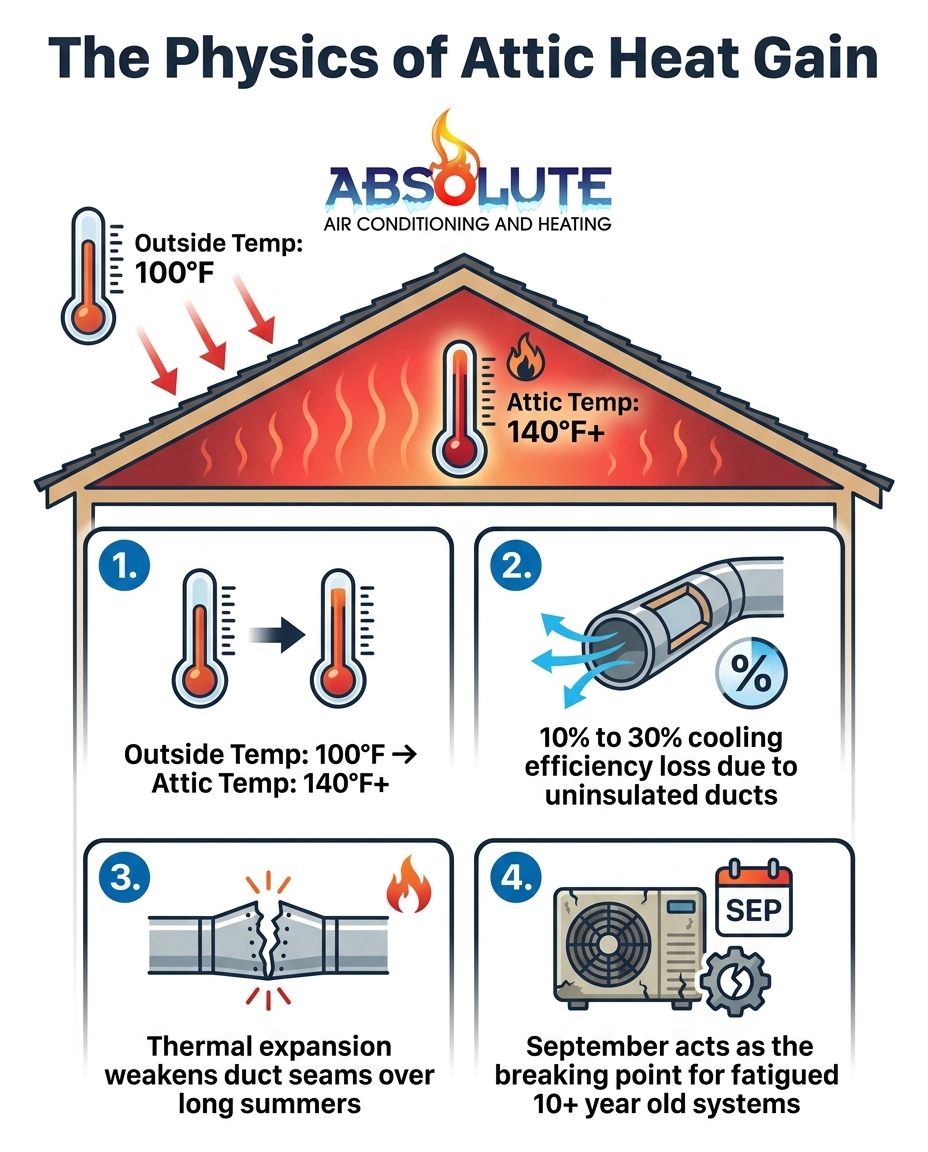
This prolonged exposure creates a compounding effect. The insulation and structural materials in your roof absorb thermal energy throughout the day, and without adequate nighttime cooling, that heat remains trapped. We frequently measure 140-degree attic temperatures by the time the afternoon rolls around. Your air handler, which houses the sensitive components responsible for circulating conditioned air, is forced to operate in an environment that is hotter than a commercial oven.
The Critical Decision Point for Homeowners
Operating an air handler in a 140-degree environment is not just an efficiency problem; it is a mechanical survival issue. When your system is suffocating in this extreme heat, the cooling capacity plummets. The air that is supposed to chill your home is being warmed before it ever reaches your vents.
This creates a critical decision point for homeowners as late summer transitions into early fall. Addressing this severe thermal damage now—before the heating season begins—is essential. Failing to relieve this stress means you will carry degraded, compromised equipment right into the winter months, setting the stage for unexpected breakdowns when you need your furnace or heat pump the most.
The Physics Behind Cooling Capacity Loss in Extreme Ambient Heat
To truly understand why your system falls behind, we have to look at the basic physics of heat transfer. Air conditioning does not actually "create" cold air; it removes heat from the indoor air and rejects it outside. When the equipment tasked with moving that cooled air is surrounded by hostile, extreme heat, the laws of thermodynamics begin to work against you.
The Mechanics of Heat Transfer in Hostile Environments
Your air handler is designed to push air that has been cooled to around 55 degrees through your ductwork and into your living spaces. However, heat naturally moves from warmer areas to cooler areas. When your air handler and the attached ductwork are sitting in 140-degree attic temperatures, the massive temperature differential causes the ambient heat to aggressively push its way into your cold air supply.
The system is forced to fight a two-front war: it must remove the heat from your living room while simultaneously fighting off the intense heat trying to invade the equipment itself. This is why the air coming out of your vents might feel lukewarm during the hottest part of the afternoon, even though the system is running non-stop.
What the Data Says About Efficiency Loss
The impact of this thermal invasion is highly measurable. According to data from the US Department of Energy, heat gain through attic equipment and poorly insulated ductwork can reduce a system's overall cooling efficiency by 10% to 30%. On our service calls, this massive drop in performance explains why a customer's home might stay at 80 degrees even when the thermostat is set to 72 degrees.
• Optimal Morning Operation — Ambient Attic Temperature: 85°F - 95°F — System Cooling Capacity: Operating at 95% - 100% efficiency — Energy Consumption: Normal baseline usage
• Extreme September Afternoon — Ambient Attic Temperature: 130°F - 150°F — System Cooling Capacity: Reduced by 10% - 30% due to heat gain — Energy Consumption: Spikes heavily due to constant cycling
The most frustrating part for many homeowners is assuming the AC is broken. In many cases, the mechanical components are functioning exactly as designed, but they are simply overwhelmed by the environmental physics. The system runs constantly to overcome this massive thermal load, leading to higher energy consumption and accelerated wear and tear.
Cumulative Thermal Fatigue: Why September is the Breaking Point
If your system managed to keep you cool through June, July, and August, you might wonder why it suddenly starts failing as the year progresses. The answer lies in cumulative thermal fatigue. Mechanical components do not just fail randomly; they wear down over time, and a long desert summer accelerates that degradation significantly.
The Impact of Diurnal Temperature Shifts
The specific desert climate of the Coachella Valley creates a unique challenge known as a diurnal temperature shift. This refers to the extreme difference between the daytime high and the nighttime low. It is not uncommon for the temperature to hit 110 degrees in the afternoon and drop to 70 degrees overnight.
These rapid shifts cause the metal components in your air handler and ductwork to constantly expand during the heat of the day and contract as it cools down at night. Over the course of a four-month summer, this constant thermal expansion and contraction weakens metal seams, loosens fasteners, and degrades electrical connections.
When Old Systems Finally Give Out
Older units—especially those approaching 15 to 18 years of age—are particularly vulnerable to this cycle. The materials have already lost much of their original resilience. By the time September late-season heatwaves arrive, the equipment has endured hundreds of these expansion-contraction cycles. The late-summer heat acts as the final straw for these fatigued components, turning minor wear into total system failure.
When our technicians at Absolute Air Conditioning and Heating diagnose thermal fatigue during this seasonal transition, we see a clear pattern: systems that are barely hanging on in August frequently collapse in September. We recently assisted a local homeowner who experienced this exact scenario when their older units finally malfunctioned after enduring the brutal summer load. Because the system was completely fatigued, our professional team installed two new TRANE A/C and Furnace systems over a two-day period. The installation met all their high expectations, fully resolving the structural and thermal failures of the old equipment.
How Heat Gain Through Ductwork Sabotages Your AC Unit in Attic
While the air handler takes a massive beating in a hot attic, the ductwork is equally vulnerable. The network of tubes carrying your conditioned air acts like a giant radiator in reverse if it is not properly protected. When exposed to severe attic temperatures, several specific vulnerabilities begin to sabotage your cooling efforts.
1. Radiant Heat Absorption: Uninsulated or poorly insulated ductwork absorbs radiant heat directly from the attic space. As the chilled air travels from the air handler to your bedroom vents, it is actively warmed by the hot metal or flex-duct material. By the time the air reaches the register, it has lost a significant portion of its cooling power.
2. Thermal Expansion and Air Leaks: As mentioned earlier, the constant heating and cooling of the attic causes duct seams to expand and contract. Over time, the mastic sealant and metal tape used to join duct sections become brittle and crack. This creates air leaks that blow freshly conditioned air straight into your attic, completely wasting the energy you just paid for.
3. The Duct Sweating Phenomenon: When there is a massive temperature differential between the freezing cold air inside the duct and the 140-degree ambient air outside the duct, condensation forms. This duct sweating can lead to moisture damage, degraded insulation, and a further drop in thermal resistance.
4. Restricted Airflow Dynamics: Proper airflow is essential for mitigating heat gain. If your attic lacks proper ventilation, the heat has nowhere to escape, compounding the stress on the ductwork. Our professional ventilation services can help assess whether your attic envelope is trapping excess heat and suffocating your mechanical systems.
Diagnosing the Symptoms of an Overheated Attic Air Conditioner
Recognizing the warning signs of an overheated system can save you from a complete mechanical failure. Because the equipment is hidden away out of sight, homeowners must rely on secondary symptoms to diagnose thermal stress. If you know what to look and listen for, you can catch these issues before they escalate.
Key Warning Signs to Watch For
• Constant afternoon cycling: If your system turns on and stays on for hours at a time during the late afternoon without ever reaching the thermostat set point, it is actively losing the battle against 140-degree attic temperatures.
• Unusual popping or banging noises: When you hear strange metallic sounds coming from above your ceiling, it frequently indicates the severe thermal expansion and contraction of ductwork struggling with temperature swings.
• Sudden energy bill spikes: A massive jump in your late-summer electricity usage points directly to efficiency loss from heat gain. The system is consuming twice the power to deliver half the cooling.
• Lukewarm airflow at the registers: If the air blowing out of your vents feels noticeably warmer than it did in June, your ductwork is likely absorbing ambient heat before the air reaches the room.
Evaluating the Attic Envelope vs. Mechanical Components
When these symptoms appear, our primary challenge during a diagnostic visit is determining whether the mechanical AC unit is failing or if the attic envelope itself is the root cause. A compressor issue requires a very different approach than deteriorating duct sealant. If you are unsure whether your equipment is mechanically sound or just thermally overwhelmed, consulting a comprehensive guide to attic AC systems can provide baseline knowledge, but having our professional team evaluate the static pressure and measure the exact heat gain is ultimately necessary to pinpoint the issue.
Addressing Thermal Stress Before the Heating Season Transition
As brutal as September late-season heatwaves can be, they also serve as a final warning. The transition into fall is the absolute best time to address the thermal damage your system sustained over the summer. Bridging the gap between late-summer repairs and winter preparation ensures your home remains comfortable year-round.
Sealing and Insulating for Fall Prep
Late summer and early fall provide the ideal window to seal ductwork leaks and upgrade attic insulation. By restoring the thermal boundary around your ductwork now, you prevent your furnace's heated air from escaping into the cold attic during the winter. Relieving the thermal stress on the air handler protects the blower motor, electrical relays, and circuit boards, ensuring they are ready to handle the demands of the upcoming heating season.
Evaluating Your Equipment's Future
This transition period is also the time to assess an older AC unit's long-term viability. If your system required constant temporary fixes just to survive the summer, it may be time to consider a full replacement before the winter cold sets in. Our crew recently helped a local homeowner who decided it was time to update their existing HVAC system after it struggled heavily. After exploring various options and getting their questions answered, our team installed a highly efficient mini-split system. Keep in mind that federal tax credits may apply to qualifying heat pump installations, making an energy-efficient upgrade even more advantageous. The superb installation left them with a clean interior and an incredible system ready for any weather.
Proactive AC maintenance is not just about changing filters; it is about securing your indoor comfort. By addressing the severe conditions in your attic now, you protect your investment and ensure your equipment operates efficiently, no matter how extreme the desert climate becomes.
Frequently Asked Questions
Why is my attic air conditioner not cooling in late summer?
Your system is likely fighting against extreme thermal heat gain rather than a mechanical failure. When the ambient temperature surrounding the equipment reaches extreme highs, the system loses cooling capacity and struggles to overcome the environmental load.
How hot does a Palm Desert attic get in September?
It is very common for the space directly beneath your roof to exceed 140 degrees during late-season heatwaves. Because the sun beats down on the roof all day and the heat becomes trapped, the temperature inside the attic easily surpasses the outdoor temperature.
Does a hot attic directly affect AC performance?
Yes, an excessively hot environment drastically reduces the efficiency of your equipment. Heat naturally transfers into the colder air handler and ductwork, warming the conditioned air before it can reach your living spaces and forcing the system to run constantly.
Should I put my air handler in the attic?
While placing an air handler in the upper levels of a home saves indoor closet space, it exposes the equipment to severe thermal stress. If the equipment must be located there, it requires heavy insulation, perfectly sealed ductwork, and proper ventilation to survive the extreme temperatures.
Why is my ac unit in attic losing cooling capacity specifically in September?
September represents the culmination of cumulative thermal fatigue after a long, brutal summer. The continuous cycles of extreme heat and diurnal temperature shifts degrade metal components, weaken duct seams, and push aging equipment past its breaking point.
How do 140-degree attic temperatures affect ductwork seams?
The severe heat causes the metal and sealant materials to constantly expand and contract. Over several months, this thermal cycling turns flexible mastic and tape brittle, causing it to crack and create massive air leaks that waste your conditioned air.
Don't let extreme attic temperatures dictate your indoor comfort as the seasons change. Whether you need a comprehensive evaluation of your ductwork or targeted AC repair in Palm Desert, addressing thermal stress now prepares your system for a flawless transition into the heating season. Reach out to the experts at Absolute Air Conditioning and Heating to relieve the burden on your equipment and secure reliable, efficient performance year-round.
Serving the Entire Coachella Valley


How to Tell if Your Attic HVAC Unit is Undersized for Your Home's Heating Load
When the first cold snap hits, a system that runs constantly without warming your house is a major red flag. Find out if your equipment is fundamentally too small or just needs seasonal upkeep.

The Danger of Relying on Emergency Heat Mode During a Palm Desert Cold Snap
When a sudden fall chill hits, flipping your thermostat to emergency heat feels like a quick fix. Instead, you are bypassing your heat pump's efficiency and causing massive utility bills.

Why Absolute AC Recommends Sealing Your Attic Ductwork Before Winter
Unsealed ductwork in your attic can silently drain up to 30% of your home's heated air. Addressing these hidden leaks proactively is the key to maintaining reliable winter comfort in Palm Desert.

