

Evaluating the Switch from a Traditional Attic AC to a Heat Pump System This Fall
The Myth of the Desert Furnace: Rethinking Your Fall HVAC Upgrade
The biggest misconception about staying comfortable in Southern California is that you require a roaring gas furnace to survive the winter months. At Absolute Air Conditioning and Heating, a pattern we see often is that if you are evaluating the switch from a traditional attic AC to a heat pump system this fall, you are already challenging that outdated rule of thumb. For decades, the standard approach to home climate control involved pairing a robust air conditioner for the summer with a combustion furnace for the winter. However, when you live in a region characterized by intense heat and relatively mild cool seasons, our team consistently finds that this traditional setup results in wasted energy and redundant equipment.
Right now, as we enter the early fall transition, our technicians are seeing many homeowners dealing with the reality of an aging attic system that barely survived a brutal summer. You face a crucial decision point: do you simply replace your struggling equipment with another like-for-like standard AC and gas combo, or do you upgrade to a modern, unified heat pump system? Making the right choice requires looking closely at how these systems actually operate in our specific environment.
For comprehensive guidance on your options, explore our Heat Pump Services.
Why Coachella Valley Winters Change the Heating Math
In our years serving the Palm Desert area, we've learned that to understand why a heat pump makes so much sense here, you have to look at the unique climate profile of the Coachella Valley region. In many parts of the country, winter brings deep freezes and prolonged sub-zero temperatures, which historically required the raw heating power of a natural gas or oil furnace. However, our local winters tell a very different story.
With average winter lows comfortably resting in the 40s and rarely dropping below freezing, our climate represents the absolute optimal operating zone for modern heat pumps. Instead of burning fuel to generate heat, a heat pump simply absorbs ambient heat from the outside air and transfers it inside your home. Because there is still plenty of thermal energy in 40-degree air, a heat pump can extract and deliver that warmth with incredible efficiency.
Maintaining a dedicated gas furnace in a mild climate often leads to wasted energy and unnecessary redundancy. You end up paying to maintain, inspect, and supply gas to a heavy-duty combustion system that you only run for a few weeks out of the year. By switching to a heat pump, you consolidate your climate control into a single, elegant system that handles year-round temperature regulation without ever relying on auxiliary gas heat. The math heavily favors the unified approach when your winter weather is this forgiving.
Attic Logistics: Swapping an AC Unit in Attic for a Heat Pump Air Handler
Replacing an HVAC system that is housed in your attic involves a unique set of logistical challenges. Our installers know firsthand that attics in the desert can easily reach temperatures exceeding 130 degrees during the peak of summer, which puts immense thermal stress on your equipment. When transitioning from a traditional furnace and AC coil setup to a heat pump air handler, precision is paramount. Our local HVAC expertise ensures that we properly size and install an air handler in the attic specifically engineered to handle the extreme summer heat loads of the desert environment.
One local homeowner reached out to us during the winter when their old heat pump finally failed. Brian, Andrew, and Sam from our team navigated the tight attic space and fitted a new heat pump smoothly, ensuring the installation went perfectly despite the confined working conditions. When evaluating the costs of installing an air handler in an attic, we always walk our clients through the specific steps involved in a successful conversion:
1. Evaluating space and clearance requirements: A heat pump air handler often has a different physical footprint than a traditional gas furnace. Our installation team must measure the attic access panel, the platform, and the vertical clearance to ensure the new, highly efficient air handler fits securely without obstructing airflow or maintenance access.
2. Assessing ductwork condition and airflow: Heat pumps require precise airflow to operate at peak efficiency. Older ductwork designed for a high-blast gas furnace may need to be sealed, modified, or resized to accommodate the steady, even airflow produced by a modern heat pump. Leaky ducts in a scorching attic will severely degrade the system's performance.
3. Ensuring proper insulation and vibration dampening: Because the air handler will be operating directly above your living space, proper suspension and vibration dampening are critical. The unit must be isolated from the ceiling joists to prevent a low hum from echoing through your home. Additionally, the casing must be heavily insulated to prevent the attic's extreme ambient heat from warming the freshly cooled air before it reaches your vents.
4. Managing high-heat environments: The electrical components of a heat pump air handler must be rated for the intense thermal conditions of a desert attic. Proper ventilation around the unit and high-quality secondary drain pans are non-negotiable to protect your ceiling from condensation overflow.
Side-by-Side Comparison: Traditional AC + Furnace vs. Full Heat Pump
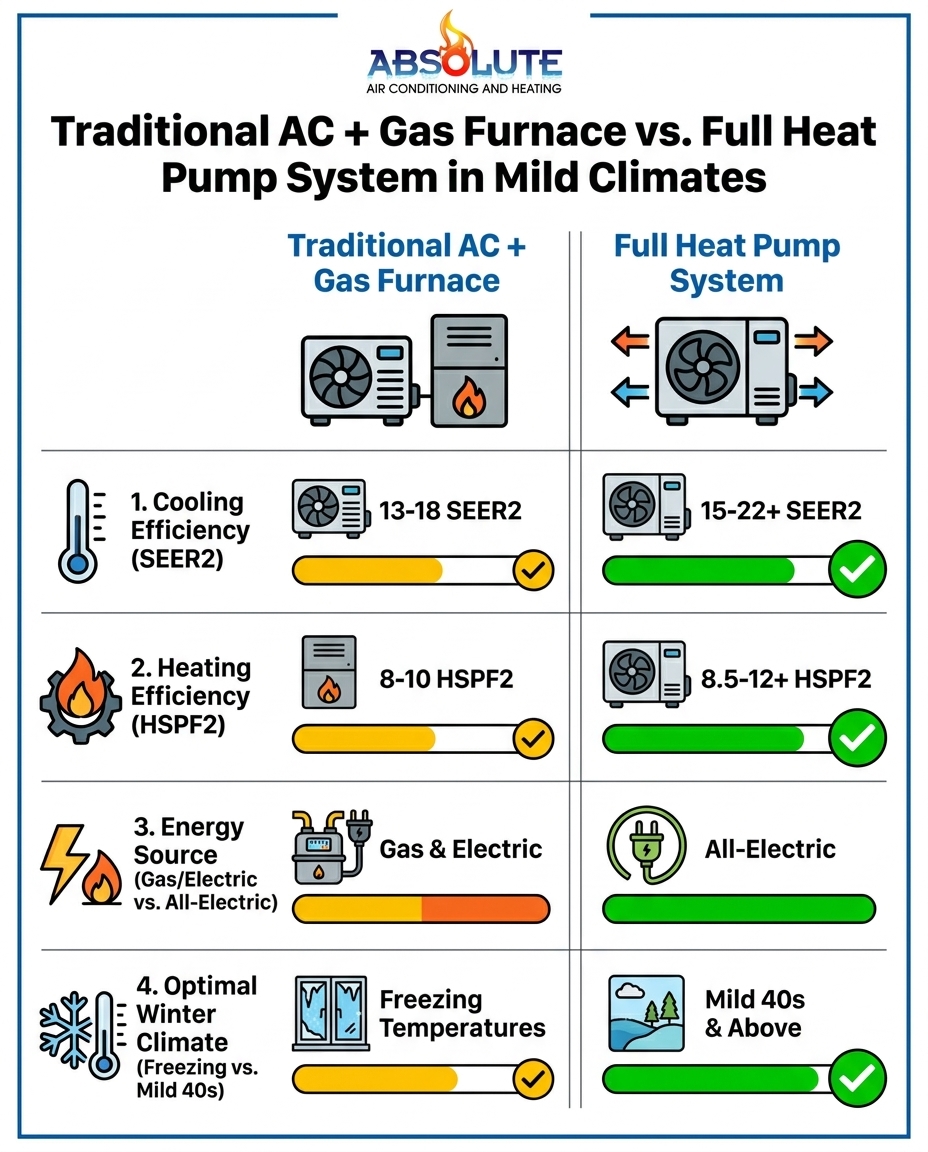
When we help homeowners make an informed decision during the early fall transition, we always start by looking at the hard data. While both setups will keep your home comfortable, they achieve that goal through fundamentally different mechanisms. Understanding these differences helps clarify why one system might offer better long-term value for your specific property.
The traditional split system relies on two completely separate energy sources: electricity for cooling and natural gas for heating. A full heat pump system is entirely electric, reversing its refrigerant flow to provide both heating and cooling. Here is how they stack up across the most important operational metrics:
• Cooling Efficiency (SEER2) — Traditional AC + Gas Furnace: Standard to high efficiency, depending on the model chosen. — Full Heat Pump System: Often features ultra-high SEER2 ratings due to advanced variable-speed compressors.
• Heating Efficiency (HSPF2) — Traditional AC + Gas Furnace: Not applicable (measured in AFUE for gas combustion). — Full Heat Pump System: Exceptionally high HSPF2 ratings, especially in mild winter climates.
• Operational Mechanics — Traditional AC + Gas Furnace: Burns natural gas to create heat; uses refrigerant to remove heat in summer. — Full Heat Pump System: Transfers ambient heat indoors during winter; transfers indoor heat outdoors in summer.
• Lifespan & Footprint — Traditional AC + Gas Furnace: Furnaces can last 15-20 years; ACs 12-15 years. Requires gas lines and flues. — Full Heat Pump System: Averages 15 years for the unified system. Eliminates the need for gas lines or exhaust flues.
• Winter Performance — Traditional AC + Gas Furnace: Produces intense, hot blasts of air. Overkill for mild desert winters. — Full Heat Pump System: Produces a steady, even warmth perfectly suited for temperatures in the 40s.
• Maintenance Requirements — Traditional AC + Gas Furnace: Requires separate maintenance for the combustion system and the cooling system. — Full Heat Pump System: Requires unified, bi-annual maintenance on a single mechanical system.
By comparing these factors directly, it becomes clear to our team and our customers that the all-electric approach eliminates the hazards and inefficiencies of burning fossil fuels indoors, while streamlining your mechanical footprint.
Cooling Power in Scorching Summers: Does a Heat Pump Compete?
The most common hesitation our technicians hear from homeowners about transitioning away from a traditional air conditioner is the fear that a heat pump won't be able to handle the intense summer heat of the Palm Desert and Coachella Valley. This hesitation stems from the name itself—"heat pump" sounds like a device built primarily for warming. In reality, a heat pump is an air conditioner that has the ability to run in reverse.
During a brutal stretch of summer heat where temperatures averaged 116°, one Coachella Valley homeowner's 18-year-old air conditioning unit began malfunctioning. Brian and his team came out twice to perform temporary repairs, keeping the old unit running just long enough until a permanent replacement could be secured. When you face temperatures that extreme, you need absolute confidence in your cooling equipment.
Rest assured, a heat pump competes flawlessly with traditional ACs because it utilizes the exact same refrigeration cycle. Here is why we consistently see modern heat pumps excel in extreme heat:
Variable-speed compressors: Unlike older, single-stage air conditioners that blast at 100% capacity and then shut off, high-efficiency heat pumps often feature variable-speed compressors. These compressors adjust their output in tiny increments, running continuously at lower speeds to maintain an exact temperature. This allows them to easily manage 110+ degree days without constantly cycling on and off, which reduces wear and tear.
Enhanced dehumidification: During the humid late-summer weeks, running continuously at a lower speed allows the indoor coil to pull significantly more moisture out of the air. A drier home feels cooler, meaning you can often set your thermostat a few degrees higher while maintaining the exact same level of comfort.
Identical cooling mechanics: In cooling mode, the reversing valve directs the flow of refrigerant exactly as a standard AC does—absorbing heat from inside your home and dumping it outside. There is zero drop-off in cooling capacity when properly sized for your square footage.
Energy Efficiency, Rebates, and Long-Term Value
We frequently remind our customers that switching to a heat pump is not just about immediate comfort; it is a strategic move for long-term energy efficiency. By completely eliminating your reliance on natural gas for heating, you insulate yourself from the volatile fluctuations of fossil fuel prices. An all-electric system allows you to take full advantage of renewable energy sources, such as home solar panels, to power both your heating and cooling needs across the Palm Desert and Coachella Valley region.
Furthermore, because heat pumps represent a significant step forward in energy conservation, they are heavily incentivized. Generic federal tax credits and local utility rebates may apply to qualifying high-efficiency installations. While programs vary and you should always consult with a tax professional or your local utility provider for current details, these incentives can dramatically improve the long-term return on investment when you choose to upgrade.
If you are currently facing a heater replacement alongside a failing AC, tackling both issues simultaneously with a unified heat pump is almost always more cost-effective than purchasing two separate pieces of equipment. You eliminate the installation overlap, reduce your mechanical footprint, and secure a system designed to work seamlessly together for the next 15 years.
Why the Early Fall Transition is the Strategic Time to Upgrade
In our experience, timing your HVAC replacement is just as critical as choosing the right equipment. Waiting for your system to suffer a catastrophic failure in the middle of a heatwave or a cold snap puts you at a severe disadvantage. The early fall transition is widely considered the optimal window for major system upgrades.
Another local homeowner took advantage of the fall season to upgrade their property, requiring the installation of two new systems. Brian and his team spent two full days completing the complex installation, meeting all high expectations and getting the house ready before the weather shifted. By acting proactively, you gain several distinct advantages:
• Beating the inevitable winter heating rush: As soon as the first cold night hits, service schedules fill up instantly with emergency furnace repairs. Scheduling in the early fall transition allows you to secure preferred installation dates that fit your schedule.
• Avoiding emergency replacements: Extreme weather fluctuations put maximum stress on aging equipment. Replacing your system now means you are not forced into making a rushed, panicked decision while your house is uncomfortably hot or freezing cold.
• Taking advantage of milder weather: Complex, multi-day attic installations are significantly safer and more precise when technicians are not battling 130-degree attic temperatures. A comfortable working environment ensures the highest quality installation, particularly when dealing with intricate ductwork modifications and vibration dampening.
Frequently Asked Questions About Heat Pump Conversions
Is a heat pump better than AC and a furnace in mild climates?
Yes, we strongly recommend heat pumps in mild climates because they eliminate the need for a redundant gas furnace. Instead of burning fuel to create heat, a heat pump efficiently transfers ambient heat from the outside air, providing excellent winter comfort while using significantly less energy. It also serves as a high-powered air conditioner during the summer.
Can an attic air conditioner be replaced with a heat pump?
Absolutely. The indoor component of a heat pump, known as the air handler, can be installed in the exact same attic space where your traditional AC evaporator coil and furnace currently sit. Our experienced installation team will ensure the new unit is properly sized, suspended, and insulated to handle the high heat of the attic environment.
Why switch to a heat pump in the fall?
The fall provides a brief window of mild weather between the extreme cooling demands of summer and the heating needs of winter. Upgrading during this time ensures you aren't left without climate control during extreme temperatures, allows for safer attic working conditions, and helps you beat the winter rush for HVAC services.
Does a heat pump cool as well as an AC in the desert?
A heat pump cools exactly as well as a traditional air conditioner because it uses the identical refrigeration cycle to remove heat from your home. High-efficiency models with variable-speed compressors are specifically designed to manage 110+ degree days with ease, providing robust and consistent cooling power.
What are the space requirements for a heat pump air handler in an attic?
While space requirements vary by model, a heat pump air handler generally requires enough vertical and horizontal clearance to allow for proper airflow, secure suspension to dampen vibration, and unhindered access for future maintenance. Your technician will measure your attic access and platform to select a unit that fits perfectly into your existing structural layout.
Make the Smart Switch for Your Home's Climate Control
Navigating the transition from an aging traditional system to a modern heat pump doesn't have to be overwhelming. As we've explored, our team at Absolute Air Conditioning and Heating knows that a heat pump offers superior year-round efficiency perfectly tailored to the unique climate of the desert. By eliminating natural gas dependency and upgrading to advanced variable-speed cooling, you position your home for maximum comfort and long-term energy savings.
We understand that every home is unique, and a professional evaluation can clarify the best path forward for your specific layout and ductwork. Don't wait for your old system to fail when you need it most. We encourage you to schedule an inspection to weigh your options before the winter weather arrives. Secure your heat pump installation in Palm Desert today and experience a clear, regionally-tailored solution that keeps you perfectly comfortable all year long.
Serving the Entire Coachella Valley


Addressing the Musty Smell from Your Attic Air Handler After Summer Humidity
That sudden dirty socks odor from your vents isn't just a nuisance—it is a sign of biological growth. Find out if it is a simple filter fix or a job for a pro.

Why We Recommend Scheduling Your Pre-Heating Tune-Up Before the October Rush
Waiting for the first cold snap to test your furnace often leads to long service delays. Take a behind-the-scenes look at how local HVAC supply chains operate in the fall.
Will Adding Insulation Around Your Attic AC Unit Actually Lower Your Cooling Bill?
Wrapping your attic air handler in a thermal blanket seems like a smart way to cut costs during early fall heat. Here is why this common myth damages your system and what actually works.

