
The Hidden Connection Between Your Attic Insulation and Your Winter Heating Bills
Preparing for Winter: The Unseen Drain on Your Heating Efficiency
With October pre-winter temperature drops just around the corner, understanding the hidden connection between your attic insulation and your winter heating bills is the first step toward achieving true home comfort. As the seasons shift, we find that most homeowners naturally turn their attention strictly to their mechanical equipment. You schedule a tune-up, change your air filter, and turn on the thermostat, assuming your furnace or heat pump is completely ready to handle the chilly nights ahead.
However, there is a major hidden factor dictating your winter comfort: the degraded R-value in your attic. When your attic insulation compacts, settles, or degrades over time, it acts like a giant sieve for the warm air your heating system works so hard to produce. Your furnace can run perfectly, but if the heat immediately escapes through your ceiling drywall, you are paying to heat the desert sky.
Addressing this thermal boundary is just as important as tuning up the mechanical components of your furnace. When you make the decision to evaluate your home as a unified system rather than just a collection of parts, you prevent significant energy waste. To get started on securing your home's comfort, exploring professional heating services with our experienced team can help you identify exactly where your system is losing efficiency.
The Physics of Desert Heat Loss: Understanding the Thermal Bridge
The problem: Thermodynamics dictate a simple but unavoidable rule—heat always moves from warmer spaces to cooler spaces. It never stays static. When you heat your home, that thermal energy is constantly looking for an escape route into the colder environment outside.
The cause: Here in Palm Desert CA, our technicians see firsthand how the significant diurnal temperature variation during the winter months impacts local homes. We might enjoy perfectly warm, sunny afternoons, but as soon as the sun goes down, the temperature can plummet sharply into the 40s. This rapid shift creates a massive temperature differential between your cozy 70-degree living room and a near-freezing attic space just a few inches above your head. This extreme temperature gradient rapidly accelerates heat transfer.
The Stack Effect Explained
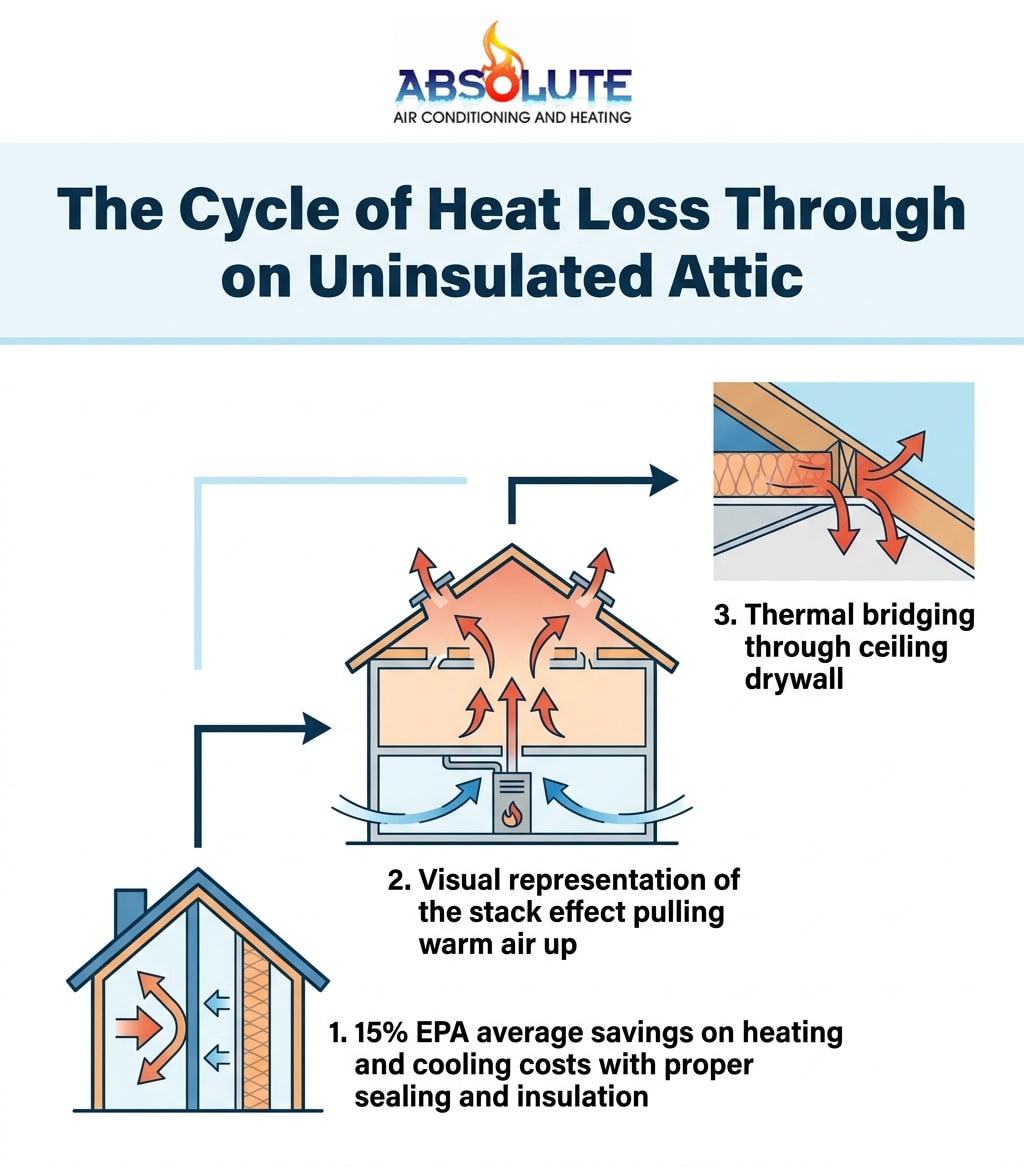
Because warm air is less dense than cold air, it naturally rises toward the highest point in your house. This phenomenon is known as the "stack effect." As your heating system pushes warm air into your living spaces, that air drifts upward. Without a robust layer of insulation blocking its path, the heat effortlessly passes right through the ceiling.
The solution: Upgrading your attic insulation stops this upward migration. When insulation degrades, it creates what building scientists call a "thermal bridge." A thermal bridge occurs when the structural materials of your home—like the wooden joists and the ceiling drywall itself—become highly conductive pathways that pull heat directly out of your rooms. By establishing a thick, continuous thermal boundary across the attic floor, you break that bridge and trap the heat exactly where you want it.
How Degraded R-Value Sabotages Your Heating System
Insulation performance is measured by its R-value, which stands for resistance to conductive heat flow. The higher the R-value, the better the material is at stopping heat from moving through it. Over the years, environmental factors, moisture, pests, and simple gravity cause materials like blown-in fiberglass or cellulose to settle and compress. In our years of inspecting Coachella Valley attics, we frequently see compressed material that has lost the tiny air pockets that actually do the insulating, causing the R-value to drop significantly.
When your attic's R-value plummets, your heating system bears the entire burden. Because the heat escapes through the ceiling almost as quickly as the furnace produces it, the thermostat registers a temperature drop rapidly. This forces the heating equipment into longer, more frequent operational cycles just to maintain a baseline level of comfort.
The Toll of Continuous Cycling
This continuous cycling drives up your winter energy consumption drastically. The equipment draws more power, burns more fuel, and runs for extended periods. Interestingly, this wintertime inefficiency mirrors the exact same struggles your system faces during the summer, which is why understanding how insulation around your attic AC unit affects cooling bills is equally important for year-round efficiency.
The Environmental Protection Agency (EPA) estimates that by simply air sealing the home and adding proper insulation, homeowners can save an average of 15% on their heating and cooling costs. The impact of a degraded thermal boundary on your mechanical equipment is profound, and certain upgrades may even qualify for generic utility incentive programs or federal tax credits—though we always recommend verifying current programs with a tax professional.
• Heating Cycles — With Healthy R-Value: Short, efficient runs that maintain steady temperatures. — With Degraded R-Value: Long, continuous running with frequent restarts.
• Temperature Consistency — With Healthy R-Value: Even warmth across all rooms and hallways. — With Degraded R-Value: Drafty rooms and noticeable cold spots near exterior walls.
• Equipment Wear — With Healthy R-Value: Normal lifespan with standard maintenance requirements. — With Degraded R-Value: Accelerated motor wear and higher risk of premature failure.
The Vulnerability of Your Attic Air Handler
The problem: Many homes we service in Palm Desert CA are built with the air handler and the primary ductwork located directly in the unconditioned attic space. This architectural choice saves interior square footage, but it places your most vital comfort equipment in the most hostile environment in your home.
The cause: When the October pre-winter temperature drops arrive, an under-insulated attic becomes nearly as cold as the outside air. If your attic lacks a proper thermal boundary at the roofline or adequate insulation on the attic floor, the metal casing of your air handler and your ductwork are fully exposed to extreme cold. As the furnace generates heat, that warm air must travel through ducts sitting in a near-freezing environment. Because metal is highly conductive, the air inside the system loses a significant amount of thermal energy before it even reaches your living room vents.
Why Location Matters for Your HVAC Equipment
This dynamic forces the mechanical components to work significantly harder. The blower motor has to push air longer, and the burners or heat pump compressor must operate continuously to make up for the heat lost in the attic. This excessive strain accelerates wear and tear on belts, motors, and electrical components.
The solution: Protecting this equipment requires a comprehensive approach to the attic's thermal envelope. By ensuring the attic floor is heavily insulated and the ductwork itself is properly sealed and wrapped, you stop the ambient cold from sapping your system's energy. Ignoring this vulnerability often leads to sudden breakdowns on the coldest nights of the year, which will quickly have you looking for reliable heating repair services to restore your home's warmth. Our team has responded to countless late-night calls that could have been prevented with proper attic sealing.
Signs Your Home's Thermal Envelope Needs Immediate Attention
Identifying an insulation deficit before the deepest cold sets in can save your heating equipment from months of unnecessary strain. Because insulation degrades slowly out of sight, the symptoms usually show up in how your home feels and how your equipment operates. When Palm Desert homeowners call us complaining of drafts or high utility bills, our technicians look for these common indicators that your thermal boundary is failing:
• Noticeable temperature fluctuations: If you walk from the living room into a bedroom and feel a distinct drop in temperature, heat is likely escaping through the ceiling of that specific room faster than the system can replace it.
• Constant system operation: Your heating system should cycle on, reach the thermostat setting, and cycle off. If the system runs almost constantly but struggles to actually reach the target temperature, it is fighting a losing battle against thermal bridging.
• Drafts near the ceiling: Recessed lighting fixtures, attic drop-down stairs, and ceiling fans often lack proper air sealing. If you can feel a chill standing directly under these fixtures, your conditioned air is leaking upward.
• Unusually high energy consumption: Compare your current utility usage to previous mild-weather months or the same month from the previous year. A sudden, unexplained spike in energy use when the weather turns cold is a major red flag for degraded R-value.
• Rapid cooling after shutoff: Once the furnace turns off, a well-insulated home should hold its heat for hours. If your home feels chilly within twenty minutes of the heating cycle ending, your ceiling drywall is failing to retain the thermal energy.
Why Fall Maintenance Must Include a Thermal Envelope Check
Routine maintenance is often viewed as a simple mechanical checklist. A technician comes out, changes the filters, tests the electrical connections, inspects the heat exchanger, and signs off. While those steps are necessary, they shouldn't be the end of the evaluation. A thorough inspection must evaluate how the mechanical equipment interacts with the home's structural boundaries.
October pre-winter temperature drops provide the critical window to evaluate the whole system. Addressing these issues early prevents emergency calls during the first major cold snap of the season. When an Absolute Air Conditioning and Heating professional evaluates your system, they can identify where thermal bridging is actively undermining your furnace's output.
Real-World Equipment Demands
Upgrading mechanical equipment is a fantastic step, but it must be supported by the home's structure. For example, during one recent fall season, our dedicated team spent two days installing two complete TRANE A/C and furnace systems for a local homeowner. The installation went perfectly, exceeding expectations with a fully updated and highly functional setup. However, to truly protect an investment of that scale, we always advise ensuring the home's thermal boundaries can actually hold the heat those powerful new units produce.
By scheduling comprehensive heating maintenance in Palm Desert, you can have a professional assess both the mechanical health of your furnace and the environmental factors in your attic that might be holding it back.
A Systems-Thinking Approach to Total Home Comfort
True home comfort requires looking beyond just the mechanical equipment to address building envelope issues. The furnace, the ductwork, the ventilation, and the attic insulation do not operate independently; they function as one interconnected ecosystem. Upgrading your mechanicals without securing the thermal boundary is an incomplete solution that leaves efficiency on the table.
The Interconnected Ecosystem
At Absolute Air Conditioning and Heating, we utilize a whole-home systems approach. We understand from decades of local experience that evaluating the thermal envelope is a non-negotiable part of true mechanical maintenance. If your attic is pulling heat out of your living space, no furnace in the world can make your home perfectly comfortable without working overtime. By treating the home as a single, unified system, we can identify exactly where performance is being lost.
Furthermore, properly sealing and insulating the home does more than just lower energy consumption—it significantly improves the overall environment inside your living space. A tighter thermal envelope prevents outdoor dust, attic allergens, and dry winter air from infiltrating your rooms. If you are looking to elevate your indoor environment even further, exploring dedicated indoor air quality solutions alongside your insulation upgrades provides a comprehensive approach to winter wellness.
Take Control of Your Winter Comfort and Efficiency
Understanding the physics of heat loss empowers homeowners to make much smarter maintenance decisions. You no longer have to guess why certain rooms feel drafty or why the furnace seems to run endlessly during the night. The connection between your attic and your living space dictates the performance of your entire HVAC system.
Evaluating your attic's R-value ensures that your heating system can finally perform at its peak efficiency, delivering the exact comfort you expect without the unnecessary mechanical strain. As the October pre-winter temperature drops approach, take action before the coldest temperatures set in. Secure your thermal boundaries, protect your mechanical equipment, and let our team help you enjoy a warm, highly efficient home all winter long.
Frequently Asked Questions
Does attic insulation help with heating?
Yes, attic insulation is critical for effective heating. It acts as a thermal barrier that stops the warm air produced by your furnace from escaping through the ceiling. Without it, your heating system has to work constantly to replace the heat that naturally rises and leaves the home.
Why is my heating bill so high in the winter?
High winter heating bills are often the result of a failing thermal envelope. When attic insulation degrades, heat escapes rapidly, forcing your furnace or heat pump to run longer and more frequent cycles. This continuous operation drives up your energy consumption significantly.
Should I insulate around my attic HVAC unit?
Absolutely, our technicians highly recommend protecting the equipment in your attic. If your air handler or ductwork sits in an unconditioned attic, the extreme cold will sap the heat from the air before it reaches your vents. Proper insulation around the equipment and ductwork prevents this thermal loss.
Can poor insulation cause high electric bills in winter?
Yes, especially if you rely on an electric heat pump or electric resistance heating. Poor insulation allows heat to escape, meaning your electric heating system must run continuously to maintain the temperature on your thermostat. This constant electrical draw directly results in higher utility bills.
What is the stack effect and how does it affect my furnace?
The stack effect is the natural physical process where warm, less dense air rises toward the top of your house. If your attic lacks proper insulation, this rising warm air escapes right through the roof. Your furnace is then forced to run constantly to replace the escaping air, causing excess wear and tear.
How do I know if my ceiling drywall is leaking heat?
You can usually feel the effects of heat loss through ceiling drywall by paying attention to room temperatures. If a room cools down rapidly the moment the furnace shuts off, or if you feel cold drafts specifically around recessed ceiling lights, your drywall is acting as a thermal bridge and leaking heat.
Serving the Entire Coachella Valley


Why Your Pilot Light Keeps Going Out During October Windstorms
Early fall wind events can create intense downdrafts that overwhelm older furnace flues. If you are waking up to a cold house, find out if you just need a relight or a specialized draft shield.

Navigating the Transition from Swamp Cooler to Central Heat Pump
Upgrading from an evaporative cooler to a modern heat pump requires careful planning. Learn how to evaluate your home's ductwork and electrical capacity before winter hits.
How to Tell if Your Attic HVAC Unit is Undersized for Your Home's Heating Load
When the first cold snap hits, a system that runs constantly without warming your house is a major red flag. Find out if your equipment is fundamentally too small or just needs seasonal upkeep.

