

Will Adding Insulation Around Your Attic AC Unit Actually Lower Your Cooling Bill?
The Myth of Wrapping Your Air Handler During Early Fall Lingering Heat
Wrapping your HVAC equipment in a thermal blanket might seem like the ultimate energy-saving hack, but answering the question—will adding insulation around your attic AC unit actually lower your cooling bill?—reveals a very different reality. Most homeowners do not realize that attempting to insulate the exterior of the air handler box is actually one of the fastest ways to damage the system. If you need professional air conditioning services or reliable AC repair in Palm Desert, our team at Absolute Air Conditioning and Heating can help you find real solutions for your energy loss rather than relying on ineffective gimmicks.
As the intense summer weather transitions into early fall lingering heat, high energy bills often persist well into September and October. The frustration of paying peak-summer utility costs during the autumn months drives many homeowners into their attics looking for a quick fix. When you climb into an attic space and feel the blistering ambient heat, it is incredibly easy to assume that the hot air is penetrating the metal box of the air handler. The logical leap is that wrapping the unit in thick aftermarket insulation will protect the cold air inside from the hostile attic environment.
Here is the thing: attempting to insulate the AC box is not the solution for thermal loss. The metal casing you see is not the only barrier between your conditioned air and the attic heat. Modern HVAC equipment is engineered specifically to operate in extreme environments without the need for exterior modification. Wrapping the unit is a misconception that ignores the true culprits of energy waste.
Instead of focusing on the metal cabinet of the air handler, the most effective fall-prep strategy requires looking at the attached delivery systems. Addressing leaky ductwork and a poor attic thermal envelope before the winter heating season begins is the only proven way to lower your utility costs and protect your equipment from unnecessary wear and tear.
Direct Answer: Should You Insulate the AC Unit in Your Attic?
The short answer is a definitive no. You should never add aftermarket insulation directly around the exterior of the attic AC unit. While the ambient temperature in a Palm Desert CA attic can easily exceed 150 degrees, the equipment itself is already designed to withstand these extremes. To understand why wrapping the unit is unnecessary, you first need to understand what the AC unit in your attic is called and how it functions. The indoor portion of your split system is known as the air handler, and it contains the blower motor and the evaporator coil. Because it houses the coldest components of the system, manufacturers build these units with robust internal defenses.
Understanding Factory Insulation in Your Air Handler
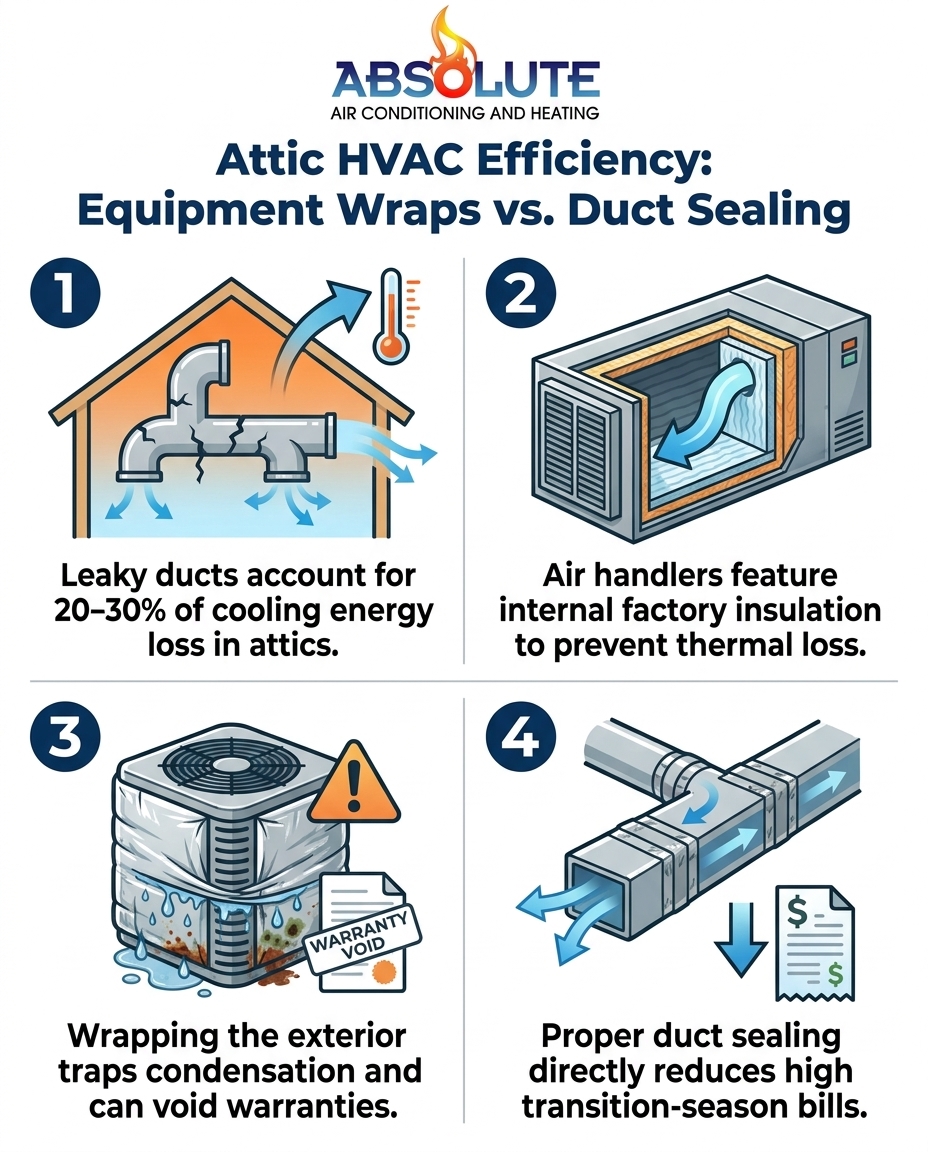
Your air handler is already manufactured with internal thermal and acoustic insulation. When you look at the bare metal exterior of the cabinet, you are only seeing the outer shell of a double-wall construction. Inside that metal casing, thick layers of specialized fiberglass or foil-faced insulation line the walls. This factory insulation is specifically designed and precisely measured to prevent thermal loss and stop condensation from forming on the outside of the box.
Adding layers to the exterior of the cabinet does not improve internal cooling efficiency. The factory insulation already provides the exact R-value required to keep the cold air inside the unit from absorbing the ambient heat of the attic. Furthermore, the internal insulation is applied in a way that does not restrict the mechanical functions of the blower motor or block essential access panels.
When you pivot your attention away from the unit itself and toward the attached delivery systems, you start to see where the real energy loss occurs. The air handler is heavily insulated, but the vast network of flexible or rigid ductwork stretching across your attic floor is highly vulnerable to the extreme heat.
The Real Energy Thieves: Unsealed Ductwork and Attic Thermal Loss
If the air handler is not the source of your high utility bills during the early fall lingering heat, where is the conditioned air going? The U.S. Department of Energy reports a staggering statistic: leaky air ducts in attics account for a 20 to 30 percent loss of cooling energy. This means that up to one-third of the air you pay to cool is either escaping into the attic or being compromised by the hostile temperatures before it ever reaches your living space.
In our years of inspecting Palm Desert attics, we've seen ambient temperatures easily exceed 150 degrees. At these extremes, any duct leak pulls in blistering air, punishing your system's efficiency even as summer ends. Poor connections around the plenum—the main distribution box attached directly to the air handler—and the branch ducts are the primary culprits for wasted energy. Over time, the extreme thermal expansion and contraction in an unconditioned attic cause the original seals to crack, peel, and fail.
How Superheated Air Penetrates Leaky Ducts
The mechanics of duct leakage go beyond simply losing cold air. When your blower motor pushes air through the ductwork at high velocity, it creates complex pressure dynamics. If there is a hole, crack, or loose connection in the duct, the high-speed air moving past that gap creates a vacuum effect. This negative pressure actively sucks superheated attic air into the ductwork.
This severe energy loss drastically reduces system efficiency regardless of how well the air handler's exterior is protected. The cold air mixes with the 150-degree attic air, and the resulting lukewarm breeze is what finally comes out of your vents. Contrast this massive thermal compromise with the negligible heat transfer through a factory-insulated air handler cabinet, and it becomes clear that professional duct sealing offers a proven return on investment compared to ineffective unit wraps.
The Hidden Risks of Wrapping Your HVAC System: Condensation and Rust
Beyond being ineffective, applying aftermarket insulation blankets to your air handler introduces severe risks to the equipment. Through our extensive experience serving the Coachella Valley, our team at Absolute Air Conditioning and Heating has seen the damage firsthand. We always aim to build trust by explicitly telling homeowners what NOT to waste their effort on, warning against gimmick unit wraps that do more harm than good. The most significant danger of wrapping an AC unit is the disruption of its natural ability to manage moisture.
Even in the dry climate of Palm Desert CA, the extreme temperature differential between the freezing cold internal evaporator coil and the blistering hot attic air creates a dew point. This temperature clash causes the unit to naturally sweat. The factory design accounts for this, utilizing internal drain pans and allowing the exterior metal casing to breathe and evaporate any surface moisture quickly.
Why Is My Attic AC Unit Sweating?
A common question homeowners ask when inspecting their attic equipment is why the unit is sweating. Normal condensation occurs when warm air hits a cold surface, much like a glass of ice water on a summer day. Proper drainage and unobstructed airflow around the unit are critical for managing this moisture. The ambient air circulating around the bare metal cabinet helps evaporate minor surface condensation before it becomes a problem.
When you wrap the air handler in an aftermarket insulation blanket, you trap this condensation against the metal casing. The moisture has nowhere to evaporate. This trapped water leads directly to rust, accelerating the deterioration of the galvanized steel cabinet. Furthermore, the dark, damp environment created under the wrap is the perfect breeding ground for mold and mildew, which can eventually infiltrate your indoor air supply. Finally, unauthorized modifications like wrapping the unit or obstructing access panels can instantly void manufacturer warranties, leaving you fully responsible for the resulting premature equipment failure.
Attic Envelope vs. HVAC Equipment: Where to Focus Your Efforts
If wrapping the equipment is off the table, where should you direct your time and resources to combat the early fall lingering heat? The answer lies in the attic envelope itself. Differentiating between insulating the HVAC equipment and insulating the attic floor or roof deck is crucial for long-term efficiency.
Insulating the attic floor stops heat from entering the living space below, which means your AC unit does not have to run as long to satisfy the thermostat. Radiant barriers attached to the underside of the roof deck reflect solar heat away from the attic entirely, lowering the ambient temperature of the space by up to 30 degrees. These improvements are long-term investments rather than quick-fix gimmicks, providing substantial benefits for both cooling and upcoming heating bills. Note that federal tax credits may apply to qualifying efficiency upgrades, so we recommend checking with your utility provider or tax professional.
• Wrapping the Air Handler — Impact on Efficiency: Negligible to Zero — Equipment Risk Level: High (Traps moisture, causes rust, voids warranty)
• Professional Duct Sealing — Impact on Efficiency: High (Recovers 20-30% of lost energy) — Equipment Risk Level: None (Protects system by reducing run cycles)
• Attic Floor Insulation — Impact on Efficiency: High (Prevents heat transfer into living space) — Equipment Risk Level: None (Reduces overall thermal load on the house)
• Radiant Roof Barriers — Impact on Efficiency: Moderate to High (Lowers ambient attic heat) — Equipment Risk Level: None (Helps ductwork operate in a cooler environment)
Improving Attic Ventilation to Support Your AC
Another highly effective strategy is improving the airflow through the attic space itself. Proper attic ventilation reduces the ambient temperature around the HVAC equipment, easing the thermal burden on the ductwork. Active ventilation (like powered attic fans) or passive ventilation (like ridge and soffit vents) allows the superheated air to escape rather than baking your HVAC system. Connecting proper ventilation to improved indoor air quality and overall system health is a cornerstone of our ventilation services, ensuring your attic breathes exactly as it should.
Effective Fall-Prep: What Actually Lowers Your Cooling Bills
As the season transitions, preparing your system for the upcoming winter while managing the lingering heat requires a professional approach. Reaching out to our local team for comprehensive AC maintenance is the most effective way to optimize your attic equipment. We've spent years prioritizing effective whole-system solutions over ineffective gimmicks, ensuring your system is actually prepared for the months ahead.
Addressing these issues now prevents high utility bills from continuing into the winter heating season. When a system is properly sealed and tuned, it operates efficiently regardless of whether it is pushing cold or warm air. Here are the actionable steps a professional takes to optimize your system:
1. Comprehensive System Diagnostic: A technician evaluates the blower motor, evaporator coil, and internal factory insulation to ensure the core equipment is operating within manufacturer specifications.
2. Duct Integrity Assessment: Professionals inspect the entire duct network, paying close attention to the plenum connections, Y-joints, and vent boots where leaks are most common.
3. Application of Professional Sealants: Unlike DIY duct tape—which quickly dries out and peels off in a 150-degree attic—professionals use specialized tools like fibrous mastic sealant and UL-listed aluminum metal tape to create permanent, airtight bonds.
4. Airflow Balancing: Once the system is sealed, the technician tests the static pressure to ensure the correct volume of air is reaching every room in the house.
Professional Duct Sealing and Assessment
Relying on an expert assessment yields significantly better results than guessing where thermal loss occurs. A professional duct inspection utilizes specialized manometers and thermal imaging to pinpoint exactly where the superheated air is infiltrating the system. Just this early fall, a Palm Desert CA homeowner reached out to our Absolute Air Conditioning and Heating technicians specifically seeking knowledge to better understand their system's upkeep. After a thorough assessment, we provided the exact information they needed to monitor their equipment confidently—empowering the customer with honest facts about duct integrity rather than selling them an unnecessary unit wrap.
Frequently Asked Questions About Attic AC Optimization
Should you insulate an AC unit in the attic?
No, you should never add aftermarket insulation directly around the exterior of an attic AC unit. The air handler is already equipped with internal factory insulation designed to provide the exact thermal barrier required. Wrapping the exterior traps condensation against the metal casing, which leads to severe rust, mold growth, and the potential voiding of your manufacturer warranty.
How do I keep my attic AC unit cool?
The best way to keep your attic AC unit cool is to lower the ambient temperature of the entire attic space. This is achieved by installing radiant barriers on the underside of the roof deck and ensuring proper attic ventilation through ridge and soffit vents. Lowering the overall temperature of the attic provides a much safer operating environment for your equipment than attempting to wrap the unit itself.
Does insulating ductwork in attic help?
Yes, ensuring your ductwork is properly sealed and insulated provides a massive boost to system efficiency. The U.S. Department of Energy notes that leaky, uninsulated ducts can account for a 20 to 30 percent loss of cooling energy. Sealing the connections with professional mastic and ensuring the ducts have the proper R-value insulation prevents superheated attic air from mixing with your conditioned air.
Why is my attic AC unit sweating?
Your attic AC unit sweats due to the extreme temperature differential between the freezing cold internal evaporator coil and the hot ambient air in the attic. This clash creates a dew point, resulting in normal surface condensation. It is critical that the unit has proper airflow around its bare metal exterior so this moisture can evaporate naturally, which is why wrapping the unit in a blanket is so dangerous.
What is the best way to prepare an attic HVAC system for the transition to fall?
The most effective way to prepare an attic HVAC system for the early fall lingering heat and the upcoming winter is to schedule a professional pre-heating season tune-up. A licensed technician will evaluate the integrity of your ductwork, clean the internal components, and apply permanent mastic sealant to any leaks. This ensures your system operates efficiently during the transition season and is fully prepared for winter heating demands.
Stop Guessing and Start Saving with Professional Attic AC Optimization
When dealing with the frustration of high utility bills during the transition season, it is easy to fall for quick fixes. However, wrapping the air handler is a dangerous myth that traps moisture, causes severe rust, and can ultimately destroy your equipment. The factory casing is already perfectly insulated to handle the extremes of a Palm Desert CA attic.
The true path to efficiency lies in addressing the real energy thieves: unsealed ductwork, poor attic floor insulation, and inadequate ventilation. Sealing your ducts and improving the overall thermal envelope of your home will provide a proven, long-lasting return on investment. Do not leave your system's efficiency to guesswork. Reach out to our expert team today to evaluate your specific attic situation, stop thermal loss at the source, and ensure your home stays comfortable and efficient all year long.
Serving the Entire Coachella Valley


Addressing the Musty Smell from Your Attic Air Handler After Summer Humidity
That sudden dirty socks odor from your vents isn't just a nuisance—it is a sign of biological growth. Find out if it is a simple filter fix or a job for a pro.

Why We Recommend Scheduling Your Pre-Heating Tune-Up Before the October Rush
Waiting for the first cold snap to test your furnace often leads to long service delays. Take a behind-the-scenes look at how local HVAC supply chains operate in the fall.

Evaluating the Switch from a Traditional Attic AC to a Heat Pump System This Fall
If your aging air conditioner barely survived the summer, you face a crucial choice before winter. See why a unified heat pump offers better year-round efficiency than standard gas combos.

